


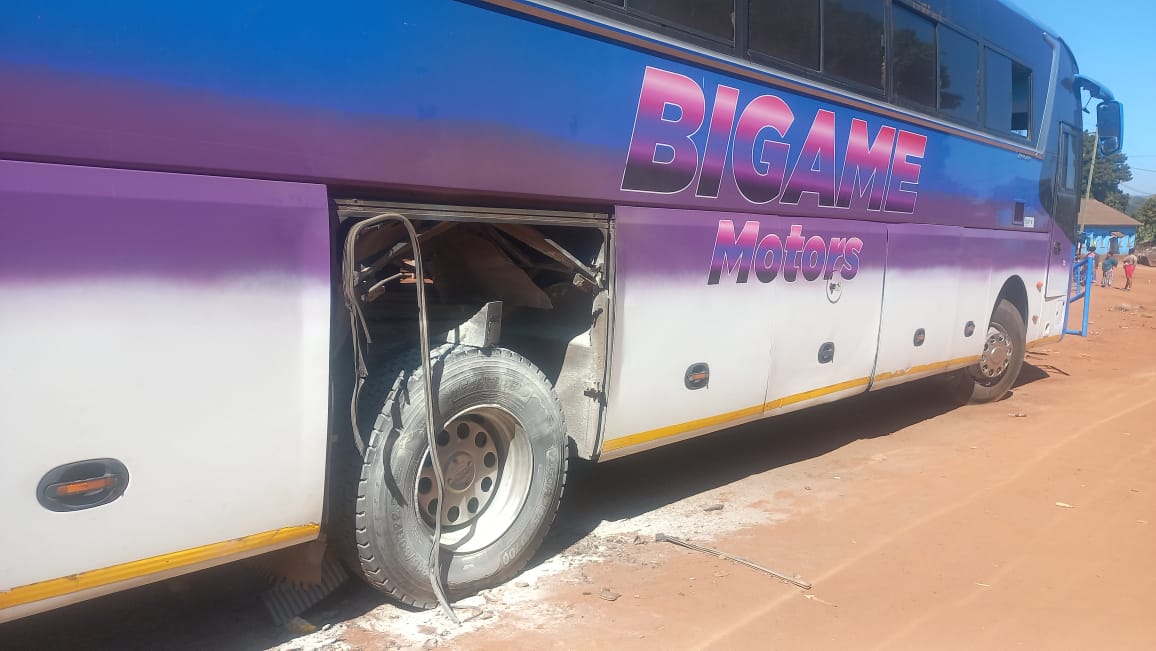
A passenger bus was attacked with a suspected explosive at an illegal terminus in Chipinge in the early hours of Friday, leaving its rear tyre and axle badly damaged. This incident has prompted a police investigation into attempted murder and malicious damage to property.
The Big Game Motors bus was parked at Chinheya Business Centre when the blast took place at about 3 AM on August 21. The driver and conductor were asleep inside the vehicle at the time but managed to escape safely. The damage was concentrated at the back of the bus, leaving it grounded at the terminus.
National police spokesperson Commissioner Paul Nyathi stated that an unidentified person approached the bus and threw a detonator on the rear wheels. No arrests had been made at the time of the report, while investigators worked to establish who carried out the attack and what motive lay behind it.
“We are investigating a case of attempted murder and malicious damage to property which happened on August 21, 2026. A bus belonging to Big Game was parked at Chinheya Business Centre. On the same day around 3 AM, a person went to the bus and threw a detonator on the rear wheels. The bus driver and conductor were sleeping inside the bus at the back,” he said. “The driver and conductor managed to escape safely. The bus was damaged at the back. We are now investigating the motive behind the attack.”
The incident has intensified concerns about competition among bus operators in Chipinge, where transport companies compete for passengers travelling to Harare, Bulawayo, Kwekwe, and other destinations. The routes are important links for residents, traders, students, and workers, and the battle for customers has increasingly drawn attention to the conduct of operators, crews, and touts at bus ranks.
Residents said the explosion was heard across much of the town. One resident, who declined to be named, said the blast appeared to be connected to rivalry between transport companies and warned that competition was becoming dangerous. “Those were explosives that we suspect were planted on the bus by a crew from a rival company. It happened around 3 AM. There was a loud bang that echoed across most parts of Chipinge town. They are fighting over routes,” said the resident.
The attack has also revived complaints about the condition of bus termini in the town. The site where the bus was parked has been described as an illegal terminus, raising questions about security, oversight, and the ability of authorities to monitor vehicles and people moving through the area at night.
Passengers said the presence of touts had added to tensions at transport points. They accused some touts of aggressively seeking customers for particular operators and provoking rival crews, sometimes in front of families waiting to travel.
“It is very frightening. Today it is a bus that has been blown up, but tomorrow it could be passengers caught in the middle,” said Tawanda Mlambo, a regular traveller between Chipinge and Harare. “We are the ones who suffer because of these fights. Bus operators are supposed to compete professionally, not use violence. Authorities must intervene before lives are lost.”
Memory Chitima added that the situation was making passengers feel unsafe when boarding buses, particularly at busy ranks where several operators compete for the same travellers. “We just want to travel peacefully and reach our destinations safely. What is happening now resembles a jungle where everyone is fighting for passengers. The Government, police, and transport authorities must bring sanity to the sector,” she urged.
Shepherd Marimo, who frequently travels to Bulawayo, expressed concern that the dispute was harming Chipinge’s transport industry and undermining public confidence in bus services. “These operators need to understand that passengers are not commodities to fight over. There must be proper regulation at bus ranks and harsh punishment for those who intimidate competitors or endanger the public,” he stated.
Rutendo Mukome highlighted that clashes involving touts were often visible to passengers and could create conditions for more serious crimes. “The touts often provoke each other and sometimes fights break out in full view of passengers, including women and children. Authorities must deal with these illegal activities because they create a breeding ground for bigger crimes,” said Mukome.
The vehicle was carrying 11 passengers, and the police confirmed that 12 people died in the explosion. Nine of the victims were later identified by their families, while efforts continued to identify the remaining three. The blast destroyed the vehicle and scattered debris across the area, turning a routine journey into one of the country’s deadliest recent public transport disasters.
The Esigodini incident led to a national warning against the illegal possession and transportation of explosives in public service, private, and family vehicles. Police emphasized that explosives could only be handled by authorised persons under the country’s explosives laws and regulations. The warning came as investigators examined how such material could have entered a passenger vehicle travelling on one of Zimbabwe’s busiest highways.
President Emmerson Mnangagwa declared the Esigodini tragedy a State of Disaster, allowing the Government to assist with funeral and medical expenses. The decision brought official support to bereaved families while authorities continued investigating the circumstances surrounding the explosion.
The two incidents have placed renewed focus on the risks created when explosives and passenger transport come together. In Esigodini, the suspected presence of explosive material inside a vehicle resulted in mass fatalities. In Chipinge, a device thrown at a parked bus damaged the vehicle and put sleeping crew members in danger. The circumstances differ, but both cases have raised concerns about how quickly an explosive can turn a transport setting into a scene of destruction.
In Chipinge, police must now determine whether the attack was an isolated act or part of a wider dispute among operators. Investigators are expected to examine the damaged bus, identify the type of device used, establish where it came from, and trace the person who approached the vehicle before the blast.
The attack has left commuters calling for bus operators to settle competition through lawful business practices rather than intimidation. They also want illegal termini closed or brought under proper control, stronger supervision of touts, and a visible police presence at places where buses wait overnight.
For the driver and conductor, the sound of the blast came while they were asleep inside the vehicle. They survived, but the damaged bus now stands as a warning of what could happen if similar attacks are carried out when passengers are on board. The investigation continues as Chipinge residents wait for authorities to restore order at the town’s transport points and identify those responsible for the attack.