


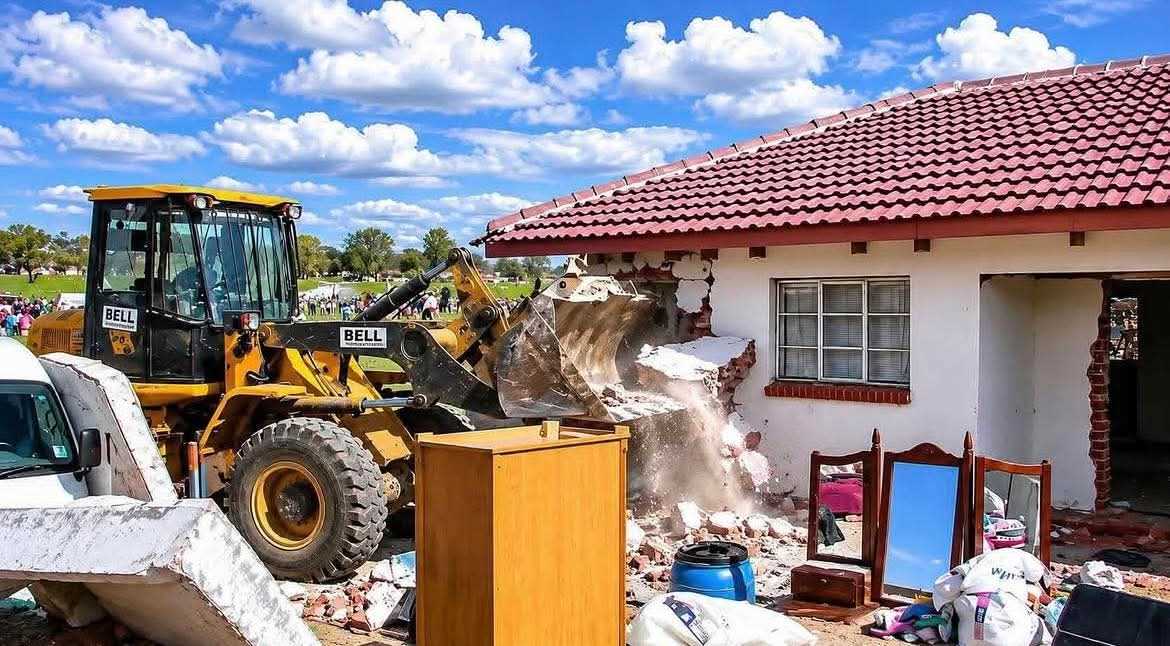
Harare homeowners are facing a new wave of uncertainty after Local Government and Public Works Minister Daniel Garwe said the city council is sitting on about 5,000 house demolition orders.
The warning has put the spotlight on the paperwork behind residential stands across the capital, where families have spent years saving, building and paying municipal charges, only to discover that the land beneath their homes may have been allocated without proper authority.
Garwe said the Government was concerned about the growth of unregulated settlements and construction on wetlands. He warned that developments built outside approved plans could create serious public health problems and put even greater pressure on Harare’s already strained water, sewerage, road and waste-management systems.
“Unregulated settlements in Harare can be a threat to public health,” he said.
The minister was speaking at a high-level stakeholder breakfast meeting on land tenure in Harare. He urged people looking for residential stands to avoid illegal land dealers, commonly known as Masabhuku deals or land barons, and warned against building on wetlands.
“Let us not encourage people to build on wetlands, buy from Masabhuku or land barons,” he said.
Garwe said the Government was not carrying out the demolitions and could not interfere with court proceedings. He said the orders were held by the City of Harare and that, in some cases, officials had tried to delay enforcement while seeking possible solutions.
“Let me emphasise that Government does not demolish houses and we cannot interfere with court processes. Currently, City of Harare is sitting on 5 000 demolition orders and in some cases we have tried to delay the process and provide solutions.”
A council task force has surveyed 22,255 sites as part of the wider regularisation and demolition exercise. The operation has also extended to Harare South, Whitecliff, Tynwald, Crowborough, Chisipite, Glen Lorne, Southlea Park, Hopley, Mainway Meadows, Tafara and Hatcliffe.
The city’s stated position is that structures built on prohibited or protected land will not be spared. That includes open spaces, farms, wetlands and vleis, as well as land reserved for schools, clinics, recreational facilities, roads and other public infrastructure.
Council spokesperson Stanley Gama said residents had been warned and that the affected areas remained earmarked for demolition.
“All areas mentioned in the document are earmarked for demolition. All structures without council approvals and built on areas earmarked for social amenities or built on top of our water or sewer infrastructure will be demolished,” he said.
“The document has full reasons why the structures will be demolished.”
The council says it will consider regularising some developments where this can be done legally and practically. However, it has ruled out regularisation where the land is required for a public purpose.
“We will not regularise where it is impossible to regularise. Land meant for a school will have to be used to build a school,” Gama said.
“We cannot regularise and endorse lawlessness. Otherwise, people will end up building houses even at Rufaro Stadium, knowing that the City of Harare will regularise. We cannot turn Harare into a jungle.”
Gama has also urged residents to verify the status of a stand before buying or building. He said unplanned settlements place pressure on sewer systems and other municipal services, leaving rate-paying residents to deal with blockages and failures.
“When sewer systems start blocking because of illegal settlements, residents will accuse the council of not doing its work, so it has to protect those legally settled and paying their bills,” he said.
The Harare Drive expansion has become one of the clearest examples of how disputed land allocations can place completed homes directly in the path of public infrastructure. About 200 houses and other properties have been identified along land reserved for the road project, including two large mansions near the National Heroes Acre.
More than 100 of the affected houses are in Retreat and Waterfalls. The project was designed to create a circular route around Harare, with engineering plans dating back to 1998. The proposed links run from Warren Hills towards Southerton, through Houghton Park and Mainway Meadows, and from Retreat towards Seke Road, Hatfield and Msasa.
In Mainway Meadows, residents have left a corridor about 60 metres wide open in recognition of the future road. In other sections, particularly around Retreat, construction has continued and new stands have been pegged on land reserved for the route.
The situation has left residents unsure whether their homes will be protected or removed. One Retreat resident said: “I think everyone is aware that there must be a road, but they were hoodwinked into thinking their properties would be regularised.”
Another resident said: “We were told that Harare Drive was supposed to pass through here, so for the meantime, I have halted plans to build my full house. Others are also saying the road will be diverted.”
A resident identified as Mr Tawanda said: “The unbuilt area reserved for Harare Drive has been pegged for new houses. My plea to the Government is to complete the entire road to avoid confusion.”
Church of Grace Ministries in Retreat was also built on the planned route. Its leader, Minister Oliver Makoni, rejected the suggestion that the church had encroached on the road reserve.
“We have never been informed by the City Council about any encroachment issues,” he said. “We have a site plan, and our papers are in order, all the papers are at Rowan Martin. Why can’t you obtain a GPS report, they have that GPS. It can verify whether we have encroached or not”.
Makoni added: “It’s nearly 10 years now, but above all the City should know that peoples’ lives are important than a road.”
Harare acting director of urban planning Samuel Nyabezi said houses built on the road reserve would eventually be removed.
“Yes, there are many houses that have been built on Harare Drive, particularly in Retreat, but at some point, those structures shall be demolished because our plan for Harare Drive road expansion is clear,” he said.
Nyabezi said the two mansions near the National Heroes Acre were also on the planned route.
“Those are two real mansions, and from our plan, it shows that all those two encroached into Harare Drive. I have told the owners that there will be no negotiations; the houses will be demolished.”
Harare mayor Jacob Mafume has taken the same position.
“We will demolish all those illegal structures. If you ask me to provide a solution, I will only push for demolition, because surely, you cannot build on land reserved for a road,” he said.
The property dispute has also raised questions about the role of housing cooperatives and informal land sellers. More than 40 cooperatives have been linked to settlements facing enforcement action. In Budiriro alone, several cooperatives have been accused of allocating stands without the authority to do so.
The first condition for a homeowner seeking protection is therefore clear: the stand must have been sold by a party with lawful authority to sell it. A cooperative is not the same as the City of Harare. An offer letter issued by a cooperative is not automatically a council-issued cession, and a receipt bearing stamps and signatures does not by itself establish ownership.
Some documents used in disputed land transactions have been described as scanned or forged offer letters, agreements of sale and title deeds. Suspected forgeries have been referred to the police, while the council has warned that structures built on land acquired through such documents will be removed.
The second condition is the location and approved use of the land. A house must not stand on a wetland, road reserve, school site, clinic site, recreational area, water or sewer corridor, airport expansion zone or other land reserved for public infrastructure. The appearance of a developed neighbourhood does not change the purpose assigned to the land in an approved plan.
The third condition is the strength of the property file. The owner must be able to produce approved plans and documents that connect the property to the council and the official land-registration system. Those records may include an approved layout plan, an approved building plan, a council-issued cession or deed of transfer, proof that rates are up to date and a surveyor-general’s diagram registered against the property.
Residents have been advised to visit their council district office before buying a stand or extending a building. They should request written confirmation that the stand appears in council records, that the seller is entitled to dispose of it and that no demolition or eviction order is pending. The approved layout should be compared with the land on the ground, because a seller may offer a plot that does not exist in the official plan.
Buyers should also conduct an independent search through a conveyancer and check the deeds registry where applicable. No deposit should be paid before the ownership trail and planning status have been examined. A verbal assurance that paperwork is “in process” offers no protection when the council identifies a structure as illegal.
The campaign has revived memories of Operation Murambatsvina, the 2005 clean-up operation that destroyed homes and informal businesses in Zimbabwe. International estimates put the number of people who lost their homes, livelihoods or both at about 700,000. The current operation is smaller, but for each family in the path of a demolition team, the financial and personal loss can be devastating.
Garwe said rapid urbanisation was one of the forces driving overcrowding in Harare. He argued that creating more economic opportunities in rural areas and growth points could ease pressure on the capital and reduce rural-to-urban migration.
“Some of the overcrowding and overpopulation that we see in some suburbs is a result of rural-urban migration. If we empower those in the rural areas, then we address this problem,” he said.
He also said secure land was vital for investment outside the major cities.
“Growth points also need access to land they can take to the bank and get funding,” he said.
“There are a lot of economic activities in growth points and rural areas, but without access to land, their growth may be minimal,” he said.
For Harare homeowners, the message is direct. A house is not protected simply because it is complete, because its owner has paid rates or because neighbours have lived in the same area for years. Security depends on three things: who sold the stand, what the land was reserved for and whether the paperwork is recognised by the council and the deeds registry.
If any one of those conditions is missing, a home that took years to build may still face the council’s demolition order.