


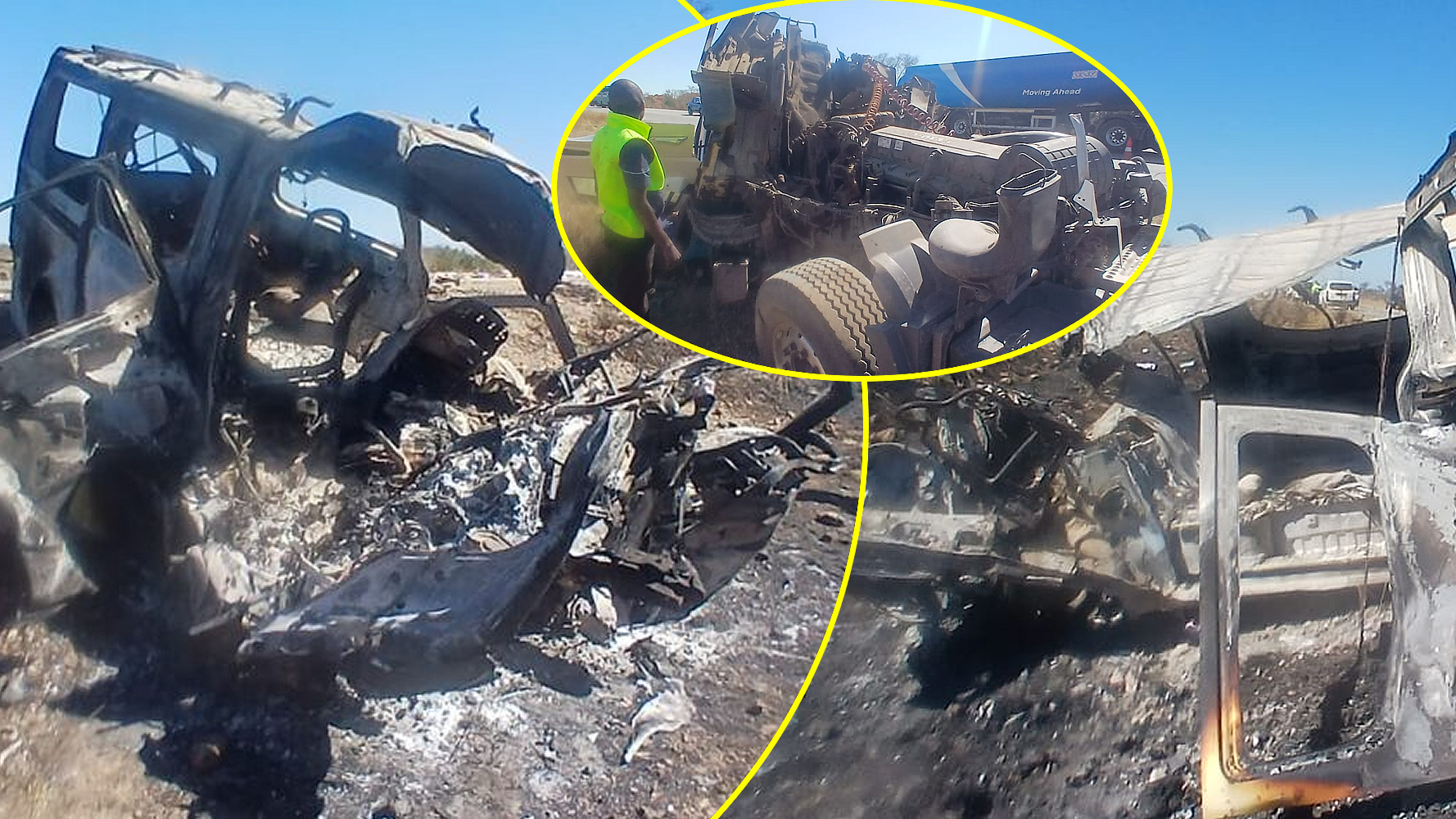
Zimbabwe is mourning 27 people after a commuter omnibus carrying African Apostolic Church members collided head-on with a haulage truck near Chivhu, turning a journey to a religious conference into one of the country’s most devastating road tragedies in recent years.
The crash happened at about 8:30pm on Friday, August 28, 2026, near Honeyspruit Bridge on the Harare–Masvingo highway. The vehicles met at a point reported in different accounts as roughly 15 kilometres from Chivhu and near the 130-kilometre peg on the highway. The truck was carrying mining equipment from South Africa towards Goromonzi District. The kombi was travelling from Dema to Ndarikure in Mvuma, carrying members of the African Apostolic, or Mwazha, Church.
The immediate explanation offered by police is that the truck was overtaking another vehicle when it struck the minibus. Paul Nyathi, the police spokesperson, told international news agencies that the collision occurred at about 8:30pm Zimbabwe time (CAT). The impact triggered a fire which trapped passengers inside the kombi. Some victims sustained fatal burns, according to Local Government and Public Works Minister Daniel Garwe.
“The two vehicles were involved in a head-on collision, resulting in an immediate fire. Several occupants of the kombi were trapped inside the vehicle, with some sustaining fatal burns,” Garwe said.
Twenty-four people died at the scene, while three others later died after being taken to Chivhu General Hospital, bringing the confirmed death toll to 27 as of August 29. Seven survivors were critically injured. They were initially treated at Chivhu before being transferred to Chitungwiza General Hospital, where medical teams were working to stabilise them. The Government has said it will meet the survivors’ medical costs and assist with burial expenses after declaring a State of Disaster.
The scale of the fire has made identification difficult. Chief Director of the Civil Protection Unit, Mr. Nathan Nkomo, released an update stating that 22 bodies have been identified, leaving 5 victims to be processed through the forensic department’s DNA matching.
Authorities have said the bodies were taken to the Chivhu General Hospital mortuary for identification and post-mortem examinations. Nathan Nkomo, chief director of the Civil Protection Unit, reported that the forensic department would handle the remaining DNA matching. The Government has also said names will be released only after the information has been consolidated and verified.
“Government is working closely with the relevant authorities and other stakeholders to consolidate information and establish the identities of the deceased. The names of the victims will be released once the identification process has been completed and the information duly verified,” Garwe said.
“She packed her clothes and the children’s things around noon, and by 2pm they were in the kombi. She complained that the vehicle was already overloaded and even asked if I knew anyone else driving to the conference who could offer them a lift. I wished them a safe journey,” Bonda said.
Reports indicate that that the kombi was overloaded as it was said to be carrying as many as 33 passengers. A standard commuter omnibus, or kombi, in Zimbabwe is officially certified and licensed to carry 15 seated passengers. Most traditional Toyota Hiace kombis are registered by the Vehicle Inspection Department (VID) to hold 15 seated passengers. Carrying more than the certified number of seated passengers is classified as illegal overloading by the Zimbabwe Republic Police (ZRP).
The central issue is therefore larger than whether one driver made a dangerous manoeuvre. Investigators must establish whether the truck had a clear and legal line for overtaking, whether the road markings and visibility were adequate, and whether the truck and kombi were roadworthy. They should also determine the speed of both vehicles, the condition of the highway, the licensing and operating records of the minibus, and whether the truck’s load affected its stopping distance or control.
The rescue operation shows both the value and the limits of emergency intervention. Civil Protection officials, police, firefighters and members of the public worked at the scene. Small cranes were used during recovery to clear wreckage from the road, while a fire tender extinguished the flames. The heavy truck and mining equipment blocked the carriageway until a heavy-duty crane removed them, after which the road became passable again.
Yet the seven critical survivors and the passengers trapped in the burning kombi also force a harder question: how quickly can professional rescue and medical care reach a night-time crash on a remote highway? Zimbabwe’s national road-safety review, published by the United Nations Economic Commission for Europe, warned that emergency-care services face institutional, staffing, funding and technical constraints. It also said roughly 70% of the road network was in poor-to-mediocre condition according to a 2017 inventory.
Police warnings after that crash were familiar, but their repetition is precisely the point.
“We appeal to drivers to seriously consider road safety while travelling,” Commissioner Nyathi warned.
The United Nations review provides an even wider measure of the problem. It said Zimbabwe recorded an average of about 2,000 road deaths a year between 2017 and 2019, based on Traffic Safety Council figures, while World Health Organisation estimates that included deaths occurring after hospital arrival or discharge suggested the true figure could be about 7,000 annually.