


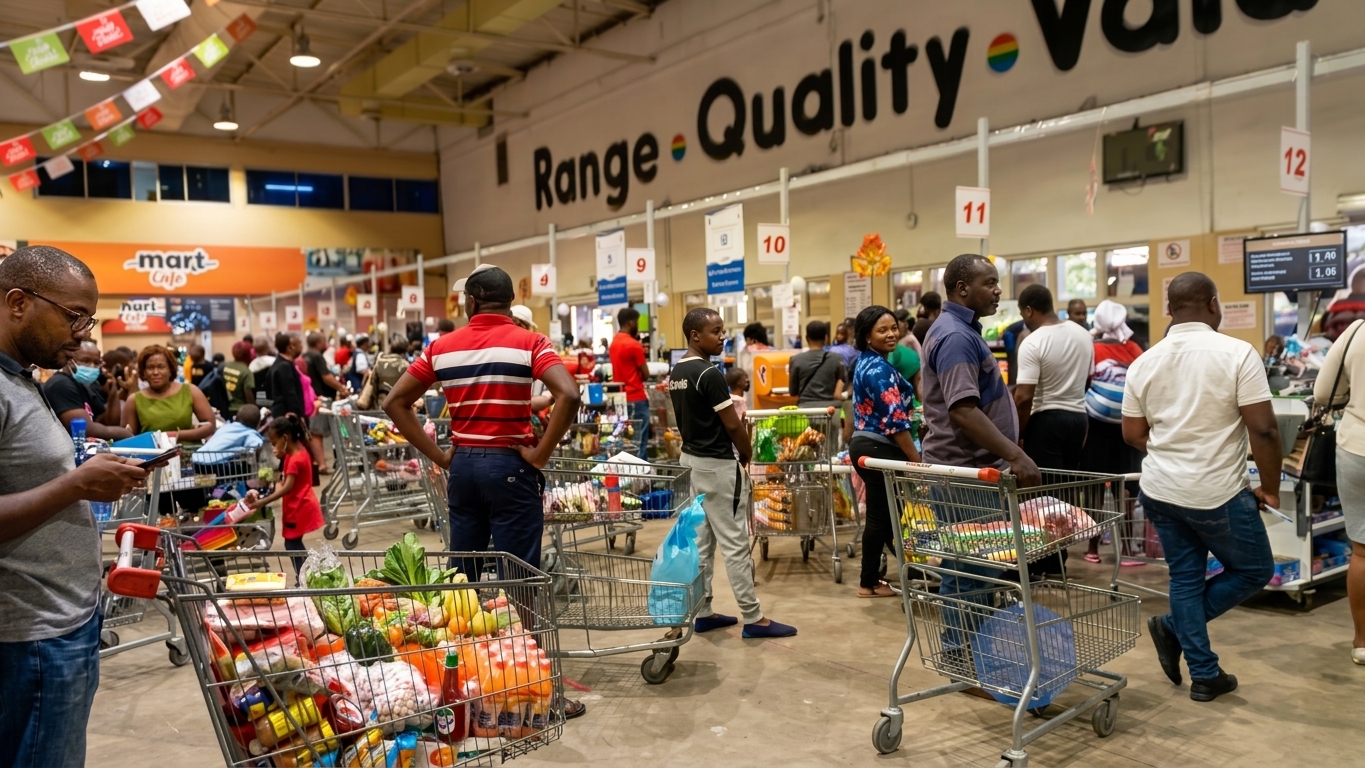
Zimbabwe’s lowest-paid workers in the retail and wholesale sector are set to earn at least US$331 a month under a new wage structure, offering a major increase to employees who have been taking home between US$150 and US$200 in many shops across the country.
The new floor, which rises slightly above the widely reported US$330 figure, means some workers could see their pay more than double. Other grades in the structure will receive monthly salaries of US$342, US$351, US$365 and US$375, depending on their classification.
The increase is expected to bring relief to thousands of employees working in supermarkets, wholesalers, convenience shops and other businesses covered by the retail and wholesale subsectors. For workers who have been earning around US$150 a month, the new minimum represents an increase of more than 100 percent. Those receiving about US$200 would still see a substantial rise.
The announcement comes as the Government moves to reshape the retail environment through a crackdown on illegal vending, new rules for local authority fees and a wider campaign to restore order in Zimbabwe’s towns and cities.
It also comes at a difficult moment for the industry. While employees in one part of the sector are preparing for higher wages, workers at OK Zimbabwe, one of the country’s largest supermarket chains, have faced the suspension of salaries and wages as the company tries to survive under corporate rescue proceedings.
The contrast has placed the financial position of retail companies under renewed pressure. Businesses will have to meet the new wage obligations while dealing with high operating costs, supply problems, changing consumer habits and competition from informal traders.
The new wage structure is being welcomed as a long-overdue improvement for workers whose earnings have failed to keep pace with the cost of living. Retail employees are often among the most visible workers in the economy, serving customers, stocking shelves, handling cash and moving goods through the country’s distribution system. Yet many have remained on modest incomes despite working in an industry that serves millions of households every day.
The increase will be particularly important for employees supporting families on a single income. A worker earning US$150 a month would now have an additional US$181 before any deductions. At the US$200 level, the increase would be US$131. The difference is likely to affect spending on food, transport, rent, school requirements and healthcare.
For employers, however, the adjustment will be a major financial commitment. A company paying a worker US$150 a month would face a wage bill that is more than twice as high for that position. The cost will increase further once allowances, employer contributions, overtime and other employment-related expenses are included.
The pressure will be greatest for smaller retailers and wholesalers operating on narrow margins. Many of these businesses compete with informal traders who do not carry the same licensing, rental, compliance and staffing costs as formal companies. The Government’s campaign against trading from undesignated areas is therefore being closely watched by formal retailers, who say they need a more level playing field.
The Confederation of Zimbabwe Retailers has welcomed the Government’s decision to address illegal vending and informal trading in undesignated areas. The organisation said the spread of street trading in central business districts had created congestion, blocked walkways and raised concerns about urban cleanliness and public health.
“The situation has compromised urban cleanliness, obstructed public walkways, created congestion and, importantly, placed compliant formal businesses at an unfair disadvantage,” said CZR president Dr Denford Mutashu.
The Government gave vendors operating in unauthorised areas of Harare until 9 September to leave and move to designated trading facilities. It then announced a comprehensive clean-up operation targeting illegal stalls, structures and trading sites, with the exercise expected to spread from Harare to other urban centres.
“Whilst the Government of the Republic of Zimbabwe acknowledges the existence of informal trading as a recognized avenue of livelihood, this, however, should be within the bounds of municipal by-laws and at legally designated marketplaces,” Local Government and Public Works Minister Daniel Garwe said.
The minister described the condition of the streets as unacceptable and warned that municipal police would remain in cleared areas to stop vendors from returning. Local authorities were also instructed to speed up the registration and allocation of compliant traders to designated markets.
CZR said it supported the relocation of vendors, but stressed that the policy should be applied across the urban economy. The organisation called for commuter omnibuses to operate from designated ranks rather than stopping in areas that create congestion.
“This is not about taking away people’s livelihoods; rather, it is about restoring order, protecting public health and safety, and ensuring that everyone participates in the economy within a fair and enforceable regulatory framework,” Dr Mutashu said.
The organisation also linked the clean-up campaign to Zimbabwe’s preparations to assume the chairmanship of the Common Market for Eastern and Southern Africa in October. Harare is due to host the 25th COMESA Summit from 19 to 22 October, bringing regional leaders, investors, business representatives and officials to the capital.
“We must put our house in order and ensure that our cities reflect the Zimbabwe we aspire to build under Vision 2030. Harare is the face of Zimbabwe, and we must restore the beauty and dignity of our Sunshine City,” Dr Mutashu said.
At the same time, Government has introduced regulatory changes aimed at reducing the cost of operating a formal business. Statutory Instrument 41 of 2026, known as the Model Fees By-laws, standardises charges imposed by local authorities. CZR said the reforms had reduced duplication and cut costs for some formal retail and wholesale businesses by as much as 60 percent.
“This is a significant stride in reducing the cost of doing business and creating a more conducive operating environment for the private sector,” Dr Mutashu said.
The lower fees may help companies absorb part of the new wage burden, although businesses still face severe financial strain. The crisis at OK Zimbabwe has exposed the depth of that pressure.
The supermarket chain entered voluntary corporate rescue on 24 February after a collapse in operational cash flows. Its Joint Works Council later agreed to suspend salaries and wages from May until further notice as part of an attempt to stabilise the company and restore profitability.
“The Company has agreed with its staff to suspend all salaries and wages with immediate effect and will, therefore, not be running any payroll beginning the month of May 2026 until further notice,” the resolution stated.
The council described the decision as “difficult and uncomfortable” but necessary. Grant Thornton’s Bulisa Mbano was appointed as the corporate rescue practitioner.
OK Zimbabwe’s crisis was driven by falling revenue, stock shortages and a loss of confidence among suppliers. By February, the company’s liabilities had risen to about US$37.4 million, including US$24 million owed to trade suppliers. Monthly sales fell from a peak of US$21.7 million to about US$1.3 million, forcing the company to seek protection while it worked on a recovery plan.
The retailer has since secured bank guarantees worth US$15 million, with US$10 million from CBZ Bank and US$5 million from BancABC. The guarantees have allowed suppliers to resume deliveries and helped the company restock parts of its network. Forty-four of its 77 branches were reported to be fully operational, while 33 remained closed.
The recovery has not removed the wage crisis facing the company’s employees. It has instead shown how the health of a retail business affects workers, suppliers, manufacturers, farmers, transport operators and consumers at the same time.
The new US$331 minimum therefore arrives as both welcome news and a test for the industry. Workers are set to receive a stronger income, but employers must now find a way to pay more while keeping shelves stocked, prices competitive and businesses open. The Government’s wage, vending and licensing measures are changing the rules of the retail market at the same time that companies are being forced to prove they can survive under them.
For employees, the immediate message is straightforward: no worker in the covered lowest retail grade should remain below US$331 a month. For employers, the challenge is equally clear: the new standard must be met in an industry where even major companies are fighting to keep their doors open.
The success of the new wage regime will depend on whether formal retailers can remain financially stable, whether local authorities enforce the same rules across the market and whether the wider economy creates enough demand to support higher pay. For now, the wage increase gives retail workers a substantial reason to welcome the latest changes, even as the sector enters one of its most demanding periods in years.