


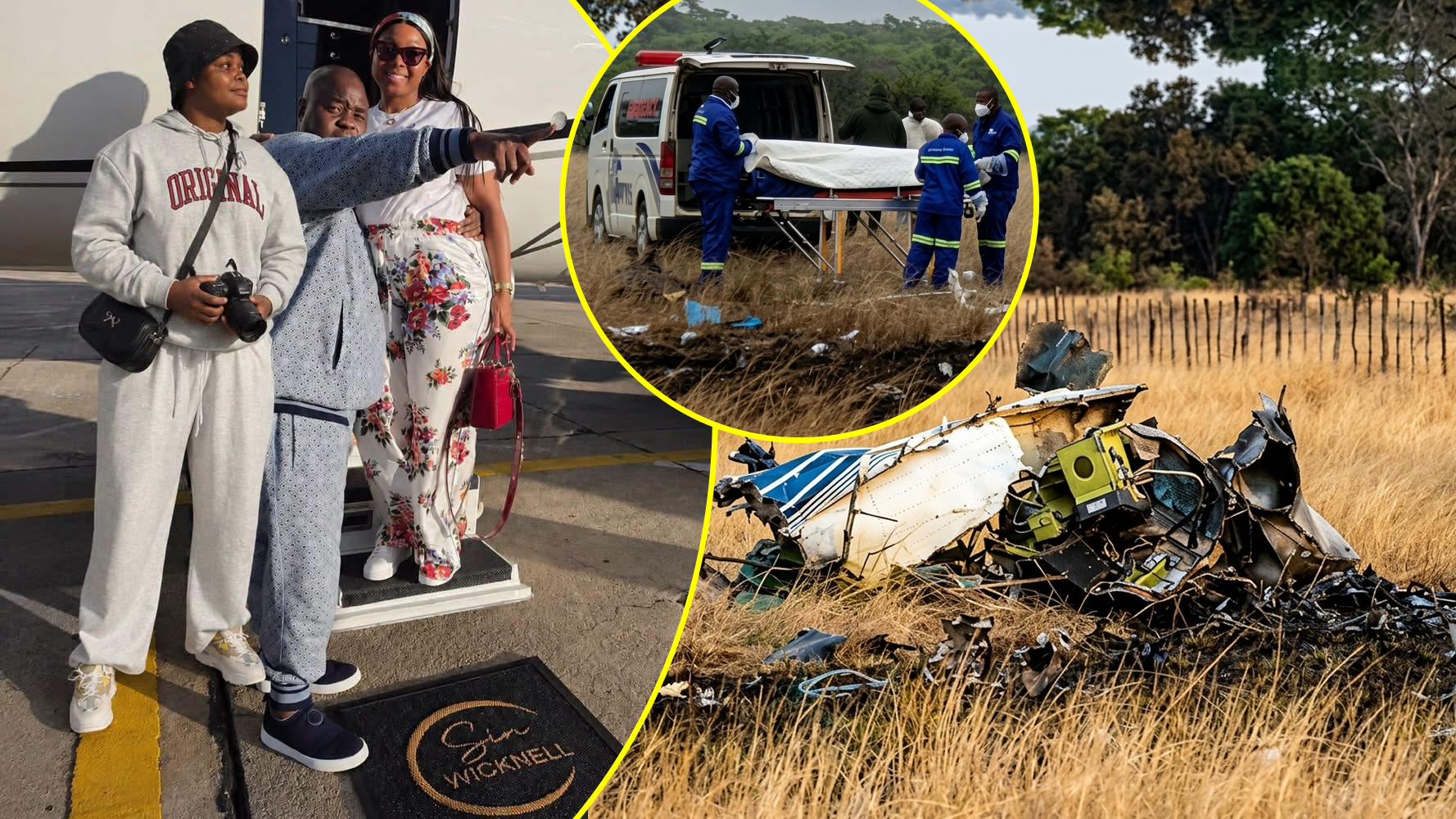
HARARE – The crash that killed Zimbabwean businessman Wicknell Chivayo and his wife, Lucy Muteke, remains under investigation, with the wreckage moved for forensic examination and a preliminary report expected within 30 days. The Bell 430 went down at Kudenga Farm in Mashonaland East on 30 September, after departing from the couple’s rural home in Gandami, Chikomba District, for Marondera.
The aircraft was registered as Z-PED and operated by Sky Helicopters Private Limited. It crashed about 40 minutes after take-off. Chivayo and Muteke were travelling with Muteke’s aide, Sanelisiwe Magagula, and pilots Calvin Soda and Courage Mutavira. All five died.
Early public statements said six people were aboard. The sixth person expected to travel with Chivayo was a member of his security detail, but he returned in a separate helicopter. Senior security aide Froster Chisi said he was travelling with other members of the team in that aircraft. He told journalists at the crash site: “There was the boss, his wife, the wife’s aide and two pilots.” Chisi said his helicopter landed in Marondera and waited for Chivayo’s aircraft, then continued to Harare when it failed to arrive. Police later confirmed five occupants aboard the Bell 430.
Chisi also described deteriorating conditions during the return journey. He said the aircraft carrying the security team encountered “challenging weather conditions”. He recalled hearing the pilot of Chivayo’s helicopter say: “I’m in bad weather, I haven’t exited the cloud.” Communication between the two helicopters was later lost. Investigators are examining the wreckage and other evidence; they have not announced a cause.
Information Minister Soda Zhemu said the wreckage had been taken to the Government Hangar at Charles Prince Airport for detailed examination, with international experts assisting. “Preliminary on-site investigations have been concluded, with the wreckage being recovered to the Government Hangar at Charles Prince Airport to allow for detailed forensic examination including international experts,” he said.
The preliminary inquiry is expected to examine the aircraft’s condition, weather at the time, maintenance records and information about the operator and crew. The investigation is being conducted under international civil aviation procedures and Zimbabwe’s Civil Aviation Act. Aviation officials had earlier said a flight recorder was recovered at the crash site. The cause has not yet been announced.
Chivayo, 43, was one of Zimbabwe’s most recognisable businessmen. As managing director of Intratrek Zimbabwe, he became associated with large state energy contracts, including a $172 million solar project in Gwanda that was followed by years of legal disputes. His public image was also shaped by conspicuous displays of wealth, high-profile meetings with political leaders and gifts of cars and money to musicians, religious figures and other public personalities.
President Emmerson Mnangagwa said he had met Chivayo a day before the crash, after a Cabinet meeting. “We are all shattered by this unexpected, sudden demise of so young a family,” he said. Kenya’s President William Ruto, who had appeared publicly with Chivayo, described him as a “dear friend” and offered condolences to the families of everyone killed.
Chivayo’s death adds to a series of fatal helicopter accidents involving prominent African business and political figures. The circumstances differ from case to case: some investigations have identified a cause, while others have not yet produced a public conclusion.
In February 2026, Kenyan MP Johana Ng’eno was among six people killed when a helicopter crashed in Nandi County. Ng’eno represented Emurua Dikirr constituency. The other people aboard included the pilot. The crash occurred in the North Rift region, and the cause was not immediately clear. President Ruto identified Ng’eno among the dead and wrote: “Our thoughts and prayers are with his family, his friends, the people of Emurua Dikirr, and all the victims and families affected by the helicopter crash in Mosop, Nandi County.”
Ghana suffered a major loss in August 2025, when a military Z-9EH helicopter crashed in the Ashanti Region, killing all eight people aboard. Among them were Defence Minister Edward Omane Boamah and Environment, Science, Technology and Innovation Minister Ibrahim Murtala Muhammed. The dead also included senior security and political officials and three Air Force crew members. The aircraft was travelling from Accra to Obuasi when it went down near Antoakrom.
Ghana’s investigation found that the aircraft was airworthy and that there was no evidence of mechanical failure, pilot error or medical impairment. Investigators concluded that a sudden downdraft in poor weather over hilly terrain caused the helicopter to lose altitude and strike a ridgeline. Visibility near Obuasi had fallen to about 200 metres. The inquiry also noted that the aircraft lacked terrain-warning and advanced navigation systems that could have improved the crew’s awareness of the surrounding landscape.
A year earlier, Kenya’s Chief of Defence Forces, General Francis Ogolla, died with nine other military personnel when a Kenya Air Force Bell UH-1H-II helicopter crashed shortly after taking off from Cheptulel Boys High School in Elgeyo Marakwet County. Ogolla was visiting troops serving in the North Rift. Two people survived the crash.
A Kenyan Ministry of Defence inquiry concluded that the helicopter suffered an engine malfunction. The report said the engine experienced a compressor stall, followed by a complete loss of power, a left yaw and a drop in engine speed. The aircraft came down on a community farm and caught fire on impact. Kenya’s Air Force later reviewed its operating procedures following the inquiry.
The crash that killed Nigerian banker Herbert Wigwe and fellow business leader Abimbola Ogunbanjo occurred outside Africa, near Halloran Springs in California’s Mojave Desert, on 9 February 2024. Wigwe, then chief executive of Access Holdings, was travelling with his wife, Doreen Chizoba, their son, Chizi, and Ogunbanjo, a former chairman of the Nigerian Exchange Group. The two pilots and four passengers were all killed.
The US National Transportation Safety Board’s final investigation found that the pilot continued a visual-flight-rules journey into instrument weather conditions. The board said the decision led to spatial disorientation and loss of control. It also identified inadequate oversight of safety processes by the helicopter operator, including failures involving risk assessments and maintenance records.
The cases have drawn attention to the loss of business leaders, elected officials and senior military figures in helicopter crashes across several years. But the investigations have not pointed to one shared cause. In Zimbabwe, the examination of Chivayo’s Bell 430 is now at the forensic stage, and officials have yet to say what brought it down.