


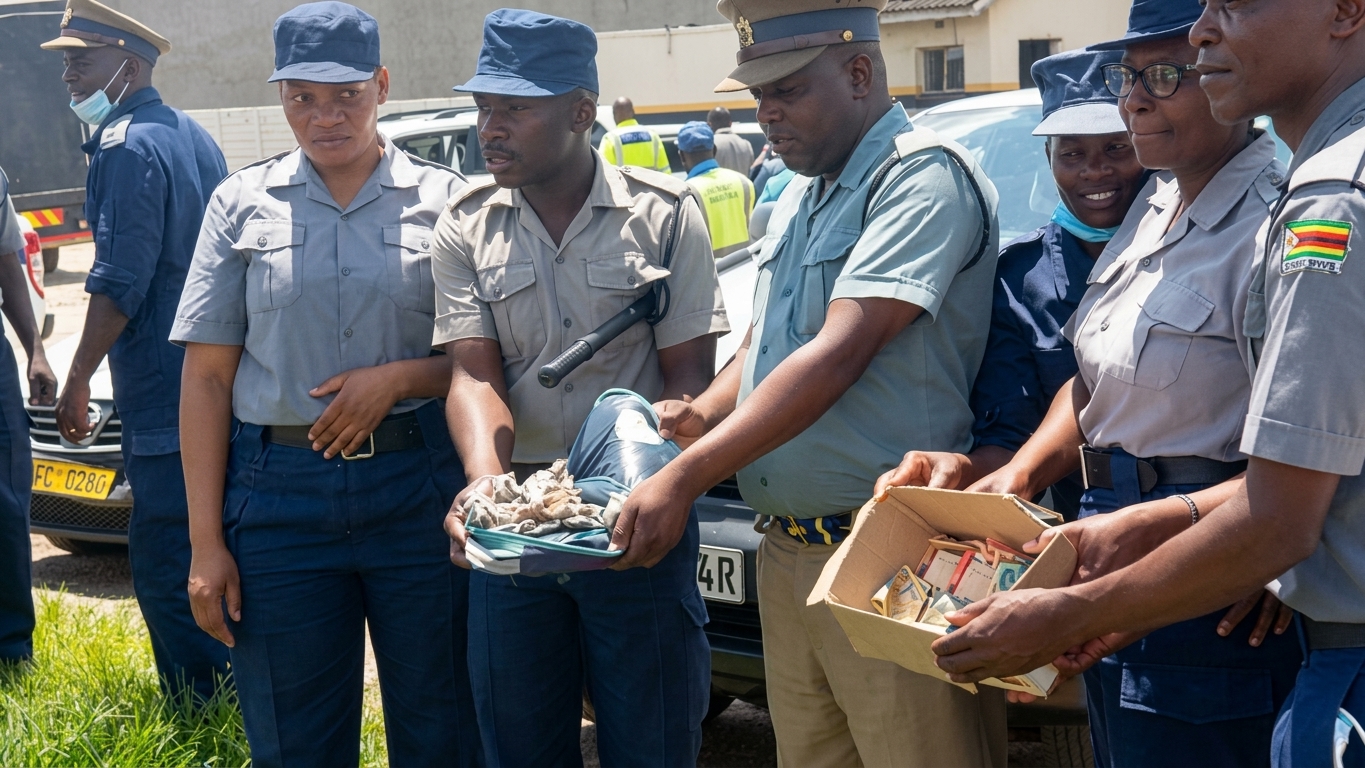
Arrest warrants have been issued for 3 women facing drug-possession charges after they failed to appear before a Bulawayo court on October 21, as the Government reported a nationwide crackdown that has taken thousands of people to court and seized drugs valued at more than ZiG 26.7 million.
The women are Amina Jassinta Jessub Arab, 47, her daughter Dyonne Tanaka Tafirenyika, 28, and their relative Noreen Jessub, 51. The court issued the warrants after their lawyer, Brezhnev Mathonsi, said they were still travelling from Harare to Bulawayo.
Magistrate Mark Dzira rejected the explanation, saying the journey did not justify missing the scheduled appearance. “They knew they were supposed to appear today; they should have travelled yesterday,” Dzira said.
The warrants mark a fresh turn in a case that has been before the courts for weeks. The 3 women were arrested on August 19 at a lodge in Bulawayo’s Ilanda suburb. They were later granted bail by the High Court, with each ordered to pay US$1,000, surrender her passport and report to Hatfield police station in Harare twice a week.
The State has said police found suspected drugs in the women’s rooms. Two sachets of cocaine, valued at ZiG 9,000, were recovered from Jessub’s room, concealed inside a shoe, while 2 more sachets of cocaine were found in Arab’s room. In Tafirenyika’s room, police reported finding a sachet of crystal methamphetamine, another sachet of cocaine and US$53,055 in cash.
Arab is the mother of Kelsea Tafirenyika, who is married to President Emmerson Mnangagwa’s son, Collins Mnangagwa. The family connection has drawn attention to the case, but the court action on Wednesday centred on the missed appearance and the need for the 3 defendants to return before the Bulawayo courts.
The case had already been delayed after prosecutors said they were waiting for outstanding witness statements before setting a trial date. At a previous appearance, the 3 women were remanded to October 21. Their lawyer had raised concern about the time taken to set a trial date, after the State had indicated it would seek an early hearing.
The court development comes as the Government reports expanded enforcement across the country. Between June 1 and September 19, 2026, 3,839 people were arrested and referred to court in connection with drug and substance abuse. Of those, 2,706 were under the age of 35. Authorities said they destroyed 73 suspected drug bases and held 171 public-awareness campaigns across the provinces.
The report separately listed 5,685 accused people in Harare, 1,022 in Bulawayo and 296 in Midlands, the lowest provincial figure. Those figures do not align with the same report’s nationwide total of 3,839 arrests: Harare’s accused tally alone is higher than the countrywide arrest count. The published figures do not explain how the two measures were calculated or reconciled. The headline figure for Harare is therefore an accused-person count, not a verified count of more than 5,000 arrests in the capital.
The enforcement drive recovered crystal methamphetamine, cocaine and dagga valued at ZiG 26,734,707. A total of 1,032 accused people were fined, while 461 were jailed for varying periods. Some received sentences of up to 15 years. The Medicines Control Authority of Zimbabwe carried out 285 inspections, and 50 violations were referred to court.
The Government also reported 4,934 drug-related cases. Of those, 4,341 had been completed, producing 4,243 convictions and 73 acquittals. Those listed outcomes add up to 4,316, leaving 25 completed cases without a stated outcome in the reported summary.
The crackdown is only one part of the national response. Prevention and youth empowerment programmes, including awareness campaigns, vocational training, research and livelihood initiatives, reached 1,393,906 people. The Government counted 814,906 women and 579,000 men among those reached.
On treatment and rehabilitation, 3,363 patients received care during the reporting period: 2,964 men and 399 women. A further 73 patients were reported to have relapsed. Psychosocial support reached 5,707 people, while 1,843 accessed assistance through the toll-free helpline 406. Another 594 people were reintegrated with their families and communities after leaving the Angel of Hope Foundation and Wilkins Rehabilitation Centres in Harare.
Officials say treatment demand continues to rise. Ingutsheni Central Hospital in Bulawayo and Ngomahuru in Masvingo have been treating people affected by drug and substance abuse, although neither is a dedicated rehabilitation centre. Refurbishment work is under way at rehabilitation facilities in Gwanda and Sakubva, Mutare, to add capacity.
The Government is also planning a 700-bed Presidential High-Capacity Drug Rehabilitation Centre on a site of about 20 hectares. The proposed model is intended to be replicated across Zimbabwe’s 10 provinces. It would bring clinical care together with psychosocial support, vocational training, agriculture, sport, recreation and help for people returning to their communities.
“The centre will integrate clinical treatment, psychosocial rehabilitation, vocational empowerment, agriculture, sport and recreation and community reintegration on approximately 20 hectares,” Professor Paul Mavima said at a post-Cabinet briefing. The model followed a benchmarking exercise at the Angel of Hope Foundation in Harare.
The proposal builds on the Zimbabwe Multi-Sectoral Drug and Substance Abuse Plan for 2024 to 2030, launched by President Mnangagwa in 2024. The plan is intended to coordinate prevention, enforcement, treatment and rehabilitation. The Government has also trained 71 people from across the provinces under a training-for-trainers programme, while 50 police officers received training in the use of modern breathalysers.
The National Drug, Substance Abuse Control and Enforcement Agency Bill is before the Parliamentary Legal Committee. The Government says it is pursuing a whole-of-government and whole-of-society response, combining enforcement with prevention, treatment and community support.
Officials have warned that businesses found breaking drug laws will face prosecution. “Any business found in violation, will face the full wrath of the law,” the Government said.