
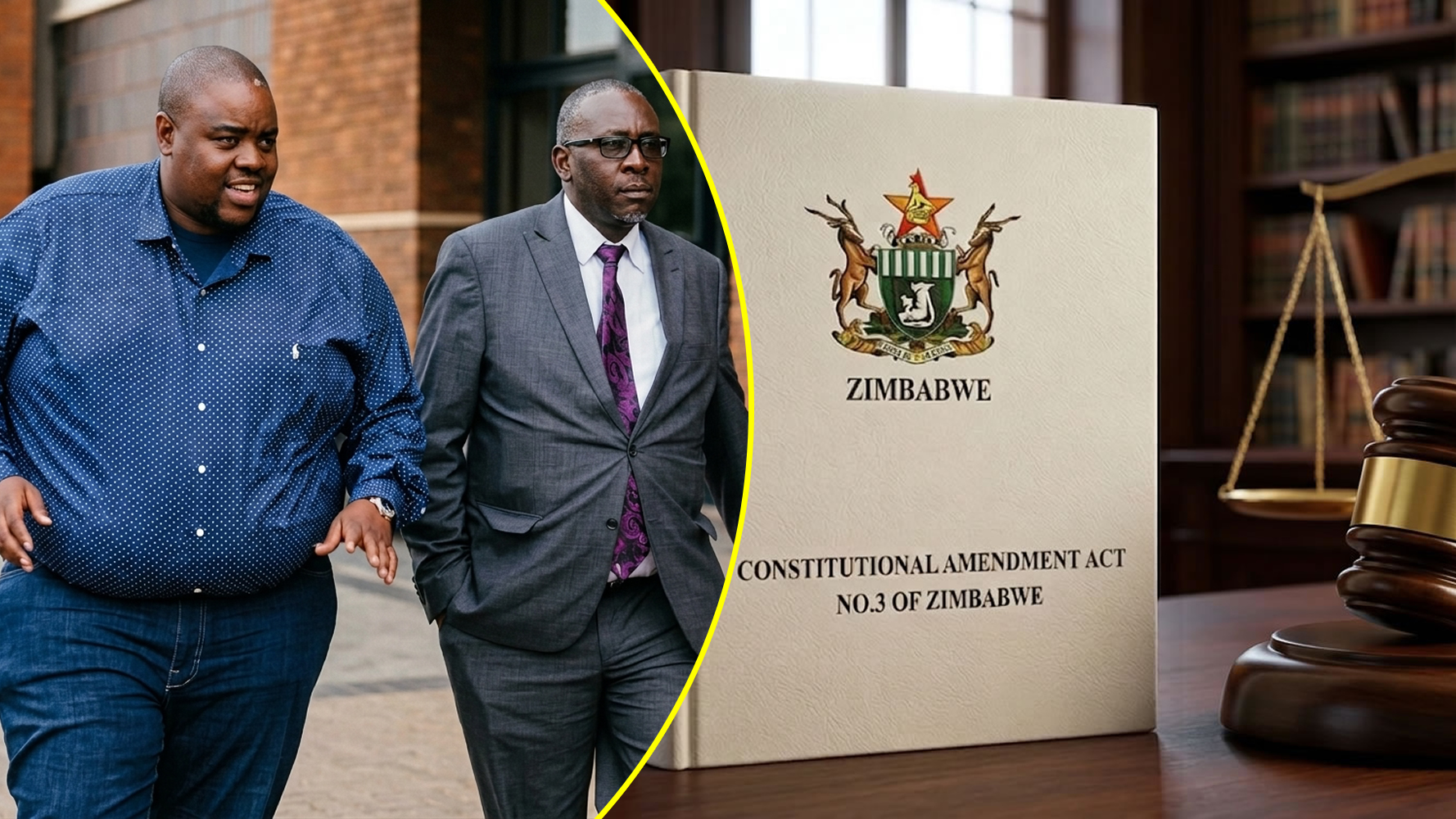

HARARE – Zimbabwe’s Constitutional Court is due to hear a series of challenges to Constitution Amendment Act No. 3 in November, as the legislation’s critics widen their campaign against changes that extend presidential and parliamentary terms and remove voters’ direct say in choosing the President.
The cases bring constitutional lawyers, opposition figures and war veterans before the country’s highest court. They are also unfolding against a sharp split within the ruling ZANU-PF party, where Vice-President Constantino Chiwenga has questioned whether decisions affecting the country are being imposed from above, while party resolutions have backed President Emmerson Mnangagwa’s continued leadership.
A timetable circulated by people involved in the cases lists hearings on November 11 and November 25. The first date is set for two applications: Vhurande Mahlupeko v Parliament of Zimbabwe and Others (CCZ277/26), and Prince Dubeko Sibanda v Parliament of Zimbabwe and the Minister of Justice (CCZ271/26). The listed November hearings are for arguments before the Constitutional Court; they are not announced as dates for final judgments. The case timetable identifies further challenges for later in the month.
The cases target different parts of the law and the process that produced it. Mahlupeko, a member of the National Constitutional Assembly, is asking the court to invalidate the Act as a whole. His application says 10 provisions included in the final law were not set out in the version published for the required public consultation period.
Sibanda, a former opposition legislator, is challenging the clauses that extend presidential and parliamentary terms from 5 years to 7 years and apply the longer terms to people already in office. His argument centres on Section 328(7) of the Constitution, which says amendments extending the period a person may hold public office do not apply to someone who held that office before the amendment.
The dispute is no longer over a proposal awaiting a vote. President Mnangagwa signed the amendment into law on July 7, 2026. The published Act changes the presidential election system so that the President is chosen by members of the Senate and National Assembly sitting together. It also extends the presidential and parliamentary terms, and includes wording stating that the new term provisions apply to the current President and Parliament notwithstanding Section 328(7).
That wording sits at the centre of Sibanda’s challenge. His case asks the court to decide whether Parliament can use the amendment to extend the current officeholders’ time in power despite the constitutional restriction. Mahlupeko’s case raises a separate question: whether the final version of the measure can stand if it included provisions that were not part of the gazetted bill put before the public.
A wider group of challenges
The November 25 schedule includes a case brought by the Movement for Democratic Change, led by Douglas Mwonzora, which challenges the removal of direct presidential voting. The party argues that a change affecting citizens’ right to vote for their President required a national referendum. A further war veterans’ case is also listed for that date, with issues including the extension of term limits and the consultation process.
The direct-vote dispute reaches beyond the method used to select a head of state. Under the new system, the President is elected by Parliament after a general election rather than by voters in a separate presidential ballot. Opponents say the amendment changes the practical meaning of the public’s political rights, even though it does not remove the words of the Declaration of Rights from the Constitution.
A separate group of six liberation war veterans, represented by constitutional law professor Lovemore Madhuku, is pursuing permission to take its challenge directly to the Constitutional Court. A three-judge panel heard that request on September 22 and reserved its judgment. The veterans argue that changing the presidential voting system affects a protected right and should have been put to a referendum.
Madhuku put their argument plainly after the hearing: “The matter which we had brought which we want to be determined by this court is that you cannot take away the right of ordinary citizens to vote directly for the president without a referendum.”
The government opposed the veterans’ request to go straight to the apex court. Advocate Sylvester Hashiti, representing Mnangagwa, the Justice Minister and the Attorney-General, argued that the applicants should begin in the High Court and said they had not established a basis for direct access. The court has yet to deliver its decision on that application.
That September matter is distinct from an earlier attempt by another group of six veterans to stop the amendment before it became law. That earlier application was struck off the Constitutional Court roll in June, with the applicants’ lawyer saying they would pursue the issues in the High Court. The new set of proceedings therefore involves several groups of applicants and more than one legal route, rather than a single war veterans’ case being heard repeatedly.
Madhuku has described the challenges as related but distinct. One focuses on the rights question; Sibanda’s case turns on whether incumbent officeholders can benefit from extended terms; Mahlupeko’s application attacks the legislative process; and the MDC seeks a ruling on the right to elect the President directly. The cases may overlap in their arguments, but they ask the court to decide different questions.
The death of kingmaker, Sir Wicknell Chivayo
Meanwhile, a Zanu PF faction that is pushing for President Mnangagwa to rule beyond 2028 – the backers of the Constitutional Amendment Act No. 3 – suffered a huge blow following the death of one of their major financiers. Wicknell Chivayo became one of the most visible financial patrons associated with CAB3 after announcing a US$3.6 million pledge — US$10,000 for each of Parliament’s 360 MPs and senators – as the amendment was advancing. Critics said gifts to lawmakers risked influencing the vote; Chivayo later withdrew the pledge and announced a revised US$5 million pledge channelled through ZANU-PF provincial structures.
His public offer of a US$350,000 package to Advocate Lewis Uriri came on September 21, 2026, the day before Uriri was due to assist war veterans challenging the amendment in the Constitutional Court. The package comprised a US$250,000 Range Rover, US$50,000 for fuel and US$50,000 for Uriri’s wife. Uriri and his wife declined it, saying: “Our decision is nevertheless firm: we will not accept the vehicle or either of the cash gifts.” Chivayo later described the timing as unfortunate and denied any attempt to influence the lawyer.
Chivayo, 43, his wife Lucy Muteke and 3 others died on September 30 when their helicopter mysteriously crashed on a farm near Waddilove Mission in Marondera Rural; 2 pilots were also aboard, and the cause of the crash is still under investigation. His death removed a prominent business ally of President Emmerson Mnangagwa and a highly visible connector between the ruling party, state-linked business and political figures across the region. That has left a conspicuous gap in the patronage and succession network surrounding the presidency, even as the contest over Mnangagwa’s future and the party’s direction continues.
Chiwenga’s challenge inside ZANU-PF
The courtroom contest is unfolding alongside a political dispute at the highest levels of the ruling party. Chiwenga did not file the court cases, and his remarks at ZANU-PF’s annual conference were not a formal legal submission. But his criticism has given the opposition to the constitutional changes an unusually visible voice within the party’s senior leadership.
At the ZANU-PF conference in Chinhoyi on October 16, Chiwenga referred to the events that led to the formation of the Second Republic after Robert Mugabe was removed from office in 2017. In a published English translation of his remarks, he asked: “What led to the emergence of the Second Republic? It emerged from correcting the rot that was prevailing. Are we not repeating the same mistakes? That is the question we should be asking ourselves.”
He also challenged delegates to consider whether resolutions reflected the wishes of ordinary party members. “Are our resolutions truly coming from the people? Do we truly understand the aspirations of our people?” he asked. He added: “Change must be driven by the people, not imposed from above.” The full address did not name CAB3 in those passages, but the comments came as the party debated resolutions aligning its rules with the new national constitutional framework.
The conference ultimately adopted resolutions that strengthened Mnangagwa’s position. The party resolved that he should be its sole presidential candidate at its next congress, deferred that congress to 2029 and directed that the party constitution be aligned with the amended national Constitution. The conference resolutions also called on the government to make consequential legislative changes flowing from Amendment No. 3.
The decisions place Chiwenga’s call for people-driven change beside the party’s formal endorsement of a path that would keep Mnangagwa at its helm through 2030. The amendments extend the presidential and parliamentary cycle from 5 years to 7 years. The next general election, due under the previous cycle in 2028, would move to 2030 under the new framework.
War veterans have now publicly backed Chiwenga’s call for collective leadership and adherence to the party’s founding principles. A pressure group said its support was about the issues raised in his speech, rather than loyalty to a faction. “Our support is principled, not factional. It is neither unconditional loyalty to an individual nor an endorsement of any internal political contest,” the group said.
The group also called for an independent investigation into claims that delegates were mobilised or paid to disrupt Chiwenga’s speech at the conference. It said: “Allegations that individuals were mobilised and financially induced to disrupt his address deserve investigation.” The claims have become part of the wider fight over whether dissenting voices can be heard within the party as it presses ahead with the constitutional realignment.
The pressure group has also said it has approached the courts over the constitutional amendment and the sovereignty of the people. Its public support for Chiwenga is separate from the applications filed by Mahlupeko, Sibanda, the MDC and the veterans seeking direct access. Taken together, though, the court cases and the party dispute have made the amendment a test of both Zimbabwe’s constitutional rules and the political authority to change them.