
Zimbabwe top court reserves ruling in challenge to Mnangagwa term extension
The Constitutional Court will consider whether Parliament followed the required process when it passed the amendment, and whether its new seven-year terms can apply to President Emmerson Mnangagwa and sitting MPs.
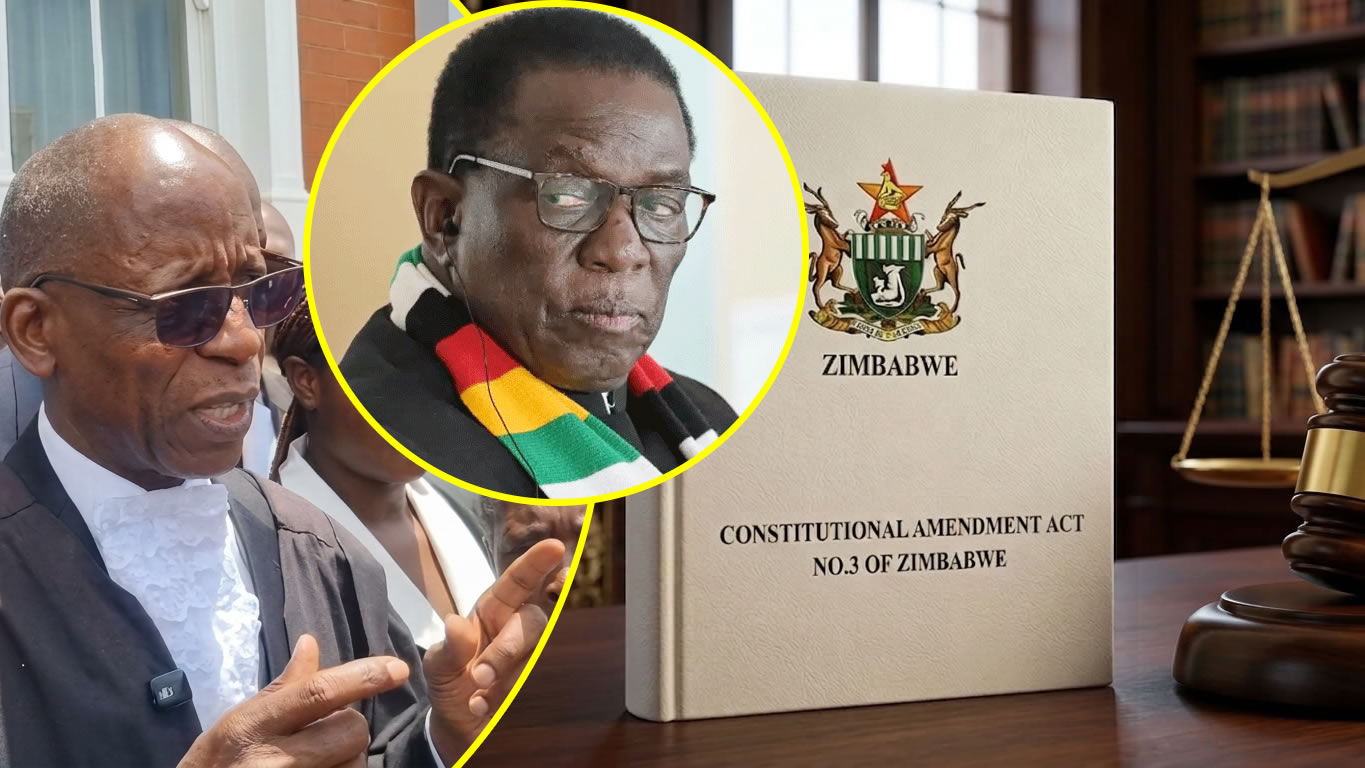
Zimbabwe’s Constitutional Court has reserved judgment in two challenges to the constitutional amendment that extends presidential and parliamentary terms from five years to seven, pushing the next general elections from 2028 to 2030 under the new framework.
A seven-judge bench heard the consolidated applications in Harare on Wednesday, 18 November. The cases were brought by National Constitutional Assembly member Vhurande Mahlupeko and former opposition legislator Prince Dubeko Sibanda. Both were represented by constitutional law professor Lovemore Madhuku.
Judicial sources indicated that a decision could come around January 2027. The court has not announced a date for delivering its ruling. The amendment remains in force while the judges consider the arguments.
The cases target different parts of the Constitution of Zimbabwe Amendment (No. 3) Act, 2026, commonly known as CAA3. Mahlupeko is challenging how the legislation was processed in Parliament. Sibanda is contesting its application to officeholders already serving when it was passed, including Mnangagwa and sitting members of Parliament.
The amendment changes the way the President is chosen. Instead of a direct vote by citizens, the President is to be elected by members of Parliament at a joint sitting of the Senate and National Assembly. It also lengthens the terms of the President and Parliament to seven years. The new provisions say the longer terms apply to the continuation in office of the incumbent President and the current Senate and National Assembly.
The Act also provides for ten additional senators appointed by the President, and changes the way electoral boundaries and voter registration are administered. Its changes to constitutional institutions and processes form part of the dispute over provisions Mahlupeko says were not included in the published draft put before the public.
Challenge to the parliamentary process
Mahlupeko, a member of the National Constitutional Assembly, argues that about ten substantive provisions were added while the Bill was being considered by Parliament, although they had not appeared in the original Government Gazette notice. That notice began the constitutional process requiring the proposals to be published for at least 90 days before they could be taken to Parliament, allowing time for public discussion.
His application, registered as CCZ 277/26, asks the court to invalidate the Act if it finds that the additions were introduced without following the required procedure. The challenge includes provisions affecting the Constitutional Court and the wider institutional arrangements set out in the law.
Madhuku told journalists after the hearing: “Our arguments were intended to show that they had not complied with the requirements in Section 328(3), which would not allow Parliament to proceed to deal with any constitutional provision that was not part of the case stated in the notice.”
The applicants are seeking to have the whole Act set aside, rather than asking judges to remove only the contested clauses. Madhuku said deleting selected provisions could leave a different piece of legislation from the one Parliament debated and passed.
“We argued that if they were to do so, the Bill would be different from what it was when Parliament passed it. We don’t know why people voted for this particular Bill. They might have voted for it because of those provisions that would have been removed by the judges,” he said.
The government’s response was that the Bill’s accompanying memorandum gave Parliament scope to consider governance issues and other matters beyond the initial proposals. The dispute puts the original public notice and the later parliamentary text at the centre of Mahlupeko’s case.
Sibanda’s challenge to term extensions
Sibanda’s application, CCZ 271/26, focuses on Section 328(7) of the Constitution. The provision says an amendment extending the time a person may hold public office does not apply to someone who held that office, or an equivalent one, before the amendment.
Sibanda argues that the safeguard prevents the longer terms from benefiting Mnangagwa and sitting MPs. The Act’s wording, however, expressly says that the new terms apply to the continuation in office of the current President and Parliament. That wording is among the central points the court must address in his case.
Madhuku said the State’s argument relied on the words “notwithstanding section 328(7)” in the amendment. He described the State’s position this way: “Parliament in court was not denying that Section 328 said that. They were saying they had overridden it. They were saying it was overridden by the expression ‘notwithstanding’.”
He added: “Our argument was that ‘notwithstanding’ cannot be a basis for you to shy away from the obligation, whether you vote for it or not.”
The State also challenged whether Sibanda had met the requirements for bringing the matter directly to the Constitutional Court. Its lawyers argued that the issue did not qualify for direct access to the country’s highest court and should have begun in a lower court. Madhuku said the applicants maintained that the constitutional obligation remained in place despite the wording Parliament inserted into the Act.
Questions about direct access arose during the hearing. Before deciding the substance of the challenges, the judges must consider whether the applicants can bring their cases directly before them. The applications seek direct access so the constitutional questions can be heard by the Constitutional Court.
Hearing delayed as bench was reconstituted
The cases had been scheduled for 11 November but were postponed for a week as the court reconstituted its bench. Judges who had been promoted after CAA3 was passed stepped aside, following concerns about their participation in cases challenging the same legislation.
The hearing on 18 November took place amid heightened security. The public gallery was filled to capacity, with citizens, civic activists and war veterans seeking to follow the proceedings. Police blocked scores of war veterans from entering, while journalists were denied access to the courtroom.
CAA3 was signed into law by Mnangagwa on 7 July 2026 as Act No. 6 of 2026. The extension means that, under the law’s terms, Mnangagwa’s current presidency would continue until 2030 rather than ending in 2028. Members of the present Parliament would also remain in office for the longer term.
The amendment’s shift from direct presidential elections to a parliamentary vote has prompted a separate court challenge. The Movement for Democratic Change is scheduled to bring its case on 25 November. It argues that removing citizens’ direct vote for the President requires a national referendum under the Constitution.
The court has also reserved judgment in a separate application, CCZ 284/26, brought by Thamsanqa Ncube and Ibhetshu Likazulu against the President and other respondents. That case was heard on 4 November. The Attorney-General’s Office later issued a notice stating that judgment had been reserved and that no final determination had been handed down.
Other applicants have sought to challenge the amendment, including war veterans contesting the end of direct presidential elections and seeking to have the Act invalidated. The court has considered whether some of those cases can proceed directly before it, with decisions on access reserved in separate applications.
Wednesday’s hearing did not produce an immediate ruling. The seven judges are now considering the arguments on the parliamentary process, the term-limit safeguard and the court’s authority to hear the cases directly. Their written decision will determine the outcome of the two applications before them, while the separately listed cases remain on the court’s calendar.