


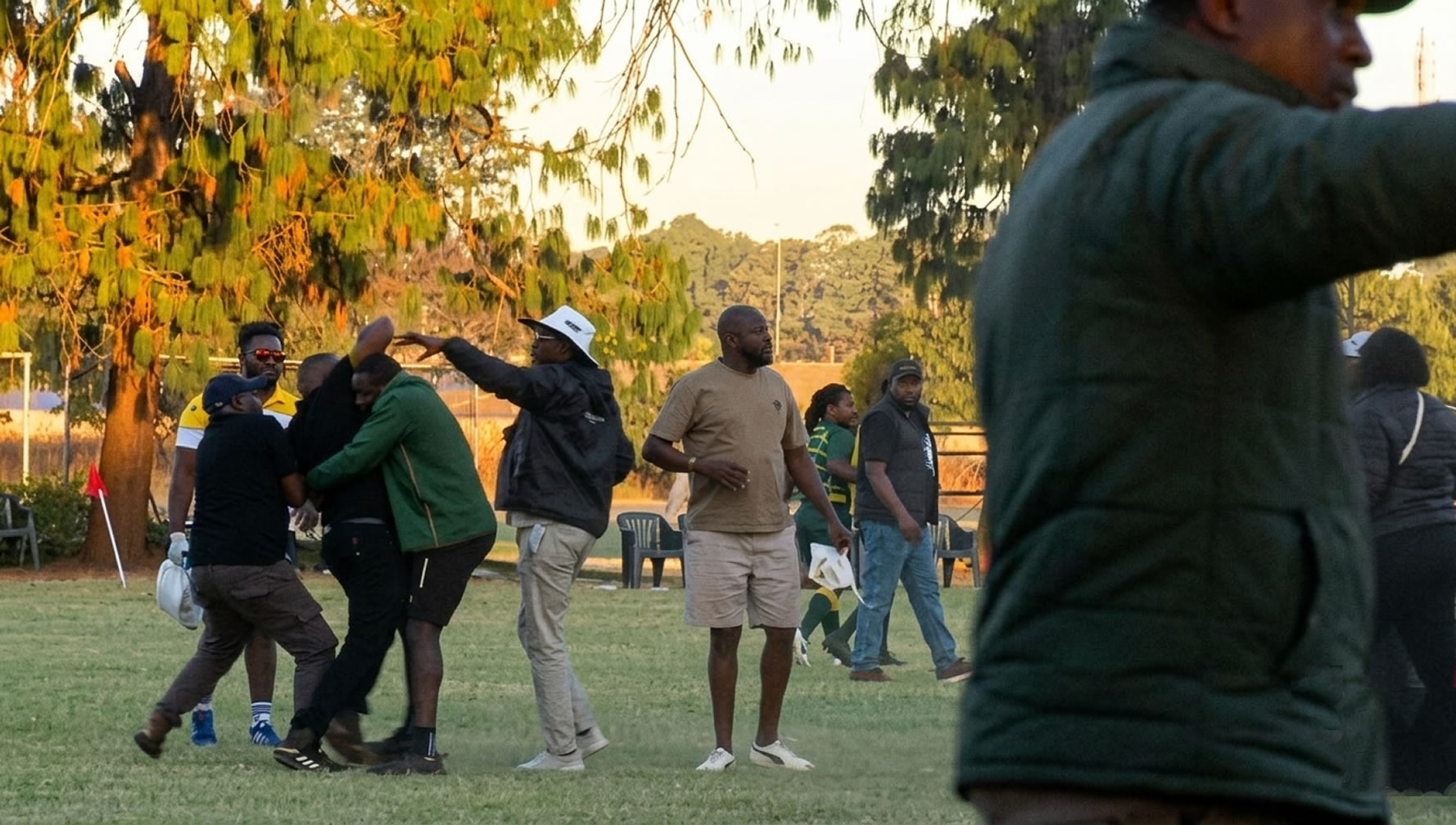
HARARE – The final whistle at a schools rugby match is usually a moment of either jubilation or respectful defeat. However, this past Saturday at Eaglesvale College in Harare, the conclusion of a high-stakes fixture against Bulawayo’s Christian Brothers College (CBC) descended into a scene of unprecedented disorder. What began as a sporting rivalry ended with the arrest of Lotshe Yuri Rodgers Mangena, the 50-year-old son of one of Zimbabwe’s most revered liberation war heroes, Alfred Nikita Mangena.
The incident, which has dominated public conversation across the country, saw Mangena accused of assaulting a teenage pupil and brandishing a firearm in front of a crowd of stunned parents, teachers, and students. The Zimbabwe Republic Police (ZRP) confirmed the arrest of Mangena on charges of assault and pointing a firearm. National police spokesperson Commissioner Paul Nyathi stated, “The suspect has since appeared before Harare Magistrate Court,” adding that the weapon involved has been seized by the authorities.
The tension began to simmer during the closing minutes of the match. Eaglesvale, the hosts, were locked in a fierce battle with the CBC “Hornets.” With the scoreline razor-thin, a controversial penalty decision in the dying moments of the game gave Eaglesvale the opportunity they needed. They converted the kick, securing a 14-13 victory. The sudden turn of events triggered an immediate and volatile reaction from some sections of the CBC support base, who felt the referee’s decision was unjust.
As the match ended, the boundaries between the spectator stands and the field of play evaporated. Videos circulating on social media captured the ensuing commotion as parents and supporters stormed the pitch. It was during this melee that Mangena, whose son is a pupil at CBC, allegedly lost his composure. According to the prosecution, led by Takudzwa Jambawu, Mangena pulled a pistol from his trousers and displayed it to the crowd.
The State further alleges that in the heat of the moment, Mangena struck a 16-year-old Form Four pupil in the face. While the teenager reportedly did not sustain visible injuries and remained in a stable condition, the act of physical violence against a minor at a school event has drawn sharp condemnation. Appearing before Magistrate Ruth Moyo, Mangena was granted US$100 bail pending further legal proceedings.
To understand the weight of this incident, one must look at the name Mangena. Lotshe Yuri Rodgers Mangena is the son of the late Rodgers Alfred Nikita Mangena, the legendary commander of the Zimbabwe People’s Revolutionary Army (ZIPRA). Nikita Mangena was a figure of immense stature in the liberation struggle, a man who built ZIPRA into a formidable conventional military force from its humble beginnings.
Born in 1943, Nikita Mangena was a pioneer of the armed struggle against the Rhodesian regime. He was known for his intellectual approach to warfare and his uncompromising discipline. Under his leadership, ZIPRA forces operated from bases in Zambia, conducting strategic raids and preparing for a post-independence national army. His life was tragically cut short on 28 June 1978, when his vehicle struck a Rhodesian landmine in Southern Zambia while he was en route to investigate an ambush that had claimed the lives of his soldiers.
The irony of a son of such a disciplined military icon being arrested for a public display of firearm-related aggression has not been lost on the Zimbabwean public. Nikita Mangena’s legacy is one of liberation and the protection of the people; the allegations against his son suggest a starkly different use of power and weaponry.
Schoolboy rugby in Zimbabwe is far more than just a weekend pastime. It is a deeply entrenched cultural phenomenon with traditions that go back decades. Matches like Eaglesvale versus CBC are part of a broader ecosystem known as the “Super 12” or the CBZ Schools Rugby Clashes. These fixtures are the lifeblood of the sport in the country, often drawing larger crowds and more passionate support than professional club matches.
The funding for these programmes is substantial. Major financial institutions like CBZ Holdings and telecommunications giants like Econet Wireless are frequent sponsors, seeing the value in “nurturing champions” at the grassroots level. Old Boys’ associations also play a critical role, pouring resources into their former schools to ensure they remain competitive. The prestige associated with winning these matches is immense, with schools like St George’s College, Peterhouse, St John’s College, Prince Edward, and Falcon College often vying for the top spots in the national rankings.
The rivalry between Harare-based schools like Eaglesvale and Bulawayo-based institutions like CBC is particularly intense, representing a “Battle of the Cities” that brings out the most fervent emotions in players and parents alike. However, the recent chaos has raised serious questions about the “win-at-all-costs” mentality that sometimes permeates these events. The Sports and Recreation Commission (SRC) has expressed grave concern, noting that the safety and discipline of sporting venues must be preserved at all costs.
From a legal standpoint, the production of a firearm in such a setting is a grave offence. The Firearms Act [Chapter 10:09] of Zimbabwe is clear regarding the responsibilities of gun owners. The law states that no person shall point a firearm at any other person without “lawful cause.” Furthermore, the public display of a weapon in a manner intended to cause alarm or intimidation is strictly prohibited.
Under Section 27 of the Act, any person who points a firearm at another person, whether the firearm is loaded or unloaded, is guilty of an offence. The penalties for such actions are severe, ranging from heavy fines (often at Level 10) to significant terms of imprisonment. The Act is designed to ensure that firearms, which require a stringent licensing process in Zimbabwe, are used only for their intended and authorised purposes, such as self-defence or sport, and never as tools of public intimidation.
The presence of a gun at a school sports fixture is a breach of both the law and the unspoken code of conduct that governs these community gatherings. “A CBC parent allegedly pulled out a gun but was restrained by other parents. Incident has been reported to police,” read one of the early reports that emerged as the news broke.
As the legal process for Lotshe Mangena continues, the rugby community is left to reflect on how a game of inches turned into a confrontation of inches—the distance between a holster and a hand. The incident has forced a conversation about the role of parents in school sports and the necessity of maintaining the spirit of the game, even when the referee’s whistle does not go your way.
For now, the focus remains on the courts and the lessons that can be learned. The memory of Alfred Nikita Mangena remains a beacon of heroism in Zimbabwe, but this recent chapter at Eaglesvale serves as a reminder that the conduct of the living can sometimes cast a shadow over the legacies of the dead. The hope for many is that the “Hornets” and the “Eagles” can return to the pitch in the future, with the only battles being fought between the try lines, and the only weapons being the skill and determination of the young men playing the game.
The ZRP has reiterated its commitment to ensuring that such incidents do not go unpunished. As Commissioner Nyathi noted in his briefing, the law applies to everyone, regardless of their background or lineage. The seizure of the firearm and the subsequent court appearance of Mangena send a clear message: the rugby pitch is a place for sport, not for the brandishing of weapons or the settling of scores through violence.