


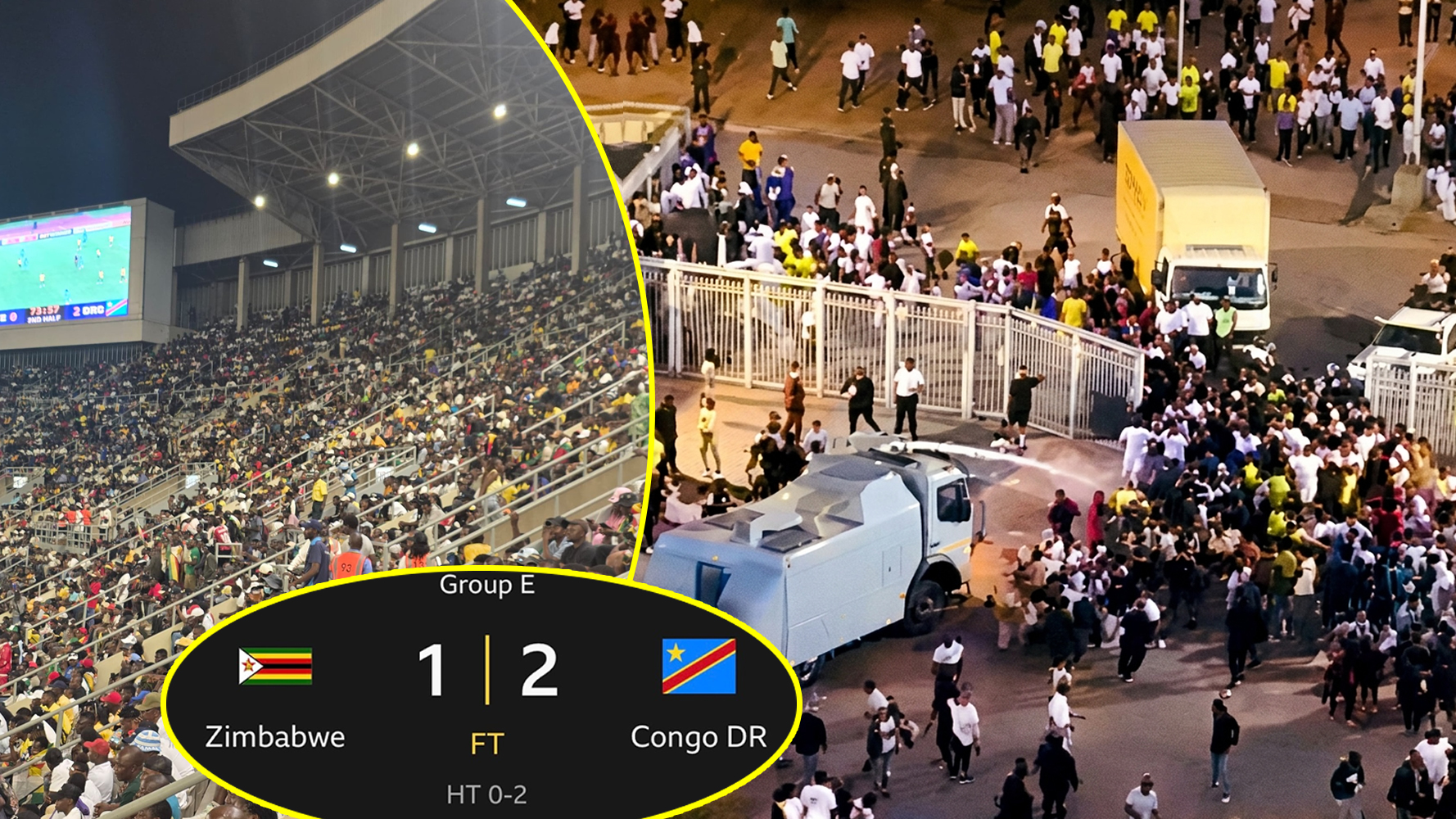
A football match meant to mark the return of Zimbabwe’s Warriors to the National Sports Stadium ended with a supporter dead after a police crowd-control truck drove into a crush at Gate 2.
The incident happened at about 6.30pm on Monday, shortly after Zimbabwe’s Africa Cup of Nations qualifier against the Democratic Republic of Congo had kicked off. Thousands of ticketed supporters were still trying to enter the ground when a surge developed at the gate. In the confusion, a fan fell and was run over by a police public-order vehicle fitted with a water cannon.
The death came as supporters were already frustrated by long queues and tighter-than-usual security checks. The presence of President Emmerson Mnangagwa inside the stadium had brought an increased security operation, while large numbers of fans had arrived for Zimbabwe’s first competitive international match at the venue in almost five years.
The Zimbabwe Republic Police confirmed that a person had died, describing the incident as involving “a police public order vehicle and a pedestrian”. National police spokesman Commissioner Paul Nyathi said the death occurred during a stampede at Gate Number Two at 1830 hours, at the beginning of the match.
“The Zimbabwe Republic Police confirms that swift and comprehensive investigations are currently underway after a fatal incident involving a police public order vehicle and a pedestrian at the National Sports Stadium, where one person died during a stampede at Gate Number Two at 1830 hours at the beginning of the soccer match between Zimbabwe and the Democratic Republic of Congo,” Nyathi said.
He added: “The Commissioner General of Police expresses his profound condolences to the family of the victim.”
“The Zimbabwe Republic Police assures the public of objective and comprehensive investigations to find out exactly what transpired.”
Police Commissioner-General Stephen Mutamba ordered an investigation into the death. The identity of the victim had not been released immediately, pending notification of the next of kin. Supporters later circulated claims that the dead woman was known as Mai Tadiwa, a Mutare-based Caps United supporter and follower of the national team, but the police had not formally released her name.
Video from the scene showed the police vehicle moving towards the area where fans were pressing against the entrance. The truck, an Israeli-made riot-control vehicle, had a water cannon mounted on it. It is designed to push back crowds with high-pressure water, but at Gate 2 its movement brought the vehicle into direct contact with people trapped in the congestion.
The match itself had been sold as a homecoming. The National Sports Stadium had been unavailable for major international fixtures for nearly five years after being banned over concerns about its condition. Renovation work, including improvements to seating, lighting and other facilities, eventually allowed the ground to host the Warriors again.
The return drew a large crowd, but the renewed stadium did not prevent the old problems of access and crowd control from returning. Supporters faced bottlenecks at the entrances, and the pressure at Gate 2 grew as the scheduled 6pm kick-off approached. Some fans with tickets complained that gates were closed or were not working properly, leaving people packed together outside while the match was already under way.
Inside, the Warriors struggled against a strong Congolese side. Yoane Wissa opened the scoring after goalkeeper Elvis Chipezeze failed to deal with a high cross. Samuel Moutoussamy then doubled the lead before half-time. Zimbabwe improved after the break and Marshall Munetsi headed in from a corner in stoppage time, but the late goal was not enough to prevent a 2–1 defeat.
The result was quickly overshadowed by the death outside the ground. A fixture intended to celebrate Zimbabwe’s return to its national stadium had instead renewed painful memories of earlier disasters at the same venue.
On 9 July 2000, 13 people died during a World Cup qualifier between Zimbabwe and South Africa. The match was being played before a crowd of about 60,000 when South African striker Delron Buckley scored his second goal to put Bafana Bafana 2–0 ahead. Bottles were thrown from the stands after the goal, and trigger-happy police responded by firing tear gas into a crowded section.
The gas caused panic. Fans tried to escape through the exits, but people at the top of the stands found that some gates were locked. Those fleeing pushed downwards while others surged upwards, creating a crush against the metal barriers. Most of the victims were crushed or suffocated. Players on the pitch, including Peter Ndlovu and South Africa’s Quinton Fortune, were also affected by the gas as the match was abandoned.
The dead included six-year-old Alec Fidesi, Eularia Made, T. Makonese, Tawanda Gwanzura, Patrick Mpariwa, Killian Madondo, George Chin’anga, Sam Mavhuro, Enock Chimombe, Joyce Chimbamba, Benhilda Magadu, Ronald Kufakunesu and Tonderai Jeke.
That tragedy has remained the darkest day in Zimbabwean football. The names of the victims have largely been kept alive by relatives, survivors and football supporters rather than through a permanent memorial at the stadium. The National Sports Stadium has continued to host major matches, but the memory of the 2000 crush has never disappeared from the stands.
There was another fatal stampede at the venue in 2019 before an Africa Cup of Nations qualifier against Congo-Brazzaville. Egna Nyamadzawo died and two other people were injured. Zimbabwe won that match 2–0, but the result could not erase the grief outside the gates.