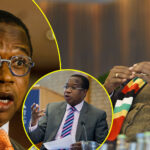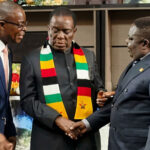


ZANU PF national spokesperson Christopher Mutsvangwa has claimed that his party helped silence Zimbabwe’s main opposition parties, the MDC formed by Morgan Tsvangirai and the Citizens Coalition for Change (CCC) formed by Nelson Chamisa, as he delivered a blunt warning to members who question party decisions in public.
“You are lucky to have Mnangagwa as the leader. We silenced MDC and CCC. ZANU PF is unstoppable,” Mutsvangwa said while addressing the party’s Masvingo Provincial Coordinating Committee at Great Zimbabwe University in mid-November.
The remark came amid a growing dispute over whether President Emmerson Mnangagwa should remain in power until 2030 and whether the party’s resolutions reflect the wishes of its members. Mutsvangwa did not name Vice-President Constantino Chiwenga, but his criticism followed Chiwenga’s speech at the ZANU PF conference in Chinhoyi, where the Vice-President called for an honest review of the party’s direction and asked whether its decisions genuinely came from the grassroots.
Mutsvangwa’s message was that debate could take place inside party structures, but dissent should stop once a decision had been made. He invoked “democratic centralism”, the principle that party members may debate internally but are expected to support the adopted line afterwards.
“Kwedu kumusangano vaMnangagwa ndivo kana wasvotwa navo chibuda inonzi democratic centralism,” he said, arguing that once Mnangagwa had been chosen by the party, members were expected to respect the result.
He also warned that publicly contradicting the party could damage a member’s standing. “Haikona kuti pajekerere wotanga kurasika uchitaura zvako, unozvibvisa chimiro pamberi pevanhu, that’s why pasina vakaratidza kufarira,” he said.
The remarks carried an unmistakable edge because Chiwenga’s conference address had raised questions about how party decisions were made. The Vice-President spoke of the Second Republic’s founding promise to correct past failures and asked whether ZANU PF was repeating them.
“Chii chakaita kuti Second Republic ivepo? Kwaive kugadzirisa zvakaipa zvanga zchichiitika kumashure. Hatisi kudzokorora here kuita zvatakambotadza? Ndomubvunzo watinofanira kuzvivunza,” Chiwenga said. He then asked: “Are our resolutions truly coming from the people?”
He also told delegates: “Change must be driven by the people, not imposed from above.”
Those words set up a direct contrast with Mutsvangwa’s insistence that party members should rally behind decisions after they have been adopted. Chiwenga framed public criticism and grassroots consultation as necessary to the party’s renewal. Mutsvangwa presented public disagreement as disloyalty that could undermine both the party and the individual speaking out.
The clash is unfolding after ZANU PF’s 23rd National People’s Conference in Chinhoyi adopted resolutions that strengthen Mnangagwa’s position within the party. Delegates resolved that he should be the sole ZANU PF presidential candidate at the party’s 2029 congress. They also postponed that congress from 2027 to 2029 and called for the party constitution to be aligned with the national Constitution Amendment No. 3 Act.
The resolutions further directed the Government to make consequential changes arising from Amendment No. 3 and called for disciplinary action against party MPs who did not attend Parliament to vote on the amendment bill. The decisions have turned succession from a background question into a public test of party loyalty.
Amendment No. 3 was signed into law on July 7, 2026. It provides for seven-year presidential and parliamentary terms and changes the method of electing the President, moving the choice from a direct national vote to a joint sitting of Parliament. Its provisions have become closely tied to the dispute over Mnangagwa’s political future and the party’s 2030 agenda.
At the Masvingo meeting, Minister of State for Masvingo Provincial Affairs and Devolution Ezra Chadzamira reinforced Mutsvangwa’s argument by questioning why potential successors had not sought the presidency when the opportunity arose after former president Robert Mugabe resigned in 2017.
“The position was left for two weeks without anyone. Therefore, if anyone wanted that position they would have assumed it. Now you see that the country is moving well, you want to enjoy the benefits,” Chadzamira said.
His remarks presented Mnangagwa’s continued leadership as a question of timing and performance: those who wanted the position, he argued, could have taken it in 2017, rather than challenging for it after the current administration had begun its development programme.
Chadzamira credited the National Development Strategy 1 and National Development Strategy 2 with driving development in Masvingo. He pointed to agriculture, mining, tourism and infrastructure, and said the province’s ambitions depended on consolidating progress and continuing towards its economic targets. He did not set out a project-by-project account at the meeting, but his intervention gave Mutsvangwa’s defence of party discipline a development argument: leadership continuity, he suggested, was linked to delivering the province’s plans.
Mutsvangwa also widened his intervention beyond succession by crediting ZANU PF with weakening the MDC and CCC. The wording was stark, but it was his claim about the opposition’s political condition, not a detailed account of how either movement was brought down.
Both opposition formations have faced internal divisions and leadership disputes. The MDC split into competing factions over leadership and the party name. The CCC, formed in 2022 under Nelson Chamisa, has also been caught in disputes over who controls its structures and can speak for the party. Chamisa left the CCC in January 2024, saying it had been hijacked, while rival claims over party authority continued.
That conflict has remained visible in recent months. In October, the CCC leadership under interim secretary-general Sengezo Tshabangu rejected letters that purported to recall Bulawayo Mayor David Coltart and 3 opposition MPs. The party said the letters did not represent its position. The named representatives were Coltart, Surrender Kapoikulu, Togarepi Zivai Mhetu and Corban Madzivanyika. The disputed letters brought rival claims inside the opposition into a public contest over who had authority to act in the party’s name.
Mutsvangwa’s remark that ZANU PF had “silenced” the opposition therefore lands against a backdrop of both ruling-party dominance and opposition turmoil. He did not explain what actions he meant by “silenced”, or identify particular events in the histories of the MDC or CCC. His statement nevertheless placed the ruling party’s role at the centre of his account, rather than describing the opposition’s difficulties as solely the result of internal divisions.
The Masvingo exchange set out contrasting positions on political discipline. Mutsvangwa said debate belongs in the Politburo, Central Committee or Presidium, but members must accept the outcome once a resolution is passed. Chiwenga’s Chinhoyi address called for party leaders to test whether those resolutions reflected popular views and whether the party was listening to its members.
Mnangagwa has not publicly changed course on the party’s 2030 plan. The Chinhoyi resolutions formalised his position as the sole candidate for the next congress, while Mutsvangwa’s remarks made clear that those who oppose the decision face pressure to fall in line or leave.
Chadzamira’s intervention added another layer to the warning. By asking why critics had not sought the presidency in 2017, he defended Mnangagwa’s continued leadership and the development agenda pursued by his Government. He did not address Chiwenga’s question about whether party resolutions reflected grassroots opinion.
For now, Chiwenga has not responded publicly to the criticism directed at him after the Chinhoyi conference. But the exchange has made the internal disagreement difficult to miss: one senior figure is asking whether the party still listens to its members, while another is warning that members who continue to speak against adopted decisions risk embarrassing themselves and weakening their standing.