


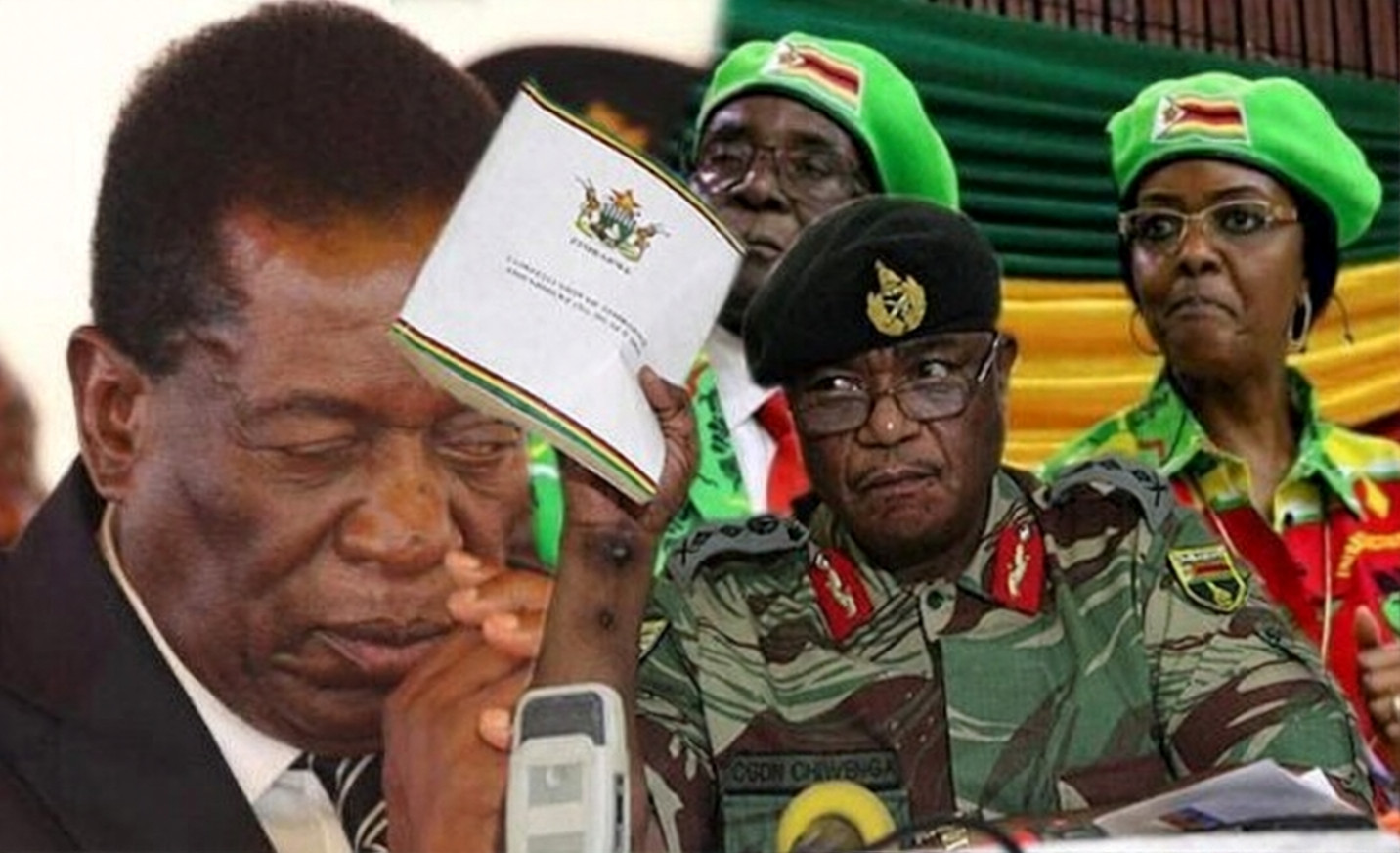
President Emmerson Mnangagwa has claimed that he had “totally” reconciled with the late former President Robert Mugabe at the time of his death, a statement that has been fiercely contested by Jealousy Mawarire, Mugabe’s last spokesperson.
In a recent interview with the Zimbabwe Broadcasting Corporation (ZBC), President Mnangagwa reflected on his relationships with several key figures in Zimbabwe’s political history, including the late former President Robert Mugabe, the former First Family, former Vice President Joice Mujuru and the late former Vice President Dr Joshua Nkomo. He said these relationships were shaped by mutual respect, shared liberation struggle experiences and a consistent commitment to national unity.
According to President Mnangagwa, Mugabe had confessed to being misinformed and they decided to move on. “I think he was misinformed because later on we discussed and he said, ‘Ah Emmerson, I am sorry about what happened, this was the work of people,’” said Mnangagwa. “We met even when he was still in power. He told me what had happened, then we reconciled and I came back. He told me what had happened and he was sorry.”
When asked whether third parties had attempted to sow divisions between them, President Mnangagwa confirmed that there had been individuals who had manipulated the situation. “Yes, (there were third hands) . . . who had manipulated him,” he said. “And I said, ‘Mr President, we have come from far, let us move on, let us forget.’”
Asked whether the reconciliation had been complete by the time Cde Mugabe passed away, President Mnangagwa said the two had fully resolved their differences. “Totally. We had opened up to each other, opened up totally,” he said.
Mawarire, who worked with Mugabe from just after he was forced out of power by Mnangagwa’s 2017 coup until his death on September 6, 2019, has vehemently denied this, branding it “a lie from the pit of hell.”
“ED knows that’s a lie from the pit of hell,” Mawarire stated. “ED didn’t meet President Mugabe after the coup, neither did Mugabe apologise, apologise for being couped?” He further questioned why, if such a reconciliation had occurred, there were no documented details or leaked images, given the government’s alleged penchant for propaganda.
“Reuben Barwe, of all people, knows that such a meeting NEVER took place and anyone with a little bit of brain would know this is a lie,” Mawarire added. “With ED government perchance for propaganda and kodak moments, surely details of that meeting, and pictures, could have been leaked to the media. Remember this is the same guy who enjoys pictures with clowns, so-called ‘influencers’ who are nothing but characters of questionable morality. You think if he could find an opportunity for a meeting with RGM after the coup, he wouldn’t milk it for propaganda purposes?”
Mugabe openly backed opposition leader Nelson Chamisa in the 2018 elections, describing Mnangagwa’s government as oppressive and calling for the international community to intervene. He went as far as describing the “second republic” as unconstitutional and illegal. There is no record of the two having met, with former first lady Grace Mugabe only marking the thawing of their relations at Mnangagwa’s third swearing-in ceremony in September 2023.
Mawarire also questioned why, if they had reconciled, President Mnangagwa would allow his proxies to continuously threaten Mugabe’s family with the possible exhumation of his body. “If ED really reconciled with Mugabe, why is he allowing proxies to torment his family, threatening exhumation of the late President?” he asked. “Lying about the dead, simply because they can’t answer back is callous.”
Mawarire accused Mnangagwa of being dishonest on multiple fronts. “ED lies about everything, his age, his wartime exploits, his academic achievements, his origins, he lies about almost everything. Everything about him is a BIG LIE,” he asserted.
Turning to his relationship with the former First Family, President Mnangagwa dismissed suggestions of animosity, saying relations remain cordial and cooperative. “Of course, we have no issues at all (with the former First Family),” he said. “If she has any problems, she comes to me and I solve them running,” he added, referring to former First Lady Grace Mugabe.
President Mnangagwa also said there were “totally no issues” between him and former Vice President Joice Mujuru, noting that perceptions of rivalry had never reflected reality. “We have no issues,” he said. “We were together in the war and there are no issues at all. We are just comrades; totally no issues,” he said. “People perceive that we would quarrel and do things; that was the perception, but to be honest, no.”
Reflecting on the period leading to the signing of the 1987 Unity Accord, President Mnangagwa said he played a critical behind-the-scenes role as an intermediary between former President Mugabe and the late Dr Nkomo, helping to bridge divisions between ZANU and ZAPU, as well as between ZANLA and ZIPRA.
“Mugabe was my boss, but he was very strong-headed. If he made a decision, he stood by it. It was very difficult for him to be flexible,” he said. “So, when these things happened, we felt there was a way of accommodating each other as ZANLA and ZIPRA, ZAPU and ZANU.”
He said his longstanding relationships on both sides enabled him to act as a trusted emissary. “I think, to some extent, I had friends on the ZAPU side; I could go and speak to ZAPU friends or ZANLA and I had ZIPRA friends also,” he said. “So it was easy for me to go across to an extent where I became an emissary between Mugabe and Nkomo.”
“Mugabe would send me to Nkomo and Nkomo would send me to Mugabe. I would arrange meetings between the two quietly, they would meet quietly and the only person who would know is me.”
President Mnangagwa also reflected on constitutional debates that shaped Zimbabwe’s governance system, including discussions on whether the country should adopt an executive or ceremonial presidency. “We debated for quite some time whether we should have an executive President or a titular President,” he said. “I was for an executive President with executive powers. Others were of the view that we should have a titular President with an executive Prime Minister, but I said no, we should go for an executive Presidency. Mugabe was also for the same, we agreed on that and we moved that way.”
At independence in 1980, Zimbabwe initially adopted a Westminster-style system, with an executive Prime Minister as head of government and a largely ceremonial President as head of state. Cde Mugabe served as Prime Minister, while Canaan Banana was President. In 1987, following the signing of the Unity Accord between ZANU and ZAPU, constitutional reforms were enacted. The office of Prime Minister was abolished, and an executive presidency was established, combining the roles of Head of State and Head of Government. Cde Mugabe became Zimbabwe’s first Executive President.
This is not the first time President Mnangagwa’s past has come under scrutiny. The narrative surrounding the acquisition of SMM by Mutumwa Mawere also provides a glimpse into the complex political landscape of Zimbabwe.
Mawere consistently denied receiving a government guarantee, saying the acquisition was financed through a sale and purchase agreement where the SMM shares themselves were pledged as security to the vendor (Turner & Newell Plc). In other words, it was a vendor financing deal. Vendor finance – also known as seller financing or trade credit – is a financial arrangement where a seller — rather than a bank or government — provides capital or credit terms to a buyer to purchase their goods, services, or assets. The vendor acted as the lender in this arrangement. So the acquisition of SMM was surrounded by controversy from start to finish.
That became a point of friction, tension and contestation with the government, first under Mugabe and later Mnangagwa. All the same, the SMM takeover made Mawere the owner of the world’s sixth-largest asbestos mining operation. At its peak, his empire included over 26 companies sprawling across various sectors, including mining (asbestos, gold, and nickel); manufacturing and logistics (companies like Turnall Fibre Cement and Steelnet, asbestos-cement products, General Beltings, Macsteel Zimbabwe, and Cernol Chemicals), financial services (banking and insurance including Zimbabwe Re-Insurance Company (Zimre), Nicoz Diamond Insurance, and First Banking Corporation (now FBC Holdings); agriculture and food, CFI Holdings (a major agro-industrial group), FSI Agricom Holdings, and Schweppes Zimbabwe Limited; and financial services, Zimbabwe Re-Insurance Company (Zimre), Nicoz Diamond Insurance, and FBC Holdings. THZ Holdings Limited, TAP Building Products Limited, Midsec Security and Investigations, Words and Images (PR), and Fortress Travel and Tours were part of his empire. He also ventured into the media space, owning Media Africa Group, which published The Business Tribune and The Weekend Tribune.
However, Mawere’s relationship with the government remained tense and vulnerable to political pressure. In the run-up to the Zanu PF congress in 2004, in which Mnangagwa was manoeuvring to be Vice-President to replace the late Simon Muzenda who had died in September 2003, Mawere was nominated to be the Zanu PF provincial secretary for finance, but he politely declined and distanced himself from the party. Mnangagwa was busy mobilising to takeover as Vice-President and positioning himself to succeed Mugabe during at the height of the Tsholotsho Declaration period or Dinyane fiasco in November 2004, characterised as a daring palace coup attempt. That was 13 years before Mnangagwa actually staged a military coup against Mugabe.
Mnangagwa was locked in a fierce succession battle with the late former Zimbabwe National Army commander retired General Solomon Mujuru who wanted his wife Joice to be Vice-President. By the time congress come in early December 2004 in Harare, Mujuru had outmanoeuvred Mnangagwa and managed to install his wife as Vice-President, while Mnangagwa stood accused of trying to stage a palace coup against Mugabe. As a result, Mnangagwa’s faction was crushed, with six provincial chairpersons and senior party officials suspended. Prior to that, during the previous 1999 congress, Mnangagwa was defeated by John Nkomo in his to be Zanu PF chair. That followed the death of Joshua Nkomo in July 1999, leading to the elevation of Zanu PF chairperson Joseph Msika to Vice-President, necessitating election of a new party chair.
Early in 2004, Mujuru had been pushing to nail Mnangagwa well ahead of the December congress. As part of that, the Zanu PF politburo, a supreme administrative organ of the decision-making Central Committee, appointed a select committee to investigate companies owned by the ruling party at a meeting held on March 31, 2004. The investigation into the party’s vast business empire amid allegations of mismanagement, corruption and looting was targeted at Mnangagwa, then the Speaker of Parliament, secretary for administration and secretary for finance for 24 years.
President Mnangagwa concluded his reflections by emphasising the importance of dialogue and reconciliation in Zimbabwean politics. He stated that constructive engagement, rather than division, is essential to national stability and progress. The contrasting narratives surrounding his relationship with the late President Mugabe, however, serve as a reminder of the complexities and enduring divisions that continue to shape Zimbabwe’s political landscape.