


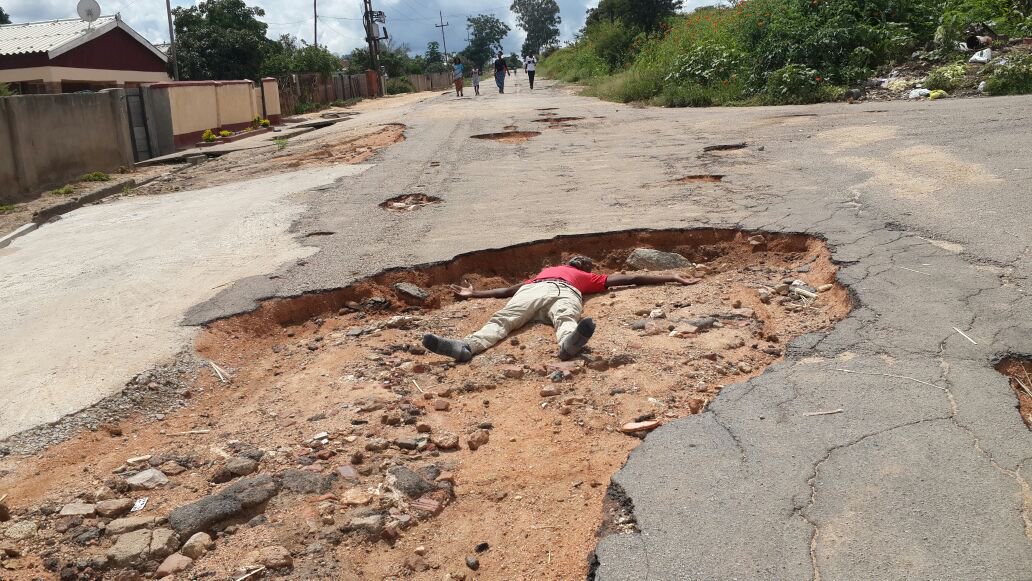
Zimbabwe’s national road network, once the envy of the region, has become a treacherous landscape of craters and jagged asphalt. For years, the narrative from local authorities has been a consistent refrain of poverty and neglect, claiming that the central government has starved them of the vital funds needed to patch a single pothole. However, a recent and explosive disclosure from the Zimbabwe National Road Administration (ZINARA) has shattered this long-standing excuse, revealing a staggering ZWG358 million “vanishing act” that has left taxpayers questioning where their hard-earned money has truly gone.
During a recent appearance before the Parliamentary Portfolio Committee on Transport, ZINARA Chief Executive Officer Nkosinathi Ncube laid bare the figures that local councils had hoped would remain buried in bureaucratic ledgers. In 2025 alone, ZINARA collected a massive ZWG12.5 billion from motorists through vehicle licensing and tollgate fees. Of this, ZWG9 billion was distributed to various road authorities and government agencies tasked with maintaining the nation’s arteries. Specifically, local authorities across Zimbabwe’s provinces received a combined ZWG358 million—a sum that should have translated into visible, tangible improvements on the ground.
Instead, the reality for the average Zimbabwean driver is a daily battle with “rim-bending” pits and dust-choked detours. The contrast between the massive injection of funds and the derelict state of the roads has sparked a fierce debate over accountability and the systemic corruption that appears to have taken root within the halls of local governance. While the money has left ZINARA’s coffers, it seems to have evaporated before reaching the tarmac, diverted into what many are now calling the pockets of a “pothole elite.”
The Blame Game and the Devolution Trap
For a long time, the relationship between ZINARA and local councils has been defined by a sophisticated “blame game.” Councils often point to ZINARA, alleging that the disbursements are either too small or arrive too late to be effective. Conversely, ZINARA maintains that its role is strictly limited to the collection and distribution of revenue. As Mr Ncube explained to the parliamentary committee, the administration’s hands are often tied by the very structure of the system.
“When people are leaving money with us, either through licensing or through the Tollgate, they will say I have just paid, but look at the road,” Mr Ncube stated during the hearing. “Our hands obviously are tied on that because we can only recommend that we cannot execute. The most important thing in the model is the monitoring and evaluation of who did what at the end of the day.”
This disconnect is the heart of the “devolution trap.” Under the guise of decentralised governance, significant funds are moved from the central treasury to local authorities with the expectation that those closest to the problems will solve them. However, without robust oversight, these funds frequently disappear into a black hole of administrative “other uses.” The ZINARA CEO confirmed that some councils had indeed diverted their road maintenance allocations to unrelated expenses, failing to provide any accountability for the missing millions.
The scale of the disbursements to provincial local authorities in 2025 is illustrated in the table below, highlighting the significant resources that were at the disposal of these councils:
|
Provincial Local Authority
|
Amount Disbursed (ZWG)
|
|
Harare City
|
121 Million
|
|
Masvingo
|
100 Million
|
|
Mashonaland West
|
84 Million
|
|
Mashonaland Central
|
20 Million
|
|
Midlands
|
20 Million
|
|
Mashonaland East
|
13 Million
|
|
Total Provincial Allocation
|
358 Million
|
Despite these substantial figures, the silence from many of these municipalities regarding their progress—or lack thereof—is deafening. While Harare City received the lion’s share of ZWG121 million, the capital’s roads remain some of the worst in the country, a stark reminder of the gap between financial allocation and physical execution.
Ghost Projects and Inflated Tenders
The investigation into where this money actually went leads down a dark path of “ghost projects” and highly suspicious procurement processes. In Harare, for instance, recent reports have uncovered a scandal involving millions of dollars earmarked for road rehabilitation that simply vanished. Internal audits and investigative findings from late 2025 pointed to at least 43 road rehabilitation contracts that were fully paid for by the City of Harare, yet no work was ever performed.
Sites in Belvedere, Kuwadzana, Mabvuku, Budiriro, and Mbare were listed as having undergone “upgrades” on paper, while residents on the ground continued to navigate the same broken streets they have endured for a decade. These ghost projects are often facilitated by a network of “preferred” contractors who receive full payment upfront for work that is never intended to be completed.
Furthermore, the issue of inflated equipment tenders has become a common method for siphoning funds. Councils often report spending millions on “specialised road maintenance machinery” that either never arrives or is found to be second-hand equipment purchased at the price of brand-new models. This systemic looting ensures that even when funds are technically “spent” on roads, the actual value reaching the street is a mere fraction of the original budget.
The Bulawayo Exception
Amidst this landscape of failure and finger-pointing, the Bulawayo City Council (BCC) has recently provided a rare glimmer of hope—and a painful point of comparison for other municipalities. Just this past week, on Friday, 27th February 2026, Bulawayo officials commissioned a fleet of new road construction and maintenance equipment worth over US$1 million.
The equipment, which includes heavy-duty graders and rollers, was purchased using a portion of the city’s ZINARA allocation. Of the ZWG33 million allocated to Bulawayo in 2025, the city utilised approximately ZWG27.38 million (equivalent to US$912,875) to bolster its internal capacity for road works. This move is intended to reduce the city’s reliance on expensive and often unreliable private contractors, ensuring that maintenance can be carried out more efficiently and at a lower cost to the ratepayer.
The commissioning in Bulawayo stands as a testament to what can be achieved when funds are actually directed toward their intended purpose. It also raises a difficult question for the authorities in Harare, Masvingo, and the Mashonaland provinces: if Bulawayo can transform its ZINARA allocation into a million-dollar fleet of machinery, why are your streets still falling apart?
A Systemic Failure of Oversight
The ZWG358 million discrepancy is not just a story of individual greed; it is a symptom of a broader, systemic failure of oversight. Legislators during the parliamentary hearing, such as Chipinge South MP Clifford Hlatwayo, expressed deep frustration with the recurring nature of these issues. They questioned why roads often begin to “peel off” and develop new potholes even before the contractors have finished their work.
Mr Ncube admitted that there are significant “contractual gaps” and “weak monitoring and evaluation mechanisms” that allow for such poor workmanship.
“Contractors should also be accountable at the end of the day,” Mr Ncube added. “It disturbs us that after some time, we see the road peeling off. Issues of accountability have to come through to the private sector as well. Funds are limited. Yes, they are not adequate, but they are being given.”
The ZINARA CEO’s admission highlights a critical flaw in the current model. ZINARA collects the money and hands it over, but has little power to ensure it is spent wisely. The local authorities receive the money but face few consequences when it is diverted. This lack of a “closed-loop” accountability system is precisely what allows the “pothole elite” to thrive.
The Road Ahead for the Taxpayer
For the Zimbabwean taxpayer, the revelation of the ZWG358 million disbursement is a bitter pill to swallow. Every time a motorist pays for a vehicle disc or passes through a tollgate, they are contributing to a fund that is meant to ensure their safety and the longevity of their vehicles. Instead, they are effectively subsidising the mismanagement and corruption of local councils.
ZINARA has proposed an “all-stakeholder indaba” to address these accountability gaps, and Mr Ncube has warned that future disbursements for 2026 will be strictly contingent on councils providing a full and transparent accounting of how they used their 2025 funds. While this is a step in the right direction, for many citizens, it feels like too little, too late.
The “vanishing act” of the ZWG358 million is a clear signal that the current system is broken. Until there is a fundamental shift in how road funds are monitored—and until those who divert these funds face real, legal consequences—the road to recovery for Zimbabwe’s infrastructure will remain a road to nowhere. The citizens are no longer interested in the “blame game”; they want to see their licensing fees reflected in the tarmac beneath their tyres, not in the bank accounts of the well-connected few.