


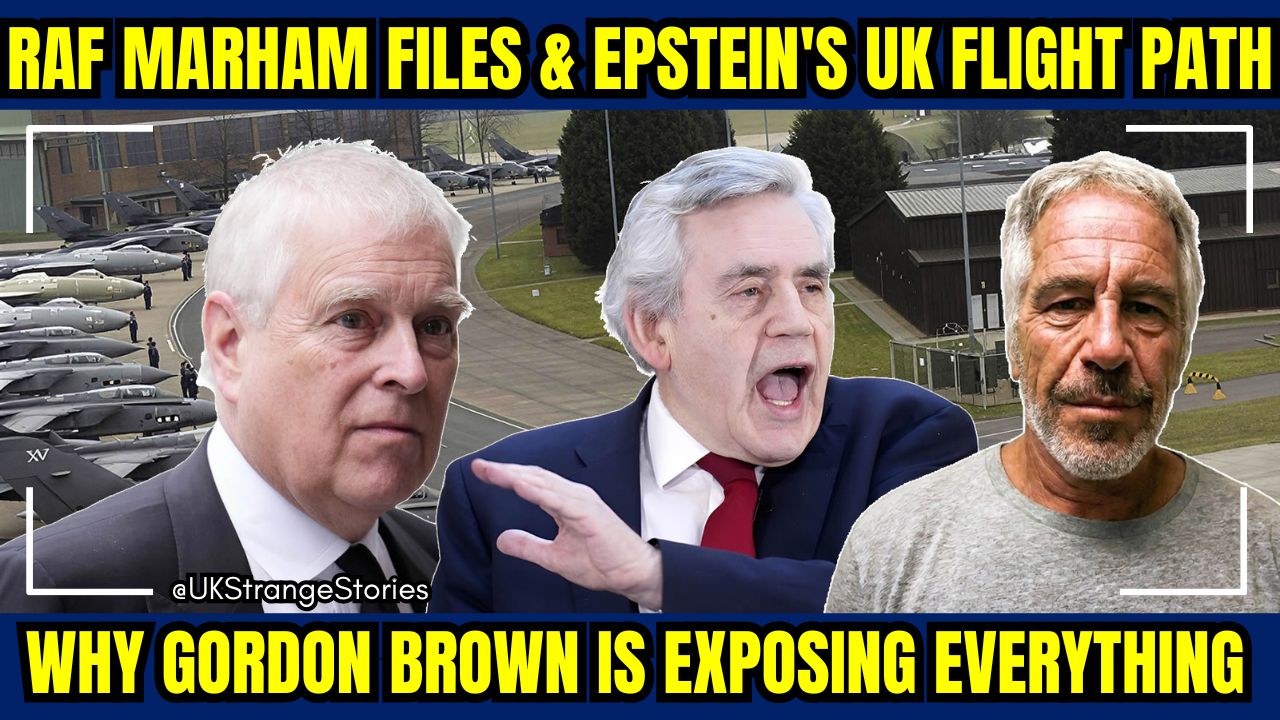
The quiet Norfolk countryside, home to the Royal Air Force base at Marham, has long been a bastion of British security. Yet, beneath its stoic facade, a shadow looms, cast by the controversial figure of Jeffrey Epstein and a perplexing flight that landed on its tarmac in December 2000. This seemingly isolated incident has now drawn the attention of former Prime Minister Gordon Brown, who, through a bombshell five-page dossier submitted to the police, is challenging the established narrative and risking his political standing to uncover what he believes is a far more intricate web of connections. The question at the heart of this unfolding drama is not merely about a single flight, but about the systemic vulnerabilities that may have allowed a convicted sex offender access to sovereign military installations, and the potential implications for the British establishment. This is the story of the RAF Marham Files, and why Gordon Brown is risking everything to expose Epstein’s UK flight path.
For years, the name Jeffrey Epstein has been synonymous with scandal, his network of influence stretching across continents and into the highest echelons of power. While much attention has focused on his activities in the United States, a lesser-known but equally disturbing aspect of his operations involved his frequent visits to the United Kingdom. Documents now suggest that Epstein’s private Gulfstream jet landed at RAF Marham, a high-security military base located just miles from the Royal Family’s Sandringham Estate, bypassing standard civilian customs procedures. This revelation, brought to light by Gordon Brown, raises critical questions about who facilitated such access and why a figure of Epstein’s notoriety was afforded such unusual privileges. The very notion of a private jet, belonging to an individual with a known history of serious offences, being granted entry to a military installation designed for national defence, speaks to a profound lapse in security protocols or, more troublingly, a deliberate bending of rules for a select few. The implications of such access extend beyond mere convenience, hinting at a deeper, more unsettling narrative where the lines between national security and private interests became dangerously blurred.
The Ministry of Defence, when initially questioned about these flights in October 2025, offered a seemingly innocuous explanation, stating that it was ‘standard practice for spare capacity at RAF airfields in the UK to be used for private or commercial aircraft, subject to fees which cover all costs.’ They further clarified that such use was ‘not automatic and will only be approved when there is no adverse impact to military aircraft and where approval would not interfere with the security or smooth running of the airfield.’ However, this explanation has failed to quell the growing unease, particularly in light of the nature of Epstein’s activities and the high-security environment of an RAF base. The suggestion that a convicted sex offender could so easily navigate these protocols points to a potential breakdown in oversight or, more disturbingly, a deliberate granting of ‘state-sanctioned anonymity.’ The lack of transparency surrounding these flights, coupled with the initial dismissive responses from official channels, has only fueled public suspicion, suggesting a concerted effort to downplay the significance of Epstein’s presence on British military soil. The public demands to know why a man like Epstein was afforded such extraordinary latitude, and what, if anything, was exchanged for these privileges.
Gordon Brown’s intervention is not a sudden impulse but the culmination of a deeper concern regarding the integrity of public office and the protection of vulnerable individuals. His five-page memorandum, submitted to several police forces including the Metropolitan, Surrey, Sussex, and Thames Valley constabularies, provides ‘new and additional information’ to previous submissions. Brown has urged a full investigation into Andrew Mountbatten-Windsor’s role as a UK trade envoy, questioning whether he used taxpayer-funded jets and RAF bases to meet Epstein. Andrew Mountbatten-Windsor, who served as a trade envoy from 2001 to 2011, has consistently denied any wrongdoing in relation to Epstein. However, the emerging details from the Epstein files, particularly an exchange in 2011 involving Ghislaine Maxwell and Epstein’s chief pilot, Larry, suggest a more direct involvement in facilitating Epstein’s access to military bases. In this exchange, Maxwell forwarded an inquiry from a journalist asking if Andrew had secured permission for Epstein to use military bases. Epstein’s response, ‘just spoke to Larry… it’s true,’ followed by Maxwell’s expletive-laden reply, hints at a concealed arrangement.
This particular exchange, unearthed from the vast trove of Epstein’s communications, serves as a chilling piece of evidence, suggesting a level of complicity and knowledge within certain circles that goes far beyond mere acquaintance. It raises profound questions about the extent to which individuals in positions of power were aware of, and potentially facilitated, Epstein’s movements and activities within the UK.
The scope of this investigation extends beyond a single flight or a single individual. The ‘Epstein UK Network’ is now under intense scrutiny, with connections being drawn to a broader European inquiry involving Peter Mandelson, a former EU trade commissioner. Mandelson was recently arrested on suspicion of misconduct in public office, and subsequently released on bail. The allegations against him are grave: that he shared sensitive EU financial data, specifically concerning a €500 billion bailout to save the euro in 2010, with Epstein. The European Commission has referred Mandelson to OLAF, the European anti-fraud office, to assess whether he broke the bloc’s rules. Mandelson’s lawyers have stated his cooperation with the UK police investigation and his priority to ‘clear his name,’ while he has previously expressed regret for his continued association with Epstein, apologising ‘unequivocally’ to Epstein’s victims. He maintains that none of the released emails indicate wrongdoing on his part. This alleged sharing of confidential information with a figure like Epstein, who was known for his intelligence-gathering activities, adds another layer of complexity to the unfolding narrative, suggesting that Epstein’s visits to the UK were not merely for pleasure, but potentially for high-level intelligence acquisition. The notion that a former EU commissioner might have divulged sensitive financial information to a figure like Epstein, whose motives were always shrouded in secrecy, paints a disturbing picture of potential influence peddling and the compromise of European financial stability. The ongoing OLAF investigation will be crucial in determining the veracity of these claims and the full extent of any breach of public trust.
The narrative of Epstein’s UK activities is further complicated by the existence of nearly 90 recorded flights linked to his private jet that either arrived in or departed from the UK. These flights, often referred to as the ‘Lolita Express,’ have been the subject of intense speculation, particularly concerning the ‘missing’ passengers and the identities of those who travelled with Epstein. The British establishment has, for two decades, seemingly sought to obscure the full extent of these movements. The question of who was on these flights, and what their purpose was, remains a critical unanswered piece of this intricate puzzle. The sheer volume of these flights, coupled with the alleged ‘misplaced’ flight logs, paints a picture of a deliberate effort to conceal the truth. The ongoing review by the Ministry of Defence into whether Epstein used RAF bases, initiated by Defence Secretary John Healey, is a direct response to the concerns raised by Gordon Brown and the public. This review aims to examine military records for any evidence of Epstein’s use of these bases for illicit activities. The persistent questions surrounding the passenger manifests of these flights, and the apparent lack of comprehensive records, fuel the suspicion that certain individuals were deliberately shielded from public scrutiny. The idea that such a significant number of flights could occur with incomplete or missing documentation within a sovereign nation’s airspace is a deeply troubling aspect of this saga, suggesting a coordinated effort to maintain secrecy at the highest levels.
The involvement of Andrew Mountbatten-Windsor in facilitating Epstein’s access to RAF bases is a particularly troubling aspect of this story. Reports suggest that Andrew ‘pulled strings’ to allow Epstein’s private jet to land at these sensitive locations. The implications of a member of the Royal Family allegedly using their influence to aid a convicted sex offender in accessing military installations are profound, raising serious questions about accountability and the abuse of power. The ongoing police investigation into Andrew’s conduct as a trade envoy, and the broader inquiry into the trade envoy role itself, seeks to shed light on these murky arrangements and determine the extent of any wrongdoing. The very fabric of public trust is tested when allegations of such a nature involve individuals at the pinnacle of society. The potential for a member of the Royal Family to have inadvertently or knowingly provided a conduit for Epstein’s activities within the UK demands a thorough and transparent investigation, not only to ascertain the facts but also to restore faith in the institutions that are meant to uphold justice and protect the vulnerable.
Gordon Brown’s decision to pursue this matter with such vigour is a testament to his belief in the importance of transparency and justice. His actions suggest a deep-seated conviction that the truth, however uncomfortable, must be brought to light. The former Prime Minister’s willingness to challenge powerful institutions and individuals underscores the gravity of the situation. This is not merely a political manoeuvre; it is a moral imperative to ensure that those who enabled Epstein’s activities are held accountable and that such abuses of power are prevented in the future. The intricate details of Epstein’s network, his alleged intelligence gathering, and the complicity of individuals within the British establishment are slowly but surely coming into focus. Brown’s unwavering commitment to this cause, despite the potential political ramifications, highlights the profound ethical dimensions of the Epstein scandal and its far-reaching implications for British society. His actions serve as a powerful reminder that even in the face of entrenched power, the pursuit of truth and justice remains paramount.
The story of the RAF Marham Files is a complex tapestry woven with threads of power, privilege, and deception. It is a narrative that challenges the public’s perception of justice and accountability, and one that demands a thorough and uncompromising investigation. The revelations brought forth by Gordon Brown, coupled with the ongoing inquiries into Peter Mandelson and Andrew Mountbatten-Windsor, paint a disturbing picture of a system that may have, wittingly or unwittingly, provided cover for Epstein’s nefarious activities. As the layers of secrecy are peeled back, the full extent of this scandal will undoubtedly emerge, forcing a reckoning with uncomfortable truths and demanding a full accounting from those who may have facilitated a predator. The public deserves to understand how such a profound breach of security and trust could have occurred, and what measures will be put in place to prevent its recurrence.
What are your thoughts on the unfolding revelations surrounding Jeffrey Epstein’s UK connections and the actions of figures like Gordon Brown? Share your perspective in the comments below and join the conversation on this critical investigation.