


HARARE – In a move that has reverberated across international markets, Zimbabwe has imposed an immediate and indefinite ban on the export of all raw minerals and lithium concentrates. Announced on Wednesday, 25 February 2026, by Minister of Mines and Mining Development Polite Kambamura, this decisive action includes all minerals already in transit, effectively halting a significant portion of the global supply chain for the critical battery metal. The decision, which accelerates a previously scheduled ban on lithium concentrates set for January 2027, has ignited a sudden panic among global consumers and sent lithium prices skyrocketing.
Zimbabwe, a nation endowed with Africa’s largest lithium reserves, has long sought to extract greater value from its vast mineral wealth. The government’s rationale behind the ban is multifaceted, centring on a push for “in-country value addition and beneficiation,” a commitment to “transparency, compliance, and accountability,” and a concerted effort to curb “malpractices during the exportation of minerals” and “leakages” within the system.
This is not Zimbabwe’s first attempt to assert greater control over its mineral resources. The pursuit of local processing, or beneficiation, has been a recurring theme in the nation’s mining policy for decades. Historically, Zimbabwe’s rich mineral deposits, including gold, diamonds, and now lithium, have been a source of both immense potential and persistent challenges. The colonial era saw the country’s mineral wealth as a primary driver for expansion, and post-independence governments have consistently aimed to transform Zimbabwe from an agro-based economy to one that fully leverages its mineral resources. However, these efforts have often been hampered by a lack of capital investment, inadequate infrastructure, and systemic issues such as corruption and smuggling.
The immediate impact of this ban has been a dramatic surge in global lithium prices. On 26 February 2026, the price of lithium rose to 173,000 Chinese Yuan per tonne (CNY/T), marking a significant 6.96% increase in a single day following Zimbabwe’s announcement. This sharp rise stands in stark contrast to the general downward trend experienced by lithium prices throughout 2024 and 2025, which saw spodumene prices plummet by over 80% between March 2023 and March 2024 after a period of unprecedented highs. The sudden reversal underscores the critical role Zimbabwe plays in the global lithium supply chain, particularly as the demand outlook for 2026 strengthens due to a booming battery storage market and continued growth in electric vehicle (EV) production.
The government’s decision to fast-track the ban, originally slated for January 2027, highlights the urgency with which Harare views the issue of mineral resource governance. A letter from the Ministry of Mines, dated 17 February, and seen by Reuters, informed Zimbabwe’s Chamber of Mines of the realignment of export processes, citing concerns over “continued malpractices during the exportation of minerals.” The letter further stated, “This review is part of a broader effort to curb leakages and enhance efficiency within our systems”. These “malpractices” are not new to Zimbabwe’s mining sector. Reports of widespread smuggling, particularly of gold, have long plagued the country, costing the treasury millions in lost tax and royalty revenues. Lithium smuggling, too, has become rampant since an initial ban on unprocessed lithium ore in 2022, with weak enforcement and pervasive corruption cited as key enabling factors. An Al Jazeera investigation in 2023 even exposed alleged “Gold Mafia” syndicates involving high-level officials, illustrating the deep-seated nature of these issues.
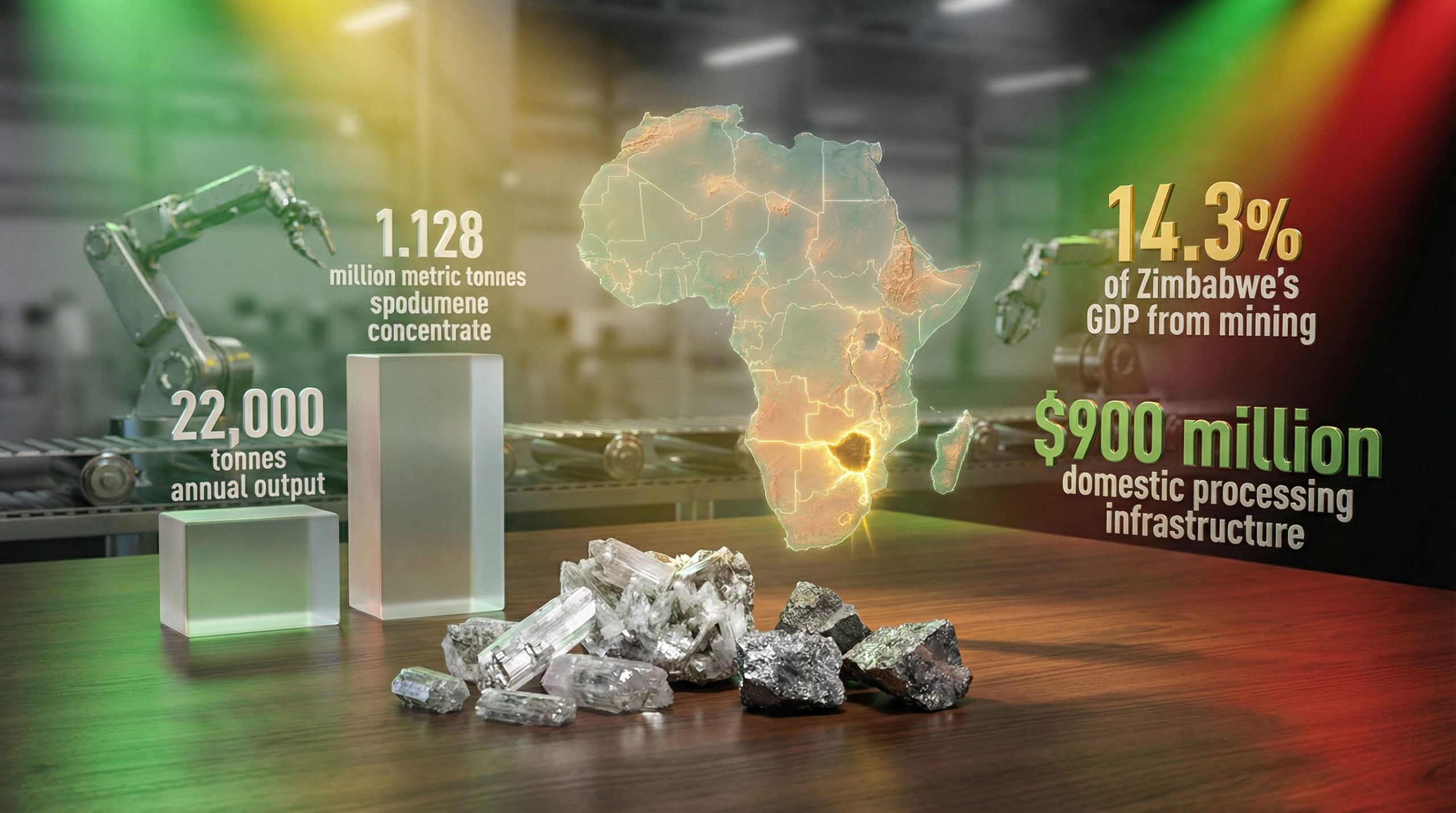
Zimbabwe’s lithium reserves are the largest in Africa, and the country has rapidly expanded its spodumene output in recent years. In 2025 alone, Zimbabwe exported 1.128 million metric tonnes of lithium-bearing spodumene concentrate, an 11% increase from the previous year. The vast majority of this concentrate is shipped to China for further processing into battery-grade materials such as lithium hydroxide or lithium carbonate. This dependency on China for processing has been a point of contention for the Zimbabwean government, which seeks to capture more of the value chain within its own borders. Major Chinese mining firms, including Zhejiang Huayou Cobalt, Sinomine, Chengxin Lithium Group, and Yahua, have made significant investments in Zimbabwe’s lithium sector. Zhejiang Huayou Cobalt, for instance, recently constructed a $400 million plant to process lithium concentrates into lithium sulphate, an intermediate product. Similarly, Sinomine has announced plans for a $500 million lithium sulphate plant at its Bikita mine. These investments, while substantial, have not fully addressed the government’s desire for comprehensive in-country beneficiation.
The ban places Zimbabwe squarely within a growing global trend of resource-rich nations tightening controls over strategic minerals. Countries like Namibia, which banned the export of unprocessed critical minerals in June 2023, and Indonesia, which successfully implemented a ban on raw nickel exports between 2020 and 2023 to force domestic smelting investments, serve as precedents for Zimbabwe’s current policy.
These nations are increasingly asserting their resource sovereignty, aiming to move beyond being mere suppliers of raw materials to becoming key players in the value-added processing of critical minerals. The global scramble for rare earths and other strategic minerals, essential for smartphones, green energy systems, and military equipment, has intensified, making such nationalistic resource policies more impactful than ever. Even geopolitical rivals are engaging in similar tactics, as evidenced by China’s December 2024 ban on exports of gallium, germanium, and antimony to the United States. Data from the Organisation for Economic Co-operation and Development (OECD) reveals that between 2021 and 2023, 14% of global trade in non-waste and scrap industrial raw materials faced at least one export restriction, underscoring the widespread nature of this phenomenon.
The implications for the global electric vehicle supply chain are profound. With most of Zimbabwe’s lithium destined for processing in China, the ban necessitates a rapid shift in the supply chain, requiring processing to occur within Zimbabwe before the material can reach international markets. This sudden disruption comes at a time when the EV battery supply chain is already facing systemic risks, with reports in early 2026 warning of potential threats to the deployment of electric transportation. The ban could lead to short-term global lithium supply shortages, further exacerbating price volatility and reshaping existing supply chains.
Beyond the macroeconomic impacts, the lithium rush in Zimbabwe has also brought significant social and environmental challenges. The discovery of lithium, particularly at sites like the Sandawana mine, has triggered informal “lithium rushes,” drawing in tens of thousands of artisanal miners. These artisanal operations are often characterised by unsafe working conditions, including reports of child labour, a lack of basic sanitation, and dangerous mining practices. Environmentally, the rapid expansion of lithium mining has led to habitat destruction, water pollution, and soil degradation, with many operations proceeding without adequate environmental impact assessments. Furthermore, communities have been displaced to accommodate large-scale mining projects, frequently without sufficient compensation or social protections, raising concerns about environmental justice and human rights.
Minister Kambamura stated that the government “will be engaging the industry in the near future on new expectations and way forward”. This suggests that while the ban is immediate, there may be avenues for mining companies to comply by investing further in local processing capabilities. The success of this policy will hinge on Zimbabwe’s ability to attract and manage these investments, enforce regulations effectively, and address the underlying issues of corruption and smuggling that have historically undermined its mining sector. The world watches closely as Zimbabwe attempts to leverage its mineral wealth for national development, a move that could redefine its economic future and significantly alter the global landscape of critical mineral supply.