


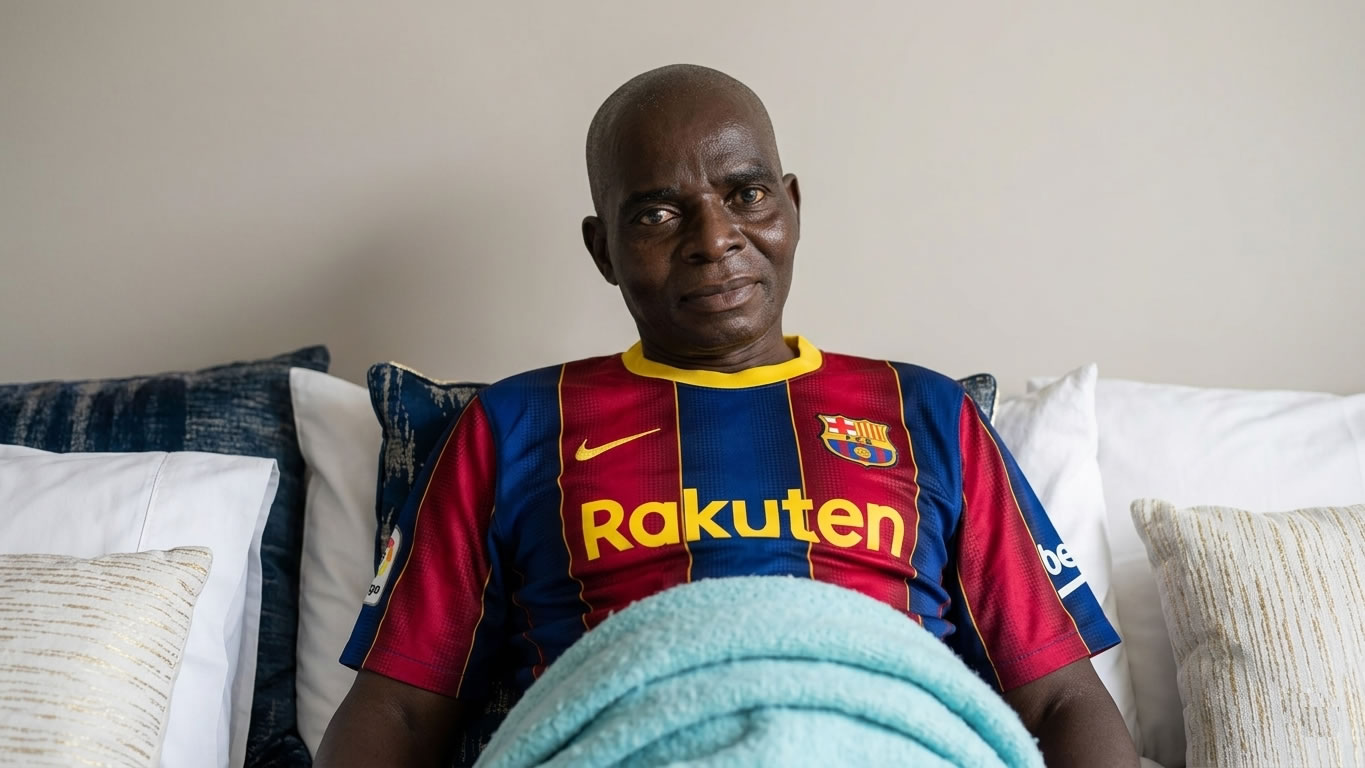
CHITUNGWIZA – In the bustling streets of Unit L, a dormitory town some thirty kilometres south-east of Harare, the name Shadreck Karichi has become a sombre cautionary tale. For Karichi, a fifty-five-year-old former municipal worker, a brief dalliance with a married woman has culminated in a medical and spiritual nightmare that defies conventional science. He sits today, a shadow of his former self, claiming that his manhood has quite literally vanished—the victim, he believes, of a potent traditional spell known as runyoka.
“As someone who worked for the Chitungwiza Municipality, in the bin collection department, I was earning a good salary,” Karichi reflects with a heavy regret that permeates the small room where he now spends most of his days. “In 2024, I met a woman who was self-employed here in Chitungwiza, and we started a relationship.”
What began as a clandestine affair soon spiralled into a sequence of events that has left Karichi bedbound and pleading for mercy. The woman, known to him only as Mai Gire, allegedly lured him into a trap of unprotected sex. “During the three months that we were together, we met three times without protection because this woman, whom I only knew as Mai Gire, didn’t want to use protection,” Karichi explains. It was a choice he would soon come to rue.
The first signs of trouble were deceptive. Karichi noticed a small boil on his private parts. Assuming it was a common sexually transmitted infection, he attempted to treat it himself by bursting it, only to find that it contained nothing but water. But the situation rapidly deteriorated. “When I met this woman and we started a relationship, she said she had divorced her husband, and then jokingly said that her husband had used muti (traditional medicine/spell) on her to put runyoka on her. I didn’t take it seriously, and we started sleeping together without protection,” he admits.
The “joke” soon turned into a horrific reality. His testicles and penis began to swell alarmingly. Desperate, he sought help at Chitungwiza Central Hospital, but the clinical environment of white coats and stethoscopes offered no answers. No known illness was detected. “I was just given injections, which helped a little,” Karichi says. “My penis eventually shrank completely, and then sores appeared, which ate away at it until it disappeared. I have nothing left; it’s just bare skin. A sore ate away at the whole ‘father’.”
The Shadow of ‘Central Locking’
To the uninitiated, Karichi’s story might sound like the plot of a folk horror film. However, in Zimbabwe, runyoka—often colloquially referred to as the “central locking system”—is a deeply entrenched cultural belief. It is a form of traditional “fencing” or “locking” used primarily by husbands who suspect their wives of infidelity, though it is also used by wives against husbands. The spell is designed to punish any interloper who dares to cross the threshold of a marriage.
According to George Kandiyero, the president of the Zimbabwe National Traditional Healers Association (ZINATHA), cases like Karichi’s are not as rare as one might hope. “Runyoka is a reality in our culture,” Kandiyero states. “It is a traditional deterrent meant to preserve the sanctity of marriage. When someone ignores the warnings and enters into a relationship with a ‘locked’ person, the consequences are severe and often irreversible without the involvement of the person who cast the spell.”
The case of Karichi is a textbook example of runyoka rwekushinya, a specific variation where the genitals of the adulterer are targeted for destruction or disappearance. But it is far from the only type. Zimbabwean lore and recent news reports are littered with accounts of runyoka rwebanga, often called the “dog style” spell, where lovers find themselves physically stuck together during the act of adultery, unable to separate until the husband arrives to perform a ritual—often involving a public shaming that serves as a permanent mark of disgrace.
A Trail of Incidents
The phenomenon is not confined to the borders of Chitungwiza. In August 2024, a man named Nelson Matupire made headlines when he reportedly set up camp at his married lover’s home. Matupire claimed he had been “locked” and refused to leave until the woman’s husband agreed to cleanse him of the spell. In another harrowing incident in Bulawayo, a sixteen-year-old boy claimed that a snake was entering his body through his foot and “eating his privates” following an encounter with a married woman.
These incidents highlight a growing tension between modern legal systems and traditional justice. While the Zimbabwean courts often view such matters through the lens of assault or extortion, for many in the community, runyoka remains a valid, albeit terrifying, form of moral policing.
For Karichi, the debate over the validity of the spell is secondary to his daily agony. He is now always wrapping a bandage around his groin, where a large, stubborn sore remains. The physical toll has been catastrophic. “I can no longer walk; I am always lying down,” he laments. “Prophets and traditional healers are saying that this woman is the only one who can save me because rituals need to be performed using her clothes and her urine for me to drink.”
The Search for Mai Gire
The woman at the centre of the storm, Mai Gire, has vanished. Karichi believes she fled to her rural home in Murewa. Her disappearance has left him in a state of limbo, as traditional protocol dictates that only she—or the husband who initiated the spell—can provide the cure.
His family has been left to pick up the pieces. Mirica Karichi, Shadreck’s fifty-three-year-old sister, has become his primary caregiver. “My brother initially hid this illness until it became clear,” she says. “He has even left his job now at Chitungwiza Municipality. The woman he was in a relationship with left some of her clothing at my house, which we are soaking in water, and then occasionally giving him the water to drink, just trying what we hear.”
The indignity of the situation is not lost on Shadreck. “I am no longer ashamed because my sister is washing this wound for me; she goes everywhere with me, trying to help me,” he says. In his fifty-five years, Karichi has had five wives and four children, but his pursuit of “too much love” has brought him to a place of absolute repentance.
“If I find someone who can cure me, I won’t be promiscuous again. I am now even afraid of women,” he declares. “I am warning other men to stop being proud and wanting to sleep with every woman they meet in the streets. I have repented. I sleep in pain, and the way to urinate is blocked; I have even had a tube inserted to drain the urine. The passage for passing stool was once blocked, but I was helped by others, and it started working well.”
A Community in Reflection
The story has sparked intense debate in Chitungwiza. While some view Karichi as a victim of a cruel and archaic practice, others see his plight as a just consequence for his actions. “I am also pleading with women not to lie to men who court them in the streets that they don’t have husbands; they should also tell the truth about their situation,” Karichi adds, his plea directed at the very demographic he once pursued so relentlessly.
The Zimbabwe National Traditional Healers Association continues to urge the public to be cautious. George Kandiyero notes that while runyoka is a powerful tool, it is often abused by “fly-by-night” practitioners who take advantage of desperate people. “Karichi needs to be helped traditionally,” Kandiyero insists. “But it is necessary for the woman he was in a relationship with to be found so that traditional medicines can be mixed with her urine as a way to reverse the runyoka spell.”
As the sun sets over the dusty roads of Unit L, Shadreck Karichi remains a prisoner in his own home, waiting for a woman who may never return. His story serves as a grim reminder of the invisible threads of tradition that still bind modern Zimbabwean society—and the heavy price some pay for ignoring them.
Reporters said when they opened Karichi’s bandage, they saw “nothing in the place of his penis except for a closed wound; it was just bare skin.” It is an image that will likely haunt the men of Chitungwiza for years to come. For Karichi, however, the haunting is not a memory, but a permanent, painful reality.