


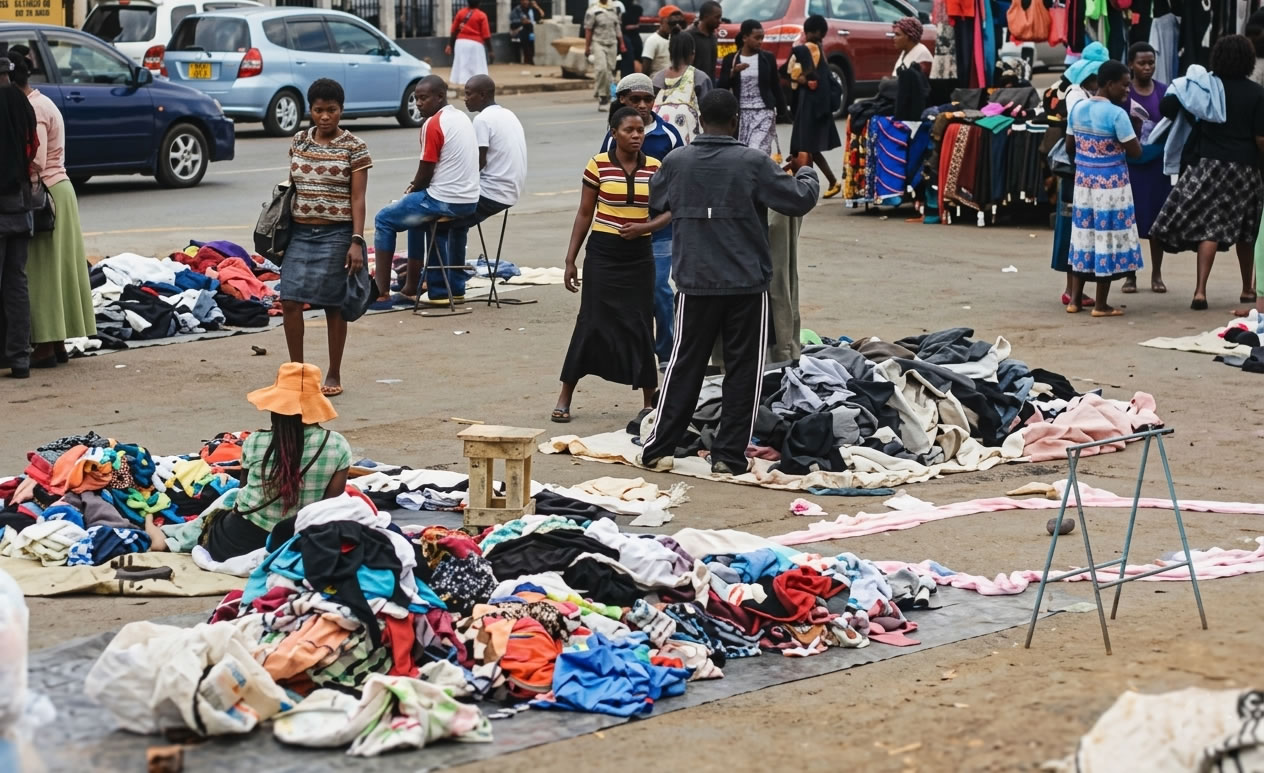
HARARE – For decades, the rhythmic thud of heavy bales hitting the dusty ground at Mupedzanhamo Flea Market in Mbare was the heartbeat of Zimbabwe’s informal economy. These bales, known locally as “mabhero,” carried more than just discarded garments from the West; they carried the hopes of millions of families who could not afford the luxury of a new shirt from a high-street boutique. But that heartbeat is being silenced.
The Government of Zimbabwe has officially legalised a total ban on the importation of second-hand clothes and shoes. Under the newly gazetted Statutory Instrument 59 of 2026, the trade that has clothed the nation for a generation is now a criminal offence unless one possesses a near-impossible-to-obtain government permit. While the official narrative speaks of “protecting the local textile industry” and “restoring national dignity,” a deeper investigation reveals a more calculated and perhaps more cynical reality.
The timing of this legislative hammer-blow is not accidental. It coincides with the multi-million-dollar resuscitation of David Whitehead Textiles, once a state-owned giant, now revived under the wings of Agri Value Chain Zimbabwe (AVCZ). With over US$20 million poured into new machinery at plants in Kadoma and Chegutu, the stage is set for a new monopoly. But for the millions who rely on the “bhero” ecosystem, this is not a revival; it is a funeral.
The Death of a Survival Ecosystem
Mupedzanhamo, which literally translates to “The Ender of Poverty,” has lived up to its name for the destitute. It was a place where a single mother could buy a bale for US$150 and, through weeks of tireless hawking, turn it into school fees, rent, and food. Now, the gates are often locked, and the stalls are empty, patrolled by police officers enforcing the new decree.
“This is not just about clothes,” says Mai Tatenda, a trader who has operated at Mupedzanhamo for fifteen years. “This is about our lives. They tell us to buy Zimbabwean, but where is the money? A simple school uniform in the shops costs US$25. I can get a better quality one from a bale for US$3. The government is not protecting us; they are suffocating us.”
The economic impact is staggering. With over 80 per cent of Zimbabwe’s employable population eking out a living in the informal sector, the “bhero” trade was one of the few remaining safety nets. By banning these imports, the government is effectively dismantling a multi-million-dollar informal value chain that supported transporters, clearers, tailors, and hundreds of thousands of vendors.
The Shadow of Monopoly: Who Really Benefits?
The Ministry of Industry and Commerce justifies the ban as a necessary step to revive the local clothing value chain. “The ban is intended to help protect local textile and shoe companies, which have struggled against cheap, unregulated imports,” an official statement reads.
However, market analysts are sceptical. Zimbabwe’s clothing industry currently lacks the capacity to meet even half of the domestic demand. Cotton production, though improving, remains far below the peaks of the 1990s. Most of the “new” clothing in Zimbabwean shops is not locally made; it is imported from China. Curiously, these cheap Chinese imports remain largely untouched by the new regulations, while the second-hand trade—the only affordable option for the poorest—is targeted with surgical precision.
The “hidden details” suggest that the ban is less about the textile industry as a whole and more about ensuring a captive market for the newly revived giants. Agri Value Chain Zimbabwe (AVCZ), led by Chairman Pradyum Kumar Ganediwal, has taken a controlling 51 per cent stake in David Whitehead. While the investment is touted as a victory for the “Buy Zimbabwe” campaign, the reality is that it creates a environment where the poor have no choice but to buy from a single, politically-aligned source. By removing the competition of high-quality, low-cost second-hand garments, the government is clearing the path for these entities to dominate the market.
A Glaring Inconsistency in Policy
One of the most frustrating aspects for citizens is the glaring inconsistency in government policy. While the importation of second-hand clothes is strictly banned, the government recently granted a reprieve for “monthly import licences” for various household items. This “licence to live” allows those with means to bring in goods, while the “mabhero” ban targets the very items the poor cannot do without.
“Why is a second-hand shirt a national threat, but a luxury imported fridge is not?” asks an economist who requested anonymity. “The answer lies in who controls the markets. The poor do not have a lobby group in the corridors of power. The textile moguls do. They have successfully lobbied for a ban that eliminates their only real competition: the affordability of the bale.”
Furthermore, the government’s own data underscores the scale of reliance on foreign apparel. According to Trading Economics, Zimbabwe imported clothing worth approximately US$1.37 million from China in 2024 alone. If the goal was truly to “protect local industry,” why are these massive inflows of new, cheap garments not subjected to the same draconian restrictions as the second-hand trade? The answer, many believe, is that the second-hand trade is the only one that truly empowers the informal trader, a group the government has long sought to “formalise” or, more accurately, control.
The Rise of “Black Gold” and Border Corruption
As with any prohibition, the ban is not stopping the trade; it is merely driving it underground and into the hands of criminal syndicates. Smuggling routes are already being established along the porous borders with Mozambique and South Africa. “Bhero” has become the new “black gold.”
At border posts like Mutare and Chirundu, the stakes have never been higher. Reports are already emerging of increased corruption, with border officials allegedly taking bribes to look the other way as trucks laden with bales cross under the cover of darkness. The ban has not removed the demand; it has only increased the price and the risk, ensuring that the only people profiting are the smugglers and the corrupt officials who facilitate them.
Zimbabwe is already losing up to US$1 billion in revenue annually to smuggling along its porous borders. This new ban will only exacerbate the problem. Instead of tax revenue from legitimate traders, the money will now flow into the pockets of “mshika-mshika” operators and corrupt security personnel. The very industry the government claims to be protecting will find itself competing not against legitimate second-hand traders, but against a flood of untaxed, smuggled goods.
The Human Cost: Raids and Resentment
Recent police operations have seen “door-to-door” raids in townships like Mbare and Highfield, with security forces seizing bales from private homes. These scenes have sparked widespread resentment. “They come into our homes like we are hiding drugs,” says one resident. “But we are just trying to dress our children. My husband lost his job at the factory five years ago. We survived because of these clothes. Now they want us to steal?”
The social fabric of communities like Mbare is being torn apart. The Mupedzanhamo ecosystem was not just about selling clothes; it was a community hub where information was shared, and social safety nets were woven. By criminalising this trade, the government is pushing thousands of law-abiding citizens into the shadows of the “illegal” economy.
The Hollow Promise of “National Dignity”
The government often frames the ban as a matter of “national dignity,” arguing that Zimbabweans should not wear the “discarded rags” of the West. But for a father who cannot afford to buy his son a pair of trousers for Christmas, dignity is found in being able to provide, regardless of the garment’s origin.
“Dignity is not a brand new shirt you cannot afford,” says a community leader in Mbare. “Dignity is having a job and being able to clothe your family. By taking away Mupedzanhamo, they have taken away the last bit of dignity many people had left. You cannot eat dignity, and you cannot wear a slogan.”
The “Buy Zimbabwe” campaign continues to be rolled out in glossy advertisements, but the reality on the ground is one of increasing desperation. The local industry, even with its new investments, is years away from being able to provide affordable, quality clothing for the masses. Most local factories are still using outdated machinery and face high production costs, making their products twice as expensive as the “mabhero” they seek to replace.
A History of Failed Bans
This is not the first time the government has attempted to ban second-hand clothes. In 2015, a similar move was blocked by Parliament after it was described as a “death sentence” for the poor. The fact that the government has now returned to this policy, but with the added weight of legal formalisation through Statutory Instruments, suggests a renewed determination to enforce a monopoly at any cost.
“We have seen this before,” says a veteran journalist who has covered the textile industry for decades. “Every few years, a new ‘investor’ comes along, promises to revive the industry, and the first thing they ask for is a ban on second-hand clothes. The industry never actually recovers to its former glory, but the investors make their millions while the poor are left with no options.”
Conclusion: The Chasm of Poverty
The ban on “mabhero” is more than just a trade policy; it is a litmus test for the government’s commitment to its most vulnerable citizens. By prioritising the interests of a few industrial giants over the survival of millions in the informal sector, the legislation risks widening the chasm of poverty that already threatens to swallow the nation.
As the sun sets over the now-quiet stalls of Mupedzanhamo, the silence is a haunting reminder of what has been lost. The “Real Reason” for the ban may be found in the balance sheets of the new textile moguls, but the real cost will be paid by the ordinary Zimbabwean, who now finds that even the simple act of getting dressed has become a political battleground.
The government may have legalised the ban, but in the court of public opinion, the verdict is already in: you cannot build a local industry on the broken backs of the poor. Until the “Buy Zimbabwe” promise includes an “Afford Zimbabwe” reality, the “mabhero” will remain the lifeblood of the nation, whether the law allows it or not. The “black gold” will continue to flow through the bushes and over the fences, a testament to a people who refuse to be stripped of their last remaining means of survival.