


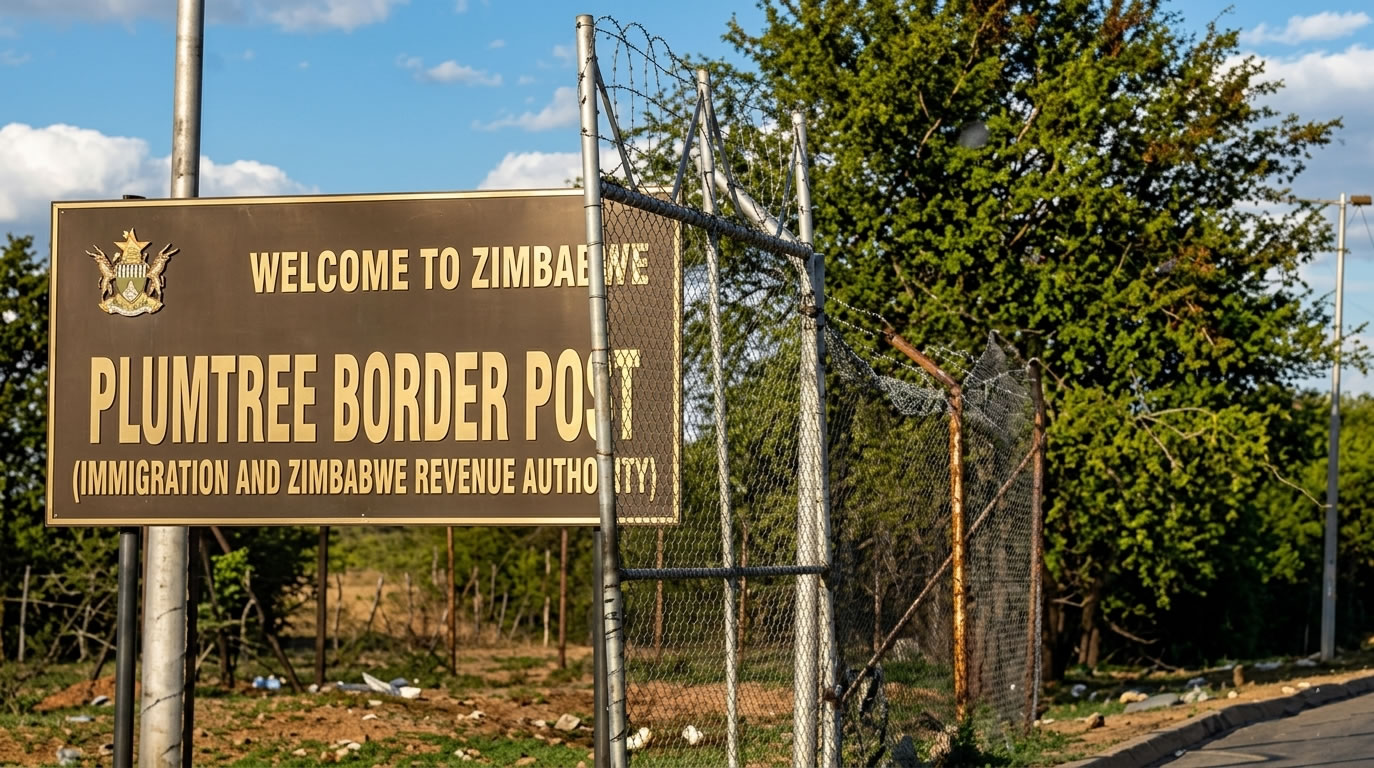
PLUMTREE – On a sweltering afternoon at the Plumtree Border Post, a routine customs inspection by Zimbabwe Revenue Authority (ZIMRA) officials took a turn from the mundane to the chilling. Amidst the usual clutter of cross-border trade—second-hand clothes, basic groceries, and electronic parts—officers stumbled upon a concealed, undeclared firearm hidden deep within a traveller’s suitcase. In most democratic nations, the discovery of an illegal weapon at a major entry point would trigger a national security alert, followed by a televised press briefing and a transparent investigation. In Zimbabwe, however, the incident was relegated to a footnote in the local news, buried beneath reports of road accidents and livestock theft.
The “quiet” surrounding this interception is not just unusual; it is deafening. Our investigative team has spent weeks tracing the ripples of this event, asking the questions the authorities refuse to answer: who was that gun for, and where was it going? As the political temperature rises over the controversial “ED2030” agenda, the Plumtree discovery hints at a much darker reality— a shadow security state arming itself in the silence of the night.
The “Weak Link” in the Chain
Plumtree has long been considered the “weak link” in Zimbabwe’s border security. While the Beitbridge Border Post to the south receives the lion’s share of surveillance technology and manpower, the western crossing into Botswana remains porous. Smugglers have mastered the art of “bush-running,” using private cars to ferry illicit goods through the thick scrubland that skirts the official checkpoint.
“A routine customs inspection yesterday led to the discovery of a concealed and undeclared firearm hidden in a traveller’s suitcase at the Plumtree Border Post,” a ZIMRA official stated briefly, before declining further comment. The “undeclared” status of the weapon is a crucial detail. This was not a misplaced hunting rifle or a forgotten heirloom; it was a deliberate attempt to bypass the state’s registry.
The sophistication of the concealment suggests that this was not the work of a desperate petty criminal or a small-time smuggler looking for personal protection. Investigative sources within the border town suggest that the Plumtree route is increasingly being used for “special consignments”—items too sensitive for the high-traffic, high-scrutiny environment of Beitbridge. The firearm intercepted is believed to be part of a larger, fragmented shipment, a common tactic used by international arms traffickers to ensure that if one piece is caught, the rest of the puzzle remains hidden and the loss is minimised.
Furthermore, the lack of transparency regarding the make and model of the weapon has raised eyebrows among security experts. “If it were a standard handgun used by common criminals, there would be no reason to hide the details,” explains a retired intelligence officer now living in Botswana. “The secrecy suggests it might be a specialised piece of equipment—perhaps something compatible with the standard-issue gear of certain units, or conversely, something completely foreign that leaves no paper trail back to the state’s official armouries.” This ambiguity fuels the suspicion that the Plumtree ‘leak’ is merely a glimpse into a much larger logistical operation aimed at bypassing official oversight.
The geographical layout of Plumtree itself aids these clandestine activities. The border town is surrounded by a network of informal paths known locally as ‘shortcuts,’ which cut through private farms and communal lands. These routes are often guarded not by the state, but by local syndicates who have reached an ‘understanding’ with certain elements of the security forces. For a fee, a vehicle can be guided through the bush, avoiding the scanners and the prying eyes of the few honest officials left at the main post. This infrastructure of illegality is what makes Plumtree the ideal entry point for the shadow security state’s requirements.
The Shadow of ED2030
To understand why a single gun in Plumtree matters, one must look at the broader political landscape of Zimbabwe in 2026. The nation is currently gripped by the “ED2030” movement—a push by loyalists of President Emmerson Mnangagwa to amend the constitution, extending his tenure beyond the current two-term limit. On 10 February 2026, the cabinet officially backed draft legislation to extend presidential terms from five to seven years, a move that would keep Mnangagwa in power until at least 2030.
This constitutional “reshuffle” has not gone down without a fight. Internal fissures within the ruling ZANU-PF party have widened into chasms. Tensions between the President and his Vice President, Constantino Chiwenga—the former general who led the 2017 coup—have reached a breaking point. Public accusations of corruption and the looting of billions from party coffers have become the new normal in Harare.
“The coup has formally stripped away the façade that Zimbabwe is a constitutional state. This is clearly a militarised party-state where the threat of violence is the ultimate political currency,” noted one political analyst who requested anonymity for fear of retribution.
In this climate, the interception of a firearm takes on a sinister hue. There are growing concerns about the emergence of “private militias”—groups of political “enforcers” who operate outside the official chain of command of the Zimbabwe National Army (ZNA) or the Republic Police. If the official security forces are divided by factional loyalties, the need for a private, “shadow” security apparatus becomes paramount for those seeking to hold onto power at all costs.
Patterns of a “Shadow Security” State
The Plumtree incident is not an isolated event. It fits into a disturbing pattern of firearm “leaks” and illegal acquisitions that have spiked since the ED2030 agenda took centre stage. Despite a month-long Presidential Gun Amnesty that ended on 24 October 2025, which urged the public to surrender unregistered weapons, the flow of illegal arms into the country has seemingly accelerated.
The “smuggling routes” are well-oiled machines. They are used by both traditional criminal syndicates and political actors who require “deniable” assets. By arming these enforcers with undeclared weapons, the state or its factions can maintain a layer of separation from the violence that often accompanies political “stabilisation.”
Recent incidents across the country’s borders highlight the scale of the challenge. While South African military forces have enhanced operations along the Limpopo River to halt smugglers and illegal crossings, the western border remains a playground for those with the right connections. The Plumtree interception proves that the “gatekeepers” are sometimes watching, but for every gun found, how many more have slipped through the “bush-runs” and into the hands of those waiting in the shadows?
Consider the case of the 800 bottles of BronCleer cough syrup seized at Beitbridge earlier this year. While seemingly unrelated, the logistics of smuggling pharmaceuticals and firearms often overlap. The same networks that move illicit drugs are frequently co-opted for more dangerous cargo. “The routes are the same, the bribes are the same, and the people at the top are often the same,” says a local journalist who has covered border crime for a decade. The transition from smuggling consumer goods to military-grade hardware is a natural progression for syndicates that operate with a degree of official protection.
In another incident in late 2025, reports emerged of ‘rogue’ police officers involved in lucrative cross-border trade near Plumtree. These officers were allegedly facilitating the movement of private cars through the bush for a fee. If the very people tasked with upholding the law are instead managing the bypasses, then the ‘security’ of the border is nothing more than a profitable illusion. This environment of institutionalised corruption provides the perfect cover for the arming of private militias, as the line between a criminal shipment and a political one becomes increasingly blurred.
The historical context of the Plumtree-Botswana corridor also plays a role. During the liberation struggle, this area was a key transit point for guerrillas and supplies. Today, that legacy of clandestine movement has been repurposed for the internal power struggles of the post-colonial state. The memory of ‘the bush’ as a space outside of state control remains potent, and it is being exploited by those who understand that in Zimbabwe, power is often seized and held in the margins, far from the glare of international observers.
A Conspiracy of Silence
The government’s refusal to provide a comprehensive report on the Plumtree interception is telling. When a state stays silent on a matter of national security, it is usually because the truth is either embarrassing or incriminating. If the weapon was destined for a criminal gang, the authorities would typically parade the suspects before the media to showcase their “vigilance.” The lack of such a display suggests that the trail leads to a destination the government would rather not discuss.
The “quiet” is a tactic, a deliberate strategy of containment. By treating the interception as a minor customs issue, the authorities hope to avoid drawing attention to the “hidden arms race” happening under our noses. This is not just a story about a gun; it is a story about the erosion of the rule of law and the preparation for a potential conflict that many fear is inevitable as the 2030 deadline approaches. The silence allows the state to maintain a facade of stability while the foundations of that stability are being systematically dismantled from within.
Moreover, the silence serves to protect the identities of those involved. In a country where the intelligence services are known for their efficiency, the failure to identify the intended recipient of the Plumtree firearm is a choice, not an oversight. “In Zimbabwe, nothing happens at the border without someone in Harare knowing about it,” asserts a former diplomat. “If they aren’t talking, it’s because they already know the answer, and the answer is too dangerous to share with the public.” This lack of accountability is what allows the shadow security state to flourish, as it operates in the gap between what the law requires and what the political reality dictates.
The psychological impact of this silence on the local community cannot be overstated. Residents of Plumtree live with the constant knowledge that their town is a transit point for dangerous secrets. “We see the cars with no plates, we see the men who don’t belong here, and then we read about a gun being found,” says a local shopkeeper. “But we don’t talk about it. Talking gets you noticed, and being noticed is the last thing you want.” This culture of fear is the ultimate tool of the shadow state, ensuring that even when the truth is stumbled upon, it remains buried in the silence of the borderlands.
The people of Plumtree and the wider Zimbabwean public deserve more than a brief mention in a “local news” section. They deserve to know who is arming the border and why. They deserve to know if the peace they currently enjoy is merely the silence before a storm, as factions within the state arm themselves for a constitutional showdown.
The Human Cost of the Hidden Race
As we look at the patterns of these “leaks,” we must also consider the profound human cost. The proliferation of illegal firearms in a country already burdened by extreme economic instability, hyperinflation, and deep-seated political tension is a recipe for a humanitarian disaster. The “enforcers” being armed today—whether they belong to the ruling party’s youth wings or more formalised private security firms—are the same individuals who will be used to suppress dissent, intimidate voters, and maintain ‘order’ during the upcoming constitutional upheavals.
The impact on the youth is particularly concerning. In an economy with few opportunities, the role of a political ‘enforcer’ offers a steady income and a sense of power. By arming these young men, the state is not just preparing for a political battle; it is poisoning the social fabric of the nation for generations to come. “We are creating a culture where the gun is the only way to get things done,” laments a community leader in Matabeleland. “When the politics is over, the guns will still be there, and the men who used them will still know how to kill. What happens to our country then?”
Furthermore, the focus on arming the border and the interior diverts precious resources away from essential services. While millions are spent on the logistics of the shadow security state, hospitals go without basic medicines and schools crumble. The firearm intercepted at Plumtree represents more than just a threat of violence; it represents a betrayal of the Zimbabwean people’s right to a peaceful and prosperous future. Every dollar spent on an undeclared weapon is a dollar stolen from a child’s education or a grandmother’s healthcare. This is the true price of the ED2030 agenda—a price that the citizens of Zimbabwe are being forced to pay with their safety and their dignity.
The Plumtree Border Post, with its dusty roads and weary travellers, remains the silent witness to this unfolding drama. The ZIMRA officials who found the gun did their jobs, but the system they serve seems intent on burying their discovery.
In the coming months, as the ED2030 bill moves through parliament and the constitutional changes are forced through, the significance of that single, undeclared firearm in Plumtree will become clearer. It was a warning shot—a sign that the “shadow security” state is no longer a theory, but a reality being built one concealed suitcase at a time.
We will continue to monitor the “smuggling routes” and the “private militias” that inhabit them. The government may choose to stay silent, but the evidence found in a traveller’s suitcase speaks volumes. The question remains: when the “ED2030” tension finally boils over, whose hands will be on those triggers, and what will be the price for Zimbabwe’s silence?
Timeline of Related Incidents:
|
Date
|
Incident
|
Location
|
Significance
|
|
24 Oct 2025
|
Presidential Gun Amnesty Ends
|
Nationwide
|
Attempt to retrieve illegal arms fails to stem the flow.
|
|
19 Oct 2025
|
ZANU-PF Resolves to Extend Term
|
Harare
|
Formal start of the ED2030 political push.
|
|
7 Jan 2025
|
S.A. Enhances Border Operations
|
Limpopo
|
Increased pressure on Beitbridge pushes smugglers to Plumtree.
|
|
10 Feb 2026
|
Cabinet Backs 7-Year Term Extension
|
Harare
|
Constitutional amendment bill officially moves forward.
|
|
2026 (Recent)
|
Firearm Interception
|
Plumtree
|
Discovery of concealed weapon hints at shadow arming.
|
Key Figures and Factions:
- Emmerson Mnangagwa: Current President, whose faction is pushing for the ED2030 constitutional extension.
- Constantino Chiwenga: Vice President, former General, leading the opposing faction within ZANU-PF.
- ZIMRA: The frontline agency tasked with intercepting illicit goods, often operating under immense political pressure.
- Private Militias: Informal groups of “enforcers” believed to be receiving undeclared weapons for political purposes.
Conclusion
The Plumtree firearm interception is a microcosm of the larger struggle for the soul of Zimbabwe. It represents the intersection of criminal opportunism and political desperation. As long as the government remains silent, the “shadow security” state will continue to grow, arming itself for a future where the ballot box may no longer be the final arbiter of power. The “quiet” is indeed deafening, and for those who care about the future of this nation, it is a sound that should not be ignored.