


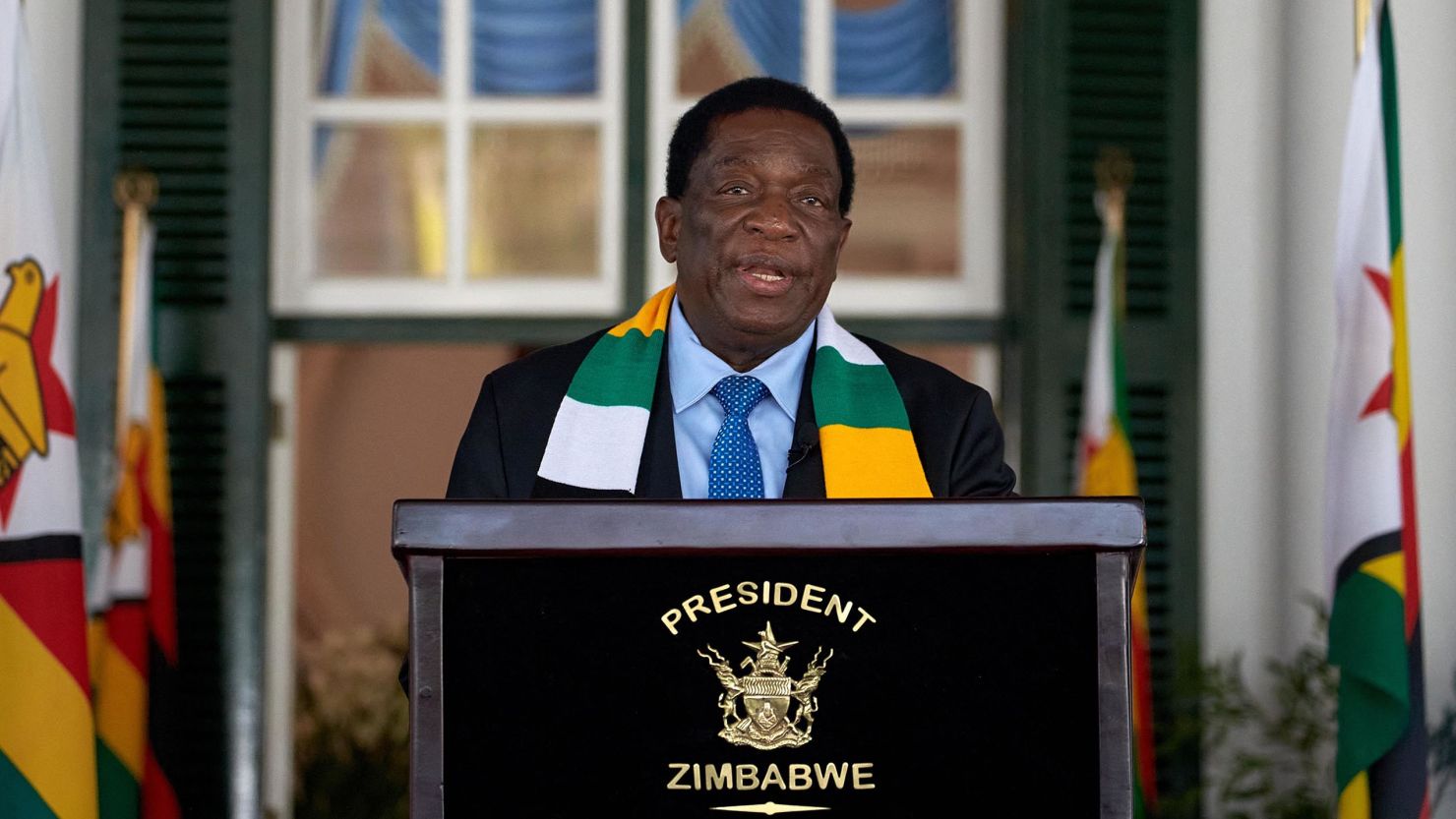
London – The political landscape surrounding Zimbabwe has become increasingly fraught, as a contentious domestic legislative push by President Emmerson Mnangagwa’s government collides head-on with a stern warning from the British Parliament. At the heart of this unfolding drama is the proposed Constitutional Amendment Bill No. 3 (CAB3), a piece of legislation that, if enacted, would fundamentally reshape Zimbabwe’s political future, potentially extending President Mnangagwa’s tenure until 2030 and dismantling key democratic safeguards. This internal manoeuvre has, however, drawn the direct attention of the British House of Lords, which has explicitly linked Zimbabwe’s cherished ambition of rejoining the Commonwealth to President Mnangagwa honouring the constitutional two-term limit.
This is no mere diplomatic nicety; it is a calculated and public ultimatum that underscores the deep international concern over Zimbabwe’s trajectory. Our investigation reveals a hidden tension between Harare and London, questioning whether President Mnangagwa will ultimately prioritise international legitimacy and the prospect of Commonwealth re-entry over an extended period of domestic control. The implications of this standoff are profound, not only for the nation’s leadership but for the average Zimbabwean, whose future is being debated in the high-stakes arena of international diplomacy.
The Unveiling of the 2030 Plot: Constitutional Amendment Bill No. 3
President Mnangagwa’s alleged ambition to remain in power beyond his current term, which is set to expire in 2028, has been a persistent undercurrent in Zimbabwean politics. This ambition crystallised with the gazetting of the Constitutional Amendment Bill No. 3 (CAB3) on 16 February 2026. Framed by its proponents as a technical reform aimed at mitigating election-related “toxicity” and fostering long-term economic growth, the bill is, in reality, a far-reaching proposal designed to consolidate executive power and weaken democratic accountability.
The core provisions of CAB3 are alarming to many observers. Firstly, it proposes to extend both presidential and parliamentary terms from the current five years to seven years. Crucially, this extension is intended to apply retroactively, prolonging President Mnangagwa’s current term from its scheduled end in 2028 to 4 September 2030. This move directly contravenes Section 328(7) of the 2013 Constitution, which stipulates that amendments extending term limits do not apply to incumbents unless approved by a national referendum. To circumvent this constitutional requirement, the Minister of Justice, Legal and Parliamentary Affairs has attempted to rebrand these changes as mere adjustments to “election cycles,” thereby arguing that a referendum is unnecessary. This legalistic sleight of hand has been widely criticised as inconsistent with the plain text of the bill and a deliberate attempt to evade popular consent.
Secondly, and perhaps most controversially, CAB3 seeks to abolish direct presidential elections. Under the proposed new procedure, the President would instead be elected by a joint sitting of Parliament, supervised by either the Zimbabwe Electoral Commission or a designated judge. This radical shift would effectively remove the Zimbabwean populace’s direct say in choosing their head of state, insulating the presidency from conventional forms of democratic accountability. Critics argue that this change is a direct response to ZANU-PF’s declining popular vote share in presidential elections, while the party has consistently maintained parliamentary supermajorities. By shifting presidential selection to Parliament, ZANU-PF aims to sustain its dominance even in the face of dwindling public support.
Furthermore, the bill proposes to increase the President’s power to appoint Senators, allowing for ten additional appointments to the upper house, doubling the previous allocation. This move would further strengthen ZANU-PF’s hold on the legislature, making it easier to secure a supermajority and push through future legislative changes without significant opposition. The bill also seeks to replace the Zimbabwe Electoral Commission’s role in voter registration with the Presidentially-appointed Registrar-General, a change that raises serious concerns about the independence and impartiality of electoral processes.
These proposed amendments are not isolated incidents but represent a continuation of a pattern observed since the enactment of the 2013 Constitution. The first and second constitutional amendments, passed in 2017 and 2021 respectively, systematically eroded the independence of the judiciary and the Prosecutor General by removing public interviews for their appointments. CAB3, therefore, is seen by many as the latest and most significant step in a broader strategy of executive consolidation through constitutional disruption, accelerating Zimbabwe’s trajectory of democratic regression.
The British Ultimatum: Commonwealth Re-entry on the Line
The British Parliament, particularly the House of Lords, has emerged as a vocal critic of Zimbabwe’s proposed constitutional changes, directly linking them to the nation’s long-held aspiration of rejoining the Commonwealth. This international body, a voluntary association of 56 independent and equal sovereign states, has been a key foreign policy objective for President Mnangagwa since Zimbabwe’s withdrawal in 2003 under the late Robert Mugabe. Re-entry is seen as crucial for restoring Zimbabwe’s international standing and unlocking economic opportunities.
During a heated debate on 15 April 2026, members of the House of Lords sharply challenged the UK government’s seemingly cautious approach to Harare’s constitutional manoeuvres. Lord David Howell, a prominent voice in the chamber, delivered a clear and unambiguous message: “Could it be explained to President Mnangagwa that the chances of joining the Commonwealth will be much improved if he stands down after two terms?”. This statement, far from being a mere suggestion, serves as a direct ultimatum, highlighting the Commonwealth’s general favour for adherence to term limits and democratic principles.
The debate saw strong condemnation of CAB3 from various Lords. Baroness Kate Hoey, a long-standing advocate for democratic governance in Zimbabwe, did not mince words. She questioned the UK government’s strategy of “engagement over confrontation,” arguing that the proposed amendments would “fundamentally alter Zimbabwe’s democratic framework”. Baroness Hoey warned that the changes would effectively disenfranchise the Zimbabwean people by removing direct presidential elections, abolish the electoral commission, and compromise judicial appointments. She further accused the ruling ZANU-PF party of maintaining power through “continued brutality, beatings, torture and imprisonment against opposition figures and those in civil society,” urging the UK to “speak out more strongly against the tyranny of the Zanu PF regime, which rules by terror and threat of terror”.
Lord Gerard Lemos, responding on behalf of the government, acknowledged the concerns but maintained that constitutional amendments were a “sovereign legislative matter for Zimbabwe”. He defended the UK’s shift towards engagement, stating that “20 years of megaphone diplomacy did not get us anywhere, and we are now in the business of engaging”. However, this stance drew significant pushback. Lord Malcolm Bruce highlighted ZANU-PF’s justification for the extension – that President Mnangagwa was “doing a good job” – as evidence of the party’s “utter contempt for democracy”. Lord Martin Callanan criticised the government’s lack of outright condemnation, noting that while there was talk of “consultation” and “listening carefully,” there was no strong denunciation of the “profoundly undemocratic” changes.
Beyond the democratic implications, concerns about corruption and economic mismanagement also featured prominently. Lord Peter Hain made serious allegations, stating that “Zimbabwe’s president is intrinsically involved in the criminality at the heart of the state,” linking the state to alleged gold and tobacco smuggling networks and weak oversight institutions, particularly the Reserve Bank of Zimbabwe. Lord Lemos, while acknowledging the importance of tackling corruption, pointed to Zimbabwe’s engagement with the International Monetary Fund as a step towards reform. The debate concluded with calls for coordinated international action, with Lord Robert Hayward suggesting that working with other countries would be more effective than acting alone.
Whispers of Resistance: ZANU-PF’s Internal Fissures
The British Parliament’s strong stance has inadvertently amplified existing internal divisions within Zimbabwe’s ruling ZANU-PF party, particularly concerning the succession question and President Mnangagwa’s extended tenure. While a faction loyal to the President is vigorously pushing the “ED2030” agenda, advocating for his continued rule until 2030, another powerful bloc, reportedly aligned with Vice President Constantino Chiwenga, views CAB3 with considerable apprehension.
Vice President Chiwenga, a former army general who played a pivotal role in the 2017 military intervention that led to Robert Mugabe’s ousting and Mnangagwa’s ascent to power, is widely believed to harbour presidential ambitions for 2028. The proposed extension of Mnangagwa’s term directly obstructs Chiwenga’s path to the presidency, creating significant internal friction. Reports suggest that the British ultimatum is being strategically leveraged by these dissenting factions within ZANU-PF to ensure that the constitutional two-term limit is respected and the 2028 transition remains on track.
This internal resistance is not merely about personal ambition; it reflects a broader struggle for the party’s future and adherence to constitutional norms, even if selectively applied. The public pronouncements from London provide a powerful external validation for those within ZANU-PF who are wary of the implications of CAB3 for the party’s long-term stability and international standing. The pressure from the House of Lords, therefore, adds another layer of complexity to the already intricate power dynamics within ZANU-PF, potentially forcing a recalculation of the political costs associated with pushing through the controversial amendments.
A Nation’s Future in the Balance: Public and Human Rights Concerns
The proposed Constitutional Amendment Bill No. 3 has not only ignited international scrutiny and internal party strife but has also sparked widespread alarm among the Zimbabwean populace and human rights organisations. The fear is palpable: that CAB3 represents a significant regression for a nation that has grappled with issues of governance and democracy for decades.
The Zimbabwe Human Rights Commission (ZHRC), an independent body tasked with protecting and promoting human rights, has raised serious concerns regarding the public consultation process for CAB3. The ZHRC flagged instances of violence, intimidation, and a lack of genuine public participation during these consultations, noting that they were “highly managed, with limited space for dissenting voices, civil society, and the media”. Such findings undermine the legitimacy of the process and highlight the coercive environment in which these constitutional changes are being advanced.
Civil society organisations and religious bodies have also voiced strong opposition. The Zimbabwe Council of Churches (ZCC), representing a significant segment of the population, has explicitly called for the withdrawal or significant amendment of the Bill. Their concerns echo those of many ordinary Zimbabweans who fear that the abolition of direct presidential elections and the centralisation of power will effectively “kill political choice” and further entrench authoritarian rule. The shift from a directly elected president to one chosen by Parliament is seen as a profound betrayal of democratic principles, stripping citizens of their fundamental right to choose their leader.
For the average Zimbabwean, the implications of CAB3 are far-reaching. It threatens to cement a system where accountability is diminished, and the executive wields unchecked power. The prospect of President Mnangagwa extending his rule until 2030, coupled with the erosion of electoral integrity and judicial independence, paints a bleak picture for the nation’s democratic future. The international pressure, particularly from the British Parliament, offers a glimmer of hope for those advocating for constitutionalism and democratic governance, but the ultimate decision rests with the political actors in Harare.
The Commonwealth Conundrum: A Path to Legitimacy or Isolation?
Zimbabwe’s desire to rejoin the Commonwealth is a critical element in this complex political equation. Having withdrawn in 2003 amidst mounting international criticism over human rights abuses and governance issues under Robert Mugabe, re-entry has been a cornerstone of President Mnangagwa’s foreign policy agenda since he took office in 2017. The Commonwealth offers a platform for diplomatic engagement, trade, and development, and its membership would undoubtedly confer a degree of international legitimacy that Zimbabwe currently lacks.
However, the path to re-entry is not straightforward. The Commonwealth operates on a set of core values enshrined in its Charter, including democracy, human rights, and the rule of law. The British Parliament’s explicit linkage of Mnangagwa’s adherence to term limits with Zimbabwe’s Commonwealth prospects underscores the importance of these values. Lord Lemos, while maintaining the UK’s engagement strategy, reiterated that the decision on Zimbabwe’s re-entry would ultimately rest with all Commonwealth members, following recommendations from the Secretary-General. This implies that even if the UK were to soften its stance, other member states would still need to be convinced of Zimbabwe’s commitment to democratic principles.
The current trajectory, marked by CAB3 and its implications for democratic governance, places Zimbabwe at a critical juncture. Pushing through the constitutional amendments, particularly those that undermine direct elections and extend presidential terms, risks alienating potential allies within the Commonwealth and further isolating the nation on the international stage. Conversely, heeding the calls for constitutional adherence and democratic reform could pave the way for renewed international engagement and the much-coveted Commonwealth membership.
Conclusion: A High-Stakes Game
The unfolding drama surrounding Zimbabwe’s 2030 plot and the British Parliament’s firm stance represents a high-stakes game with profound consequences for the nation. President Mnangagwa faces a stark choice: to pursue an extended period of domestic control through controversial constitutional amendments, potentially at the cost of international legitimacy and Commonwealth re-entry, or to uphold constitutional principles and democratic norms, thereby opening avenues for greater international engagement.
The internal resistance within ZANU-PF, coupled with the vocal concerns of human rights organisations and the Zimbabwean public, adds further pressure to the Mnangagwa administration. The British ultimatum, delivered with clarity and conviction, serves as a powerful external factor that cannot be easily dismissed. The world watches as Zimbabwe navigates this critical period, with the hope that the principles of democracy, human rights, and the rule of law will ultimately prevail, ensuring a future where the voice of the people is heard and respected.