


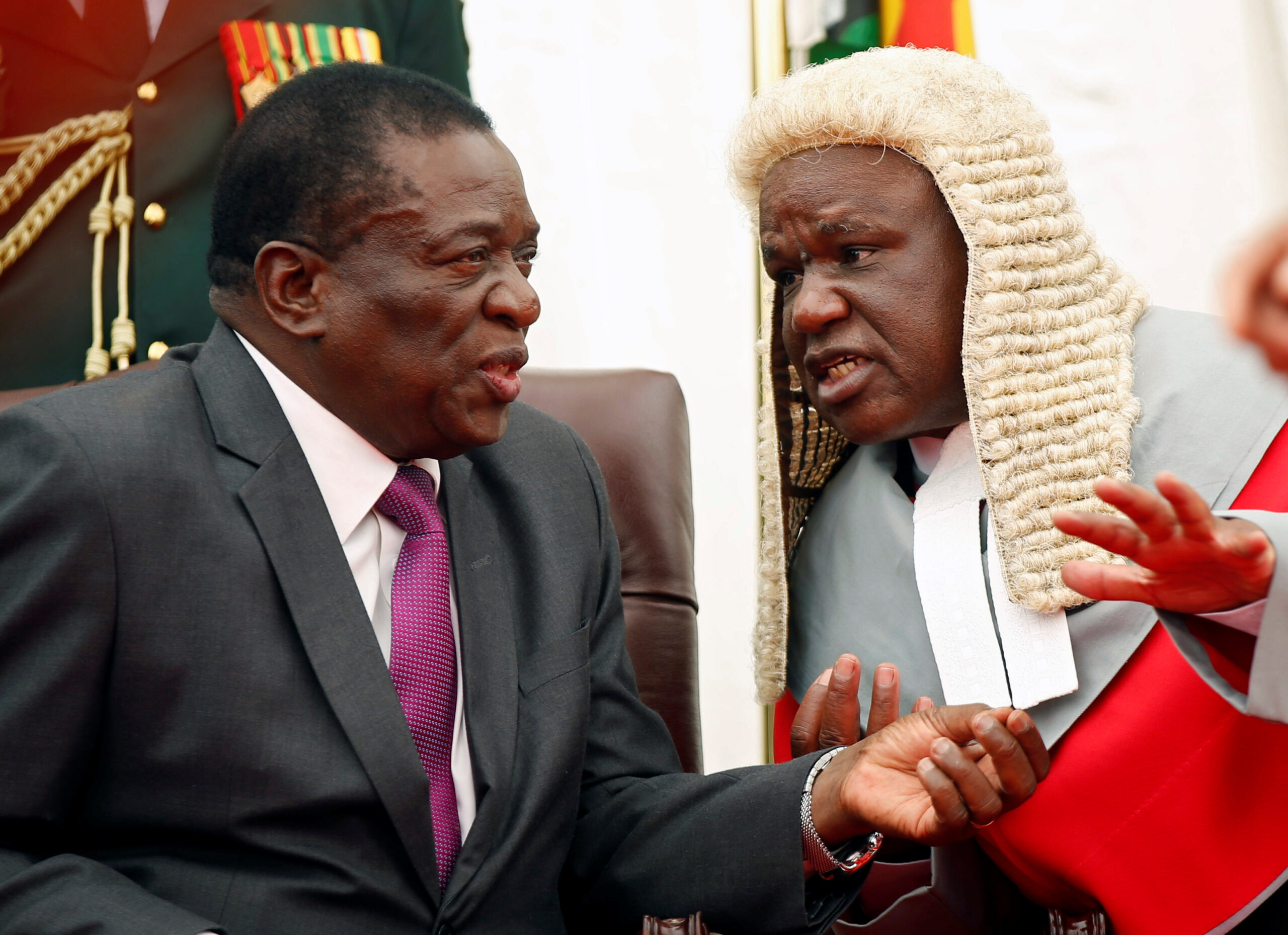
Harare – As Chief Justice Luke Malaba finally prepares to vacate his high-profile office on 14 May 2026, the celebratory headlines mask a decade of judicial turbulence that has shaken the foundations of Zimbabwean democracy. This article goes far beyond the official retirement announcements to dissect the “Malaba Legacy”—a period defined by the highly controversial Constitutional Amendment No. 2, which many legal experts believe was tailored specifically to keep him in power beyond the mandatory retirement age of 70. His departure today marks the end of an era of what critics have termed “captured” jurisprudence, leaving behind a complex legacy that will undoubtedly haunt Zimbabwean courts for generations to come.
Today, President Emmerson Mnangagwa announced the appointment of Justice Elizabeth Gwaunza as the new Chief Justice, with Justice Paddington Garwe as her deputy. While this transition appears smooth on the surface, it follows years of intense legal and political manoeuvres that saw Malaba cling to power long after many believed his tenure should have ended. The question remains: is this a genuine changing of the guard, or a carefully choreographed transition designed to maintain executive influence over the judiciary ahead of the next electoral cycle?
The Controversial Extension: Constitutional Amendment No. 2
The genesis of the controversy lies in Constitutional Amendment No. 2, enacted in 2021. This amendment controversially extended the retirement age for judges from 70 to 75. Critics swiftly condemned the move, arguing it was specifically designed to allow Chief Justice Malaba, who turned 70 on 15 May 2021, to remain in office. The timing of the amendment, pushed through Parliament with unusual haste, raised immediate red flags among the legal fraternity and civil society organisations.
However, the jubilation was short-lived. The government, led by Justice Minister Ziyambi Ziyambi, immediately challenged the High Court’s decision. In a fiery statement on 15 May 2021, Ziyambi launched a scathing attack on the High Court judges, accusing them of being “captured” by foreign interests. He declared, “I want to make it clear today that we do not accept the decision of the High Court. We have a serious situation of a Judiciary that has been captured by foreign interests… The High Court’s decision is a typical case of judicial overreach and as Government, we are not going to accept that.” He further threatened to investigate the conduct of the judges, specifically targeting Judge Happias Zhou, whom he alleged was “not a fit and proper person to be a judge.”
The Midnight Appeal and Malaba’s Defiant Return
The legal drama intensified with what became known as the “midnight appeal.” On Monday, 17 May 2021, the government filed an appeal against the High Court’s ruling. Despite the clear declaration that he was no longer Chief Justice, Malaba defiantly returned to his office at the Constitutional Court on 24 May 2021. The Judicial Service Commission (JSC) controversially claimed that the appeal automatically “suspended” the High Court order, allowing Malaba to resume his duties. This position was hotly contested by prominent legal experts, including human rights lawyer Beatrice Mtetwa and constitutional law expert Lovemore Madhuku, who argued that a declaratory order, which simply states the law, cannot be suspended by an appeal.
This episode highlighted deep internal fractures within the judiciary and the JSC itself. Reports indicated that some JSC members were reportedly uncomfortable with the executive’s aggressive stance and the blatant disregard for the High Court’s judgement. The perception of a “hidden hand” within the executive branch, orchestrating legal manoeuvres to maintain control over the courts, became a pervasive narrative.
The 2018 Election Petition and Allegations of a ‘Reward’
Critics have long alleged that Malaba’s controversial extension was a reward for his role in the 2018 election petition ruling. Malaba presided over the bench that unanimously dismissed Nelson Chamisa’s challenge to President Mnangagwa’s victory, a decision that cemented Mnangagwa’s presidency. This ruling, coming after a contentious election, was seen by many as evidence of Malaba’s alignment with the executive, further eroding public trust in the judiciary’s independence.
The investigative angle focuses on the “hidden hand” within the judiciary and the executive branch, exploring the internal fractures within the Judicial Service Commission (JSC) and the strategic appointment of Justice Gwaunza as his successor, alongside Justice Garwe as the deputy. Our analysis asks the tough question: is this a genuine transition or a carefully choreographed “changing of the guard” to ensure continued executive influence over the courts ahead of the next electoral cycle? For the average citizen, the independence of the judiciary can feel like an abstract concept; our story makes it real by showing how these high-level manoeuvres affect the fairness of everyday legal battles and the protection of basic rights.
A Legacy of Controversy and the Path Forward
Luke Malaba’s tenure will be remembered for its profound impact on Zimbabwe’s legal landscape. His critics argue that his actions, particularly his acceptance of the extended term, severely undermined the principle of judicial independence and created a precedent where constitutional provisions could be manipulated for political gain. Human rights lawyer Beatrice Mtetwa, a vocal critic of the executive’s influence on the judiciary, has consistently highlighted the dangers of a compromised justice system. While direct quotes from Mtetwa on the “secret deals” are difficult to pinpoint, her consistent advocacy against judicial capture speaks volumes about the concerns within the legal community.
As Justice Elizabeth Gwaunza takes the helm, the judiciary faces an uphill battle to restore public confidence. Her appointment, while seemingly a natural progression given her role as Deputy Chief Justice, will be scrutinised for any signs of continued executive influence. The timing of Malaba’s retirement, amidst the ongoing debate around Constitutional Amendment (No. 3) Bill — which seeks to extend President Mnangagwa’s term from 2028 to 2030 — further underscores the delicate balance of power within Zimbabwe. The judiciary’s role in upholding the constitution and protecting fundamental rights will be more critical than ever.
Deputy Chief Justice Gwaunza, in her farewell remarks to Malaba, acknowledged his contributions, stating, “Your legacy is not confined to the judgements you have written or the offices you have held. It lives in the systems you have built, the standards you have set and the people you have inspired.” While these words offer a glimpse into the official narrative, the true measure of Malaba’s legacy will be debated for years to come, particularly by those who believe his actions set a dangerous precedent for the rule of law in Zimbabwe. His retirement, officially on 14 May 2026, allows him to pursue his described passions of reading and ranching, far from the madding crowd of constitutional crises.
Conclusion
Chief Justice Luke Malaba’s departure marks a pivotal moment for Zimbabwe’s judiciary. His tenure, characterised by constitutional battles and allegations of executive interference, leaves a complex and often contentious legacy. The appointment of Justice Elizabeth Gwaunza signals a new chapter, but the underlying issues of judicial independence and the separation of powers remain at the forefront. As Zimbabwe navigates its political future, the integrity of its courts will be paramount in ensuring justice and upholding the democratic principles that many fought so hard to achieve. The “secret deals” and political manoeuvres that defined Malaba’s later years serve as a stark reminder of the constant vigilance required to safeguard the rule of law.