


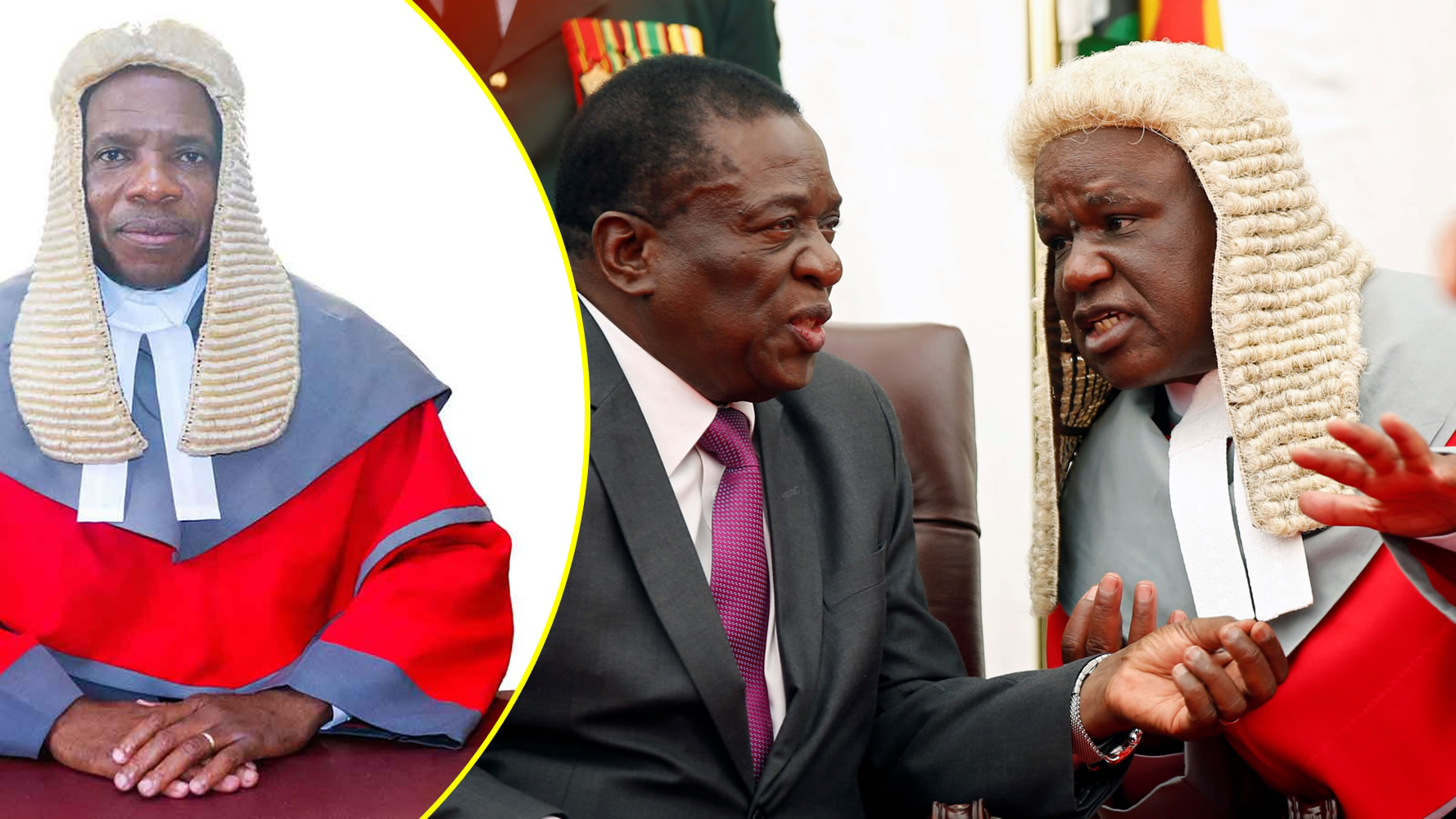
HARARE – The hallowed halls of the High Court in Harare, typically a bastion of measured legal discourse and stoic tradition, have been unsettled by a development that many insiders believe signals a new and more aggressive phase in the battle for Zimbabwe’s soul.
In November 2025, President Emmerson Mnangagwa officially set in motion a tribunal to investigate High Court Justice Never Katiyo for “gross misconduct.” While the official narrative presented by the Attorney General’s office frames this as a necessary step toward judicial accountability, the timing and the specific cases handled by Justice Katiyo have ignited a fierce debate across the legal fraternity.
Is this a genuine attempt to prune a “bungling” judge from the bench, or is it a calculated warning shot to any member of the judiciary who might consider ruling against the state in the high-stakes constitutional challenges looming on the horizon?
At the heart of the probe are two startling incidents that occurred in quick succession during the latter half of 2025. The first, and perhaps most egregious, involves a property dispute between a Bulgarian state firm, Technoimpex JSC, and a local entity over a property known as Bath Mansions Flats in Harare. In July 2025, Justice Katiyo handed down what was later described as a “fabricated” or “fictitious” ruling. The judgment remarkably recorded that a full hearing had taken place and that senior advocate Thabani Mpofu had appeared on behalf of one of the parties. However, the reality was far more disturbing: no such hearing had occurred, and Advocate Mpofu categorically denied ever participating in the case.
The fallout was immediate and embarrassing for the bench. Faced with the undeniable evidence of his own fabrication, Justice Katiyo was forced to take the extraordinary step of rescinding his own judgment. In a withdrawal dated August 7, 2025, he admitted that the ruling had been “erroneously issued.” For a High Court judge to “make up” a hearing and the presence of a prominent lawyer is not merely an administrative oversight; it is a fundamental breach of the oath of office that strikes at the very core of judicial integrity.
|
Case Reference
|
Nature of Alleged Misconduct
|
Key Details
|
Outcome/Status
|
|
Technoimpex JSC vs Local Firm
|
Issuing a “fictitious” judgment
|
Claimed a hearing occurred and Advocate Thabani Mpofu appeared when neither happened.
|
Judgment rescinded on August 7, 2025; cited as “erroneously issued.”
|
|
NPA vs Maureen Kademaunga & Others
|
Procedural violation in a political case
|
Granted leave to appeal an acquittal before the legal deadline for the respondents to file their opposition.
|
Heavily criticised by legal practitioners as a “blatant violation of procedure.”
|
Barely a week after the Technoimpex debacle, Justice Katiyo found himself in the spotlight again. This time, the case was overtly political. He granted the National Prosecuting Authority (NPA) leave to appeal the acquittal of opposition politician Maureen Kademaunga and several others, who had been cleared of charges related to attacking Zanu PF supporters in 2024. The controversy arose because Justice Katiyo granted the application just four days after it was filed, despite the fact that the respondents had until August 20 to file their responses under the High Court Rules. By jumping the gun, the judge effectively denied the opposition figures their right to be heard, leading lawyers to describe the move as a “blatant violation of procedure.”
“Once is an error, twice is a trend,” remarked a senior Harare lawyer who spoke on the condition of anonymity. “Confidence in the judiciary depends on the integrity and diligence of those who serve on the bench. When you see a pattern of serial blunders and a disregard for basic procedure, the situation becomes untenable.”
However, to understand why this probe has “raised eyebrows,” one must look beyond the immediate “blunders” and into the broader political landscape of Zimbabwe. Justice Katiyo was appointed to the bench by President Mnangagwa in 2021, a move that was controversial from the start. Reports at the time suggested he had performed poorly during the Judicial Service Commission (JSC) public interviews, yet he was elevated nonetheless. His sudden fall from grace, therefore, invites questions about whether he has simply outlived his usefulness or if he failed to deliver on “unspoken expectations” in more sensitive matters.
The “fit to hold office” criteria are ostensibly designed to ensure that judges possess the necessary competence, integrity, and independence. Section 187 of the Constitution of Zimbabwe allows for the removal of a judge only for inability to perform the functions of their office, gross incompetence, or gross misconduct. While the allegations against Katiyo certainly fit the description of misconduct, many observers are questioning the role of the Judicial Service Commission and the President’s discretionary powers in this specific instance.
The shadow of “ED2030″—the slogan representing the push for President Mnangagwa to extend his tenure beyond the current constitutional limit—looms large over every major judicial appointment and disappointment. As the country moves toward 2026, a year that will see the retirement of several key judicial figures, including Chief Justice Luke Malaba in May, the composition of the High Court and Supreme Court becomes a matter of existential importance for the ruling party. Any constitutional amendment to allow a third term or to extend the current one would almost certainly face a legal challenge in the High Court.
In this context, the probe into Justice Katiyo serves as a potent “warning shot.” It reminds every judge that their tenure is fragile and that the same executive power that elevated them can just as easily initiate their downfall through a tribunal process. This is not a new tactic in the Zimbabwean political playbook. History is littered with examples of judicial “purges” where the law was used as a scalpel to remove those perceived as independent or “uncooperative.”
|
Historical Judicial “Purges” in Zimbabwe
|
Year
|
Reason/Context
|
Result
|
|
Justice Benjamin Paradza
|
2003
|
Perceived as unfavourable to the authorities after ruling against the state.
|
Arrested at the High Court and hounded out of office.
|
|
Justice Erica Ndewere
|
2020
|
Granted bail to opposition leader Job Sikhala; claimed she was victimised for defying Chief Justice Malaba.
|
Fired for “gross incompetence” in 2021.
|
|
Justice Edith Mushore
|
2022
|
Had ruled against the extension of Chief Justice Malaba’s term in 2021.
|
Fired for “absenteeism” after disappearing from work.
|
The case of Justice Erica Ndewere is particularly instructive. Like Katiyo, she was accused of “gross incompetence,” but she maintained throughout her ordeal that she was being targeted for refusing to follow “unlawful instructions” from Chief Justice Malaba regarding the bail application of an opposition figure. Similarly, Justice Edith Mushore, who was part of the three-judge panel that initially ruled the extension of Malaba’s term as illegal in 2021, was later fired for “absenteeism.” The message to the bench is clear: independence carries a heavy price.
Attorney General Virginia Mabiza, in her official statement, maintained the procedural correctness of the move. “Following a recommendation from the Judicial Service Commission in terms of Section 187 of the Constitution of Zimbabwe, His Excellency, the President, has initiated the process to establish a tribunal to inquire into the question of the removal from office of High Court Judge, Honourable Justice Never Katiyo,” she confirmed. She further noted that the Law Society of Zimbabwe had been asked to nominate legal practitioners to serve on the tribunal.
Yet, for the average Zimbabwean citizen, the “unseen files” of the tribunal are of less interest than the ultimate impact on the rule of law. If the judiciary is seen as a revolving door where judges are brought in for their perceived loyalty and discarded when they become a liability or an embarrassment, then the independence of the High Court is indeed under its greatest threat. The criteria for being “fit to hold office” appear to be shifting from legal acumen to political reliability.
As the tribunal begins its work, the legal fraternity will be watching closely. Will the proceedings be transparent? Will the “unseen files” reveal more about the cases Justice Katiyo was handling behind the scenes? Or is this simply a cleanup operation to ensure a more “compliant” and “competent” judiciary ahead of the 2030 legal battles?
The independence of the judiciary is the final line of defence for any democracy. When that line is blurred by political expediency and the selective application of “accountability,” the very foundation of justice begins to crumble. Whether Justice Katiyo is a victim of a purge or a necessary sacrifice for the sake of judicial standards, the chilling effect on his colleagues is undeniable. In the high-stakes game of Zimbabwean politics, the bench has become a battlefield, and the probe into Never Katiyo is merely the latest skirmish in a much larger war for control over the scales of justice.