


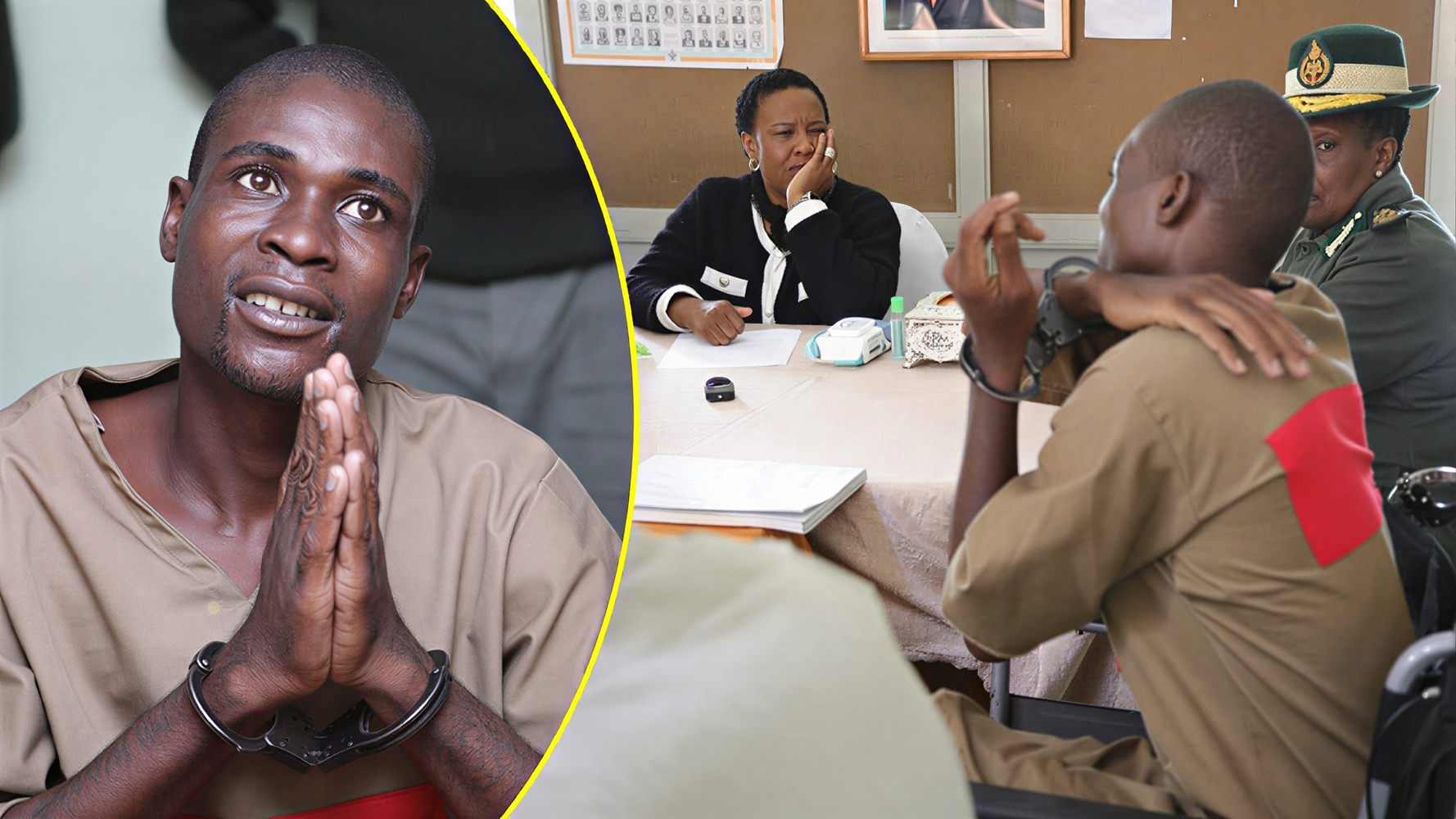
HARARE – In the quiet, dust-swept peripheries of Guruve, a name that once belonged to a mere thief has become synonymous with a darkness that the nation is struggling to comprehend. Anymore Zvitsva, a man whose confession has laid bare a terrifying tally of 25 victims, sits today in a wheelchair within the cold, grey walls of Chikurubi Maximum Security Prison. But as the details of his “killing journey” emerge, a more sinister reality is surfacing: Zvitsva was not merely a lone predator; he was a supplier in a thriving, underground market for human life.
The confession of the suspected Guruve serial killer has indeed gripped the nation, yet the most terrifying detail remains largely unexamined: the market for human remains. Zvitsva claims he was paid as little as US$200 or even a “cup of mbanje” (marijuana) to drain the blood of his victims for sale to prominent “prophets” and traditional healers. This is not just a story of a lone madman, but a documentary-style exposé on a hidden industry that trades in human life for promised spiritual prosperity.
The Prophet’s Price for Blood
Seated across from First Lady Dr Auxillia Mnangagwa during her recent prison visit—a visit intended to gain insight into the mind of a man responsible for such “heinous crimes”—Zvitsva was chillingly candid. He spoke of a ritualistic economy where human parts and fluids are commodities.
“There is one woman I killed and gave the blood to a prophet who gave me US$200. I don’t know what he wanted to use it for,” Zvitsva told the First Lady, his voice steady despite the gravity of his admission. He identified these self-styled religious leaders by name: Junioius Kasinauyo and Gidza Dhorobha.
The transaction for a human life, in Zvitsva’s world, was often as trivial as a fix of drugs or a small sum of foreign currency. The “prophets” he mentioned are part of a growing number of self-styled religious leaders who operate in the shadows of Zimbabwe’s urban and rural peripheries, exploiting the intersection of extreme poverty and religious desperation. This intersection creates a fertile ground for “fly-by-night” prophets who promise instant wealth through rituals that require the most horrific of ingredients.
A Systemic Failure in Monitoring
The state has been notably slow to name or apprehend the buyers in this ritualistic chain. While Zvitsva remains behind bars, the “prophets” who allegedly commissioned these horrors or provided the market for his “products” often remain at large, protected by the very “Ted Bundy” cult-like fascination that surrounds such high-profile killers. This fascination risks glamorising the killer while the legal protocols designed to ensure justice are undermined.
The First Lady, visibly shaken during the encounter, asked Zvitsva if he was indeed a “human being”. Her inquiry highlights the profound trauma across Guruve, where some homes have been abandoned as families struggle to recover from the attacks. The execution of the murders was so shocking that entire communities have fled their homesteads, unable to come to terms with the proximity of such evil. Dr Mnangagwa noted that she was “troubled in mind” before deciding to see Zvitsva face to face, driven by a need to hear “from the horse’s mouth” how such depravity could occur.
The Ritualistic Economy and the “Lotion” of Death
Zvitsva’s methods were as varied as they were gruesome. He recounted how he would burn victims’ body parts to ashes, mixing them with cooking oil to use as a “lotion” for fortune-telling. He believed these ashes, when used in the construction of a shop, could bring wealth.
“Through the ashes, I used them to build a building which I later destroyed. I had hope that I would make more money,” he confessed. He also spoke of cutting breasts from a female victim to sell to a local miner, Nathan Churweni, who allegedly wanted them to “boost” a gold mine.
“The breasts I gave to Nathan Churweni, who said he would give me my money when he came back from Mozambique, but that never materialised after he heard that police were looking for me,” Zvitsva said. This detail exposes the “gold ritual” culture prevalent in some mining communities, where human sacrifice is whispered to be a shortcut to striking a rich vein.
This “hidden industry” is not an isolated phenomenon. Zimbabwe has a haunting history of ritualistic killings, most notably the 2020 murder of seven-year-old Tapiwa Makore in Murewa. In that case, the child was killed and dismembered for rituals intended to bring business success. Though his killers, Tafadzwa Shamba and Tapiwa Makore Senior, were eventually sentenced to life imprisonment, the head of the young boy was never recovered—a stark reminder of the permanent scars left by this trade. The recent Supreme Court decision to commute their death sentences to life imprisonment has sparked fresh debate about the adequacy of the law in deterring such “black magic” murders.
The Descent into Darkness: A Timeline of Depravity
Zvitsva’s journey into serial killing began, by his own account, in 2024. He described his first murder as a botched theft born of hunger. After stealing 10 kilogrammes of mealie-meal, he returned to the house later that night, believing the owner might have cash. A struggle ensued, and he killed the woman with a “Colombian knife” and an axe.
“That is when I realised I had stabbed someone. This was when my journey of killing people began,” he said. Since then, he claimed, a “killing spirit” or “evil spirit” took hold of him. “According to my own thinking, the evil spirit started after my first killing and never left me”.
His crimes extended to his own family, a detail that has particularly horrified the Guruve community. He confessed to meeting his niece and her child; after she accused him of attempted theft, he “labelled her a traitor” and strangled her with a wire. He then turned his attention to her child, aged between three and five.
“While approaching where I had killed her mother, I closed her face so that she could not see her. I then killed her as well,” he admitted. He buried the child in a shallow grave but used the mother’s body for his “rituals,” cutting off her breasts and even attempting to roast and consume her flesh. “I only chewed it once before my heart refused,” he claimed, a rare moment of apparent hesitation in his narrative of slaughter.
Evasion and the “Spirit Medium” Persona
To evade capture, Zvitsva lived a life of extreme stealth. He spent long periods hiding in bushes and forests, avoiding leaving clear footprints by walking along the sides of paths or through thick grass. “I would never walk openly, I would make sure I was hiding always like someone trying to catch a wild animal,” he said.
Chillingly, he carried weapons such as knives and traditional spears, which he likened to those pictured in photos of spirit mediums like Mbuya Nehanda. This appropriation of cultural and spiritual symbols served to further his own delusion of being driven by a higher, albeit darker, power. Even as police began a nationwide manhunt, Zvitsva continued to kill, including his own aunt and her child, after hearing he was being sought by police.
The “Papa” Phenomenon and Religious Desperation
The term “Papa” or “Prophet” in Zimbabwe often carries immense weight, representing a figure of spiritual authority and, supposedly, a gateway to prosperity. However, the Guruve case exposes the dark underbelly of this devotion. When extreme poverty meets the promise of “spiritual prosperity,” the results can be lethal. The “ritualistic economy” thrives on the belief that human life can be bartered for luck, wealth, or power.
The state’s hesitation to aggressively pursue the “buyers” of human parts suggests a systemic failure in monitoring these self-styled religious leaders. While the police national spokesperson, Assistant Commissioner Paul Nyathi, has confirmed that investigations are continuing into possible accomplices, the public remains anxious. The names mentioned by Zvitsva—Junioius Kasinauyo and Gidza Dhorobha—should be at the centre of a massive crackdown on ritualistic practices. Instead, the focus remains largely on the “lone madman” narrative, ignoring the network that sustained his crimes.
A Nation in Mourning and the Quest for Justice
As Zvitsva awaits judgment, he has appealed for forgiveness, a plea that many find difficult to stomach. “I am Anymore Zvitsva from Guruve. I committed heinous crimes. I killed women, children and other men. May you have mercy for all my wrongdoings. To all the families I wronged, may you please find it in your hearts to forgive me. Even to you, First Lady, His Excellency the President and the entire nation, I am sorry for my deeds,” he pleaded.
But for the families in Guruve, forgiveness is a distant prospect. The trauma is etched into the landscape—in the shallow graves, the abandoned huts, and the lingering fear that the “killing spirit” Zvitsva spoke of might still be lurking in the shadows of those who paid him. The First Lady asked Zvitsva what suitable ruling he thought suited him best. His response was a deflection: “I have nothing to say. It is up to the State, which knows”.
This investigation reveals that Zvitsva was a symptom of a much larger malady. The ritualistic economy thrives on the silence of the state and the desperation of the poor. It is a world where a “cup of mbanje” can buy a human life, and where “prophets” profit from the blood of the innocent. Until the “Blood Prophets” are unmasked and the market for human life is dismantled, the ghosts of Guruve will continue to haunt the nation’s conscience. The story of Anymore Zvitsva is not just a chronicle of a serial killer; it is a warning of what happens when a society allows the trade in human life to become a hidden, but thriving, industry.
Timeline of Terror: The Guruve Serial Killer Case
|
Date
|
Event
|
|
April 2024
|
Alleged start of Anymore Zvitsva’s killing spree in Guruve and Mvurwi, beginning with a botched robbery .
|
|
August 2024 – November 2025
|
Period of undetected killings; Zvitsva claims to have supplied blood and parts to various buyers .
|
|
December 2025
|
Intensification of police search as multiple bodies and shallow graves are discovered in the Guruve district .
|
|
January 2026
|
Capture of Anymore Zvitsva; he initially faces 12 murder counts, which later rises to 25 .
|
|
February 2026
|
Public outrage grows as details of the “ritualistic economy” begin to surface in court proceedings.
|
|
March 14, 2026
|
First Lady Dr Auxillia Mnangagwa visits Zvitsva at Chikurubi Maximum Security Prison; Zvitsva names “prophets” .
|
|
March 16, 2026
|
National debate intensifies over the state’s failure to arrest the buyers and “prophets” named in the confession.
|