


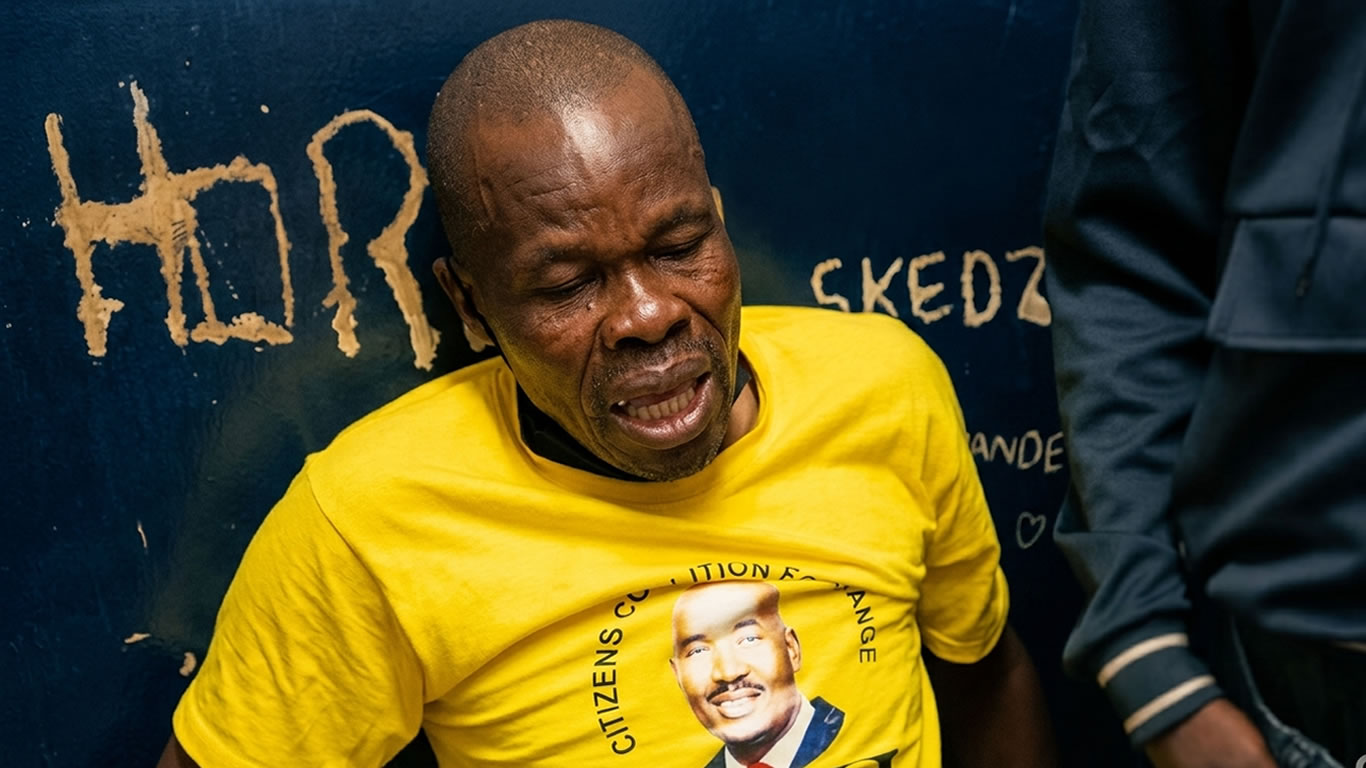
HARARE — On 25 May 2026, as Zimbabweans marked Africa Day with speeches of liberation and sovereignty, a small, quiet meeting took place within the grey, oppressive walls of Harare Remand Prison. Walter Mzembi, a former Cabinet minister who had recently tasted the sweet air of freedom after his own acquittal, walked back through those heavy gates—not as an inmate this time, but as a visitor. He was there to see a man the world seems to have moved on from: Godfrey Karembera.
To the public, Karembera is better known as “Madzibaba VeShanduko” (the Father of Change). For years, he was a vibrant, inescapable fixture at opposition rallies, his bright yellow robes a beacon of defiance and his energetic dancing a symbol of hope for thousands. Today, those robes are faded, and the man inside them is broken. While the “big fish” of Zimbabwean politics navigate their way through high-court acquittals or comfortable exiles, Karembera remains a “disposable activist,” caught in the gears of a legal system that appears to have forgotten him.
“Godfrey Karembera is one of my sons that I spent time counselling inside,” Mzembi remarked after the visit. “We prayed, laughed and reminisced.” But behind the smiles and the prayers lies a haunting reality. Karembera has been in custody since 20 October 2025. His “crime”? He was handing out flyers.
The Farmer from Guruve
Before he became a political symbol, Godfrey Karembera was a 47-year-old farmer from Mutata Village in Guruve South. He is a husband and a father of three. His journey into the crosshairs of the state began not with a grand conspiracy, but with a simple choice of colour. He began wearing yellow church-like robes to support Nelson Chamisa and the Citizens Coalition for Change (CCC). In his village, the nickname “Madzibaba VeShanduko” was one of respect. To the authorities, however, it was a mark on his back.
His persecution did not start with his current imprisonment. In 2022, he was arrested in central Harare for simply wearing his yellow gown. The police claimed he was being “disorderly.” During that encounter, he was beaten on his back and the soles of his feet. It was a prelude to the horrors that would follow.
In April 2025, the violence reached his doorstep. While Karembera was away, his family home was targeted in a petrol bomb attack. His 17-year-old son, Laxmore, was sleeping inside with his younger siblings. As the first explosion shattered the night, Laxmore acted with a courage beyond his years, grabbing his brother and sister and fleeing into the dark fields. He was cut by glass and scorched by flames, but he saved his siblings. To this day, no one has been arrested for the attack that nearly claimed the lives of Karembera’s children.
The “Crime” of Paper
The current legal nightmare for Karembera began in October 2025. The state has charged him with “incitement to commit public violence.” When one examines the evidence, the gravity of the charge collapses under the weight of its own absurdity.
Karembera was arrested for his alleged involvement in the “One Million Man March,” a protest planned for 17 October 2025, by war veteran Blessed Geza. Geza had been vocal on social media, accusing the government of corruption. Karembera’s role was that of a foot soldier. He and a few others printed flyers with slogans like “Stop the looting,” “Zimbabwe is not for sale,” and “7 billion reasons to march.”
According to police reports, they recovered 7,200 flyers from a silver Toyota Aqua. The state alleges that Karembera distributed these papers in suburbs like Glen View and Highfield. They also point to a video he recorded, inviting citizens to gather peacefully at Africa Unity Square.
In a functioning democracy, distributing information about a peaceful protest is a protected right. In Zimbabwe, it is a ticket to Chikurubi or Harare Remand. There were no weapons found. There were no calls for arson or assault. There were only words on paper—words that questioned where seven billion dollars of national wealth had vanished.
A Body Broken by “Ghost Detention”
The most harrowing chapter of Karembera’s story is what happened before he ever saw a judge. According to his legal team, Karembera was a victim of “ghost detention.” He was abducted by men in unmarked vehicles before his formal arrest was recorded.
During this period of illegal detention, he was subjected to brutal torture. When he finally appeared in court, he could not walk without assistance. His lawyer, Paida Saurombe, told the magistrate that her client bore clear marks of severe physical abuse. The torture was so systematic that reports emerged of Karembera being unable to urinate naturally—a common and painful consequence of severe beatings to the kidneys and lower back.
Despite his deteriorating health, prison authorities have repeatedly denied him access to private medical care. He remains in a cell, his body a map of the state’s intolerance for dissent. “He is in visible pain,” his supporters say, yet the wheels of justice turn with agonizing slowness.
The Carousel of Selective Justice
The legal proceedings against Karembera have been a masterclass in delay and obfuscation. Bail hearings have been postponed dozens of times. In February 2026, the case took a bizarre turn when Magistrate Ruth Moyo recused herself after the defence argued the court was no longer impartial. The case was shuffled to another magistrate, Tapiwa Kuhudzai, who had previously denied Karembera’s challenges to his remand.
This “selective justice” is the most bitter pill for Karembera to swallow. While he languishes in a cell for printing flyers, high-profile figures accused of massive corruption or political violence often walk free within days. Even Walter Mzembi, who faced ten counts of flouting government procedures, was acquitted and is now a free man.
The contrast is stark. Mzembi had the stature and the connections to navigate the system. Karembera, the “small man” from Guruve, has no international legal team. He has no massive social media campaign. He is the “forgotten activist,” a man whose “political fathers” seem to have moved on to new battles, leaving their most loyal foot soldier to rot.
The Political Shadow: The 2030 Agenda
To understand why the state is so determined to keep a farmer in jail, one must look at the broader political landscape. In late 2025, Zimbabwe was gripped by tensions surrounding the “2030 Agenda”—a campaign by supporters of President Emmerson Mnangagwa to amend the constitution and allow him to serve beyond his two-term limit.
Anyone perceived as a threat to this agenda, or anyone capable of mobilising the grassroots, became a target. Karembera, with his recognisable yellow robes and his ability to draw a crowd, was an easy example to make. The state is reportedly even considering charging him under the controversial Patriotic Act of 2023, a law so vaguely worded that almost any criticism of the government can be interpreted as “injuring the sovereignty” of the nation.
The Human Cost of Silence
The tragedy of Godfrey Karembera is not just his own; it is the tragedy of his family. In Mutata Village, his wife waits. His children, still traumatised by the petrol bombing of their home, wonder if their father will ever return. Their fields lie fallow because the man who worked them is behind bars.
“Why is this simple man still behind bars while the ‘big fish’ are swimming free?” is the question that haunts every visit to Harare Remand. Is he still in jail because he refuses to “repent” for his beliefs? Or is it because, in the cold calculus of political warfare, he no longer has “political value” to those who once stood on stages and cheered his dancing?
Karembera’s story is a powerful reminder of the “hidden cost” of standing up to the system in Zimbabwe. He is a prisoner of politics, not of justice. His yellow robes may have faded in the prison laundry, but his plight remains a vivid stain on the conscience of the nation.
As Africa Day 2026 passes into history, the “Forgotten Prisoner” remains in his cell. He is not a criminal; he is a farmer who dared to believe that his voice, and his flyers, could make a difference. Until the day he walks free, the “hidden truth” of Zimbabwe’s prison system remains written in the scars on his back and the silence of those who should be shouting for his release.