


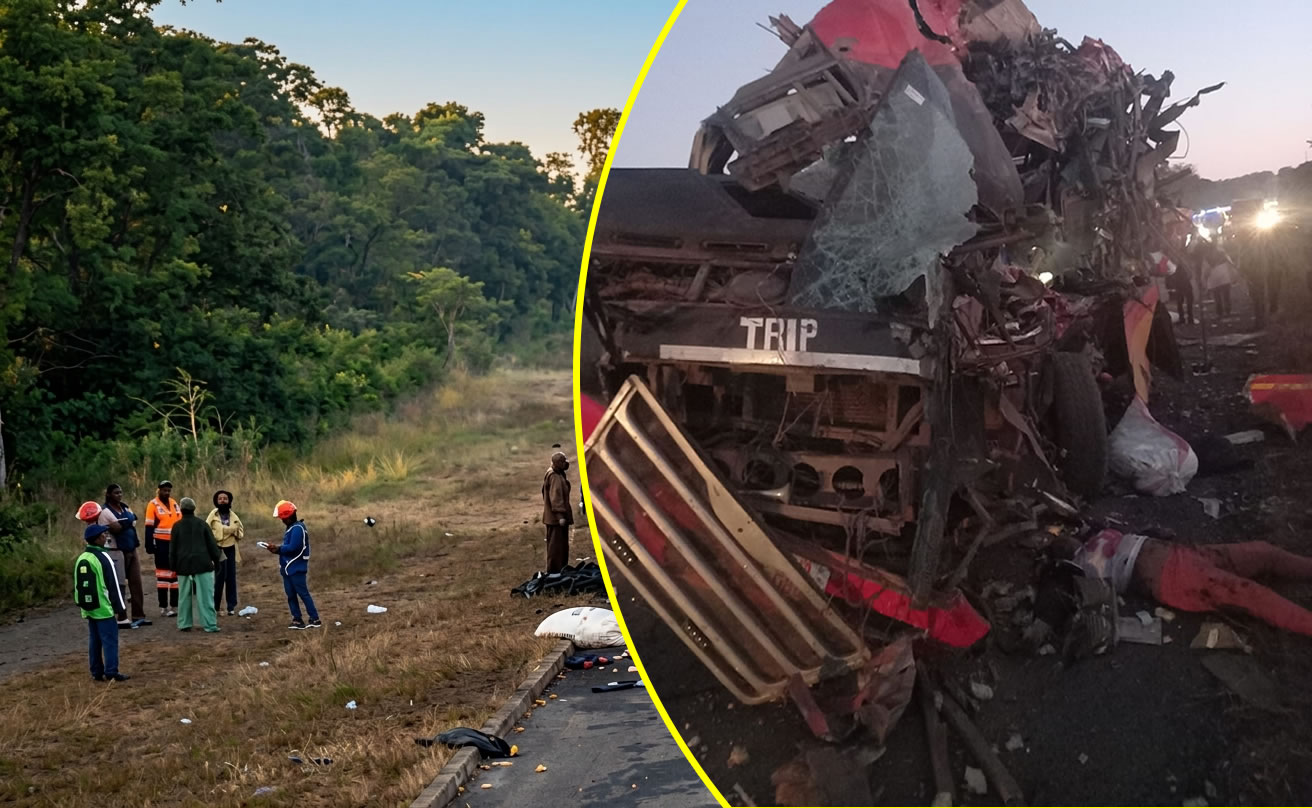
Gokwe – A tragic head-on collision between a Trip-Trans bus and a haulage truck on the Gokwe-Kwekwe Road has claimed the lives of 10 people, marking another grim statistic in Zimbabwe’s ongoing struggle with road safety. The devastating incident occurred in the early hours of Wednesday, around 5:00 AM, near the 110-kilometre peg towards Kwekwe. This accident has significantly contributed to the country’s alarming road fatality count for May, which now stands at 41 from major crashes alone.
The Trip-Trans bus, carrying 36 passengers, was reportedly attempting to overtake another vehicle when it collided with the oncoming haulage truck. The impact was catastrophic, leading to immediate fatalities and numerous injuries. National police spokesperson Commissioner Paul Nyathi confirmed the details of the accident, stating, “The ZRP confirms a fatal road traffic accident which occurred at the 110 km peg along the Gokwe-Kwekwe Road at around 0500 hours this morning. A Trip-Trans bus with 36 passengers tried to overtake and collided with a haulage truck. More details to be released in due course.”
Initially, reports indicated eight fatalities, but the death toll tragically rose to 10 as rescue efforts continued and more victims succumbed to their injuries. The scene of the accident was one of chaos and despair, with emergency services working tirelessly to extract trapped passengers and attend to the wounded. The injured were transported to nearby medical facilities, many in critical condition, highlighting the severe nature of the collision.
This incident casts a harsh light on the precarious state of road safety in Zimbabwe, where accidents involving public transport vehicles are a disturbingly common occurrence. The primary culprits often cited include excessive speeding, the deteriorating condition of many roads across the country, and pervasive human error. Transport Minister Felix Mhona has previously indicated that over 90% of road accidents are attributable to human error, a figure that underscores the urgent need for improved driver training, stricter enforcement of traffic laws, and a cultural shift towards responsible driving.
The month of May has been particularly brutal on Zimbabwe’s roads. In addition to the Gokwe-Kwekwe tragedy, the country has witnessed several other major incidents. Just days prior, eight Roman Catholic parishioners lost their lives when their vehicle plunged into a river. Earlier in the month, another 17 people, predominantly Malawian nationals returning home from South Africa, perished in a bus crash in northern Zimbabwe. These incidents collectively paint a stark picture of a nation grappling with a severe road safety crisis.
Indeed, the statistics for road traffic accidents in Zimbabwe are sobering. Between January and May 2024 alone, the Traffic Safety Council of Zimbabwe (TSCZ) recorded a staggering 21,183 road accidents, averaging more than 141 incidents per day. Such figures reveal a systemic problem that goes beyond isolated incidents, pointing to broader issues within the transport sector and infrastructure.
The involvement of a Trip-Trans bus in this latest fatal collision also brings to the fore questions about the safety record of the transport operator. A review of past incidents reveals a troubling pattern of accidents involving Trip-Trans vehicles over recent years:
- 28 February 2024: Four individuals lost their lives in a head-on collision on the Harare-Chirundu Road. This accident involved a police pickup truck and a Trip-Trans bus, further adding to the operator’s accident history.
- 12 April 2024: A Trip-Trans bus was reportedly involved in a collision with a truck and a lorry. Eyewitness accounts suggested the bus failed to stop at a red light, leading to the multi-vehicle crash. This incident points to potential issues with driver adherence to traffic regulations.
- 13 December 2024: A Trip-Trans bus caught fire approximately 30 kilometres from the Zimbabwean border in Zambia. Fortunately, there were no casualties reported in this incident, but it raised concerns about vehicle maintenance and operational safety.
- 1 March 2015: A Trip-Trans bus was involved in a fatal accident at the 85-kilometre peg along the Harare-Mutare Highway. This incident resulted in six deaths and left 39 people injured, highlighting a significant loss of life and widespread casualties.
- 24 July 2025: A Trip-Trans bus was involved in an accident on Seke Road, a location known as a blackspot for road incidents. This recurring involvement in accidents at notorious locations suggests a need for route-specific risk assessments and driver awareness.
- 21 December 2025: Forty passengers narrowly escaped death when a Trip-Trans bus veered off the road and rammed into a ditch. This incident, while not fatal, underscored the dangers of losing control of a large passenger vehicle and the potential for mass casualties.
- 17 January 2026: The driver reportedly lost control of the vehicle approximately 4 kilometers from the old Tollgate, but fortunately, all passengers on board narrowly escaped death and no injuries were reported.
The repeated involvement of Trip-Trans buses in various accidents, ranging from fires to head-on collisions and vehicles veering off the road, suggests a pattern that demands thorough investigation by regulatory bodies. While the specific causes for each incident may vary, the cumulative effect paints a worrying picture for passenger safety.
The broader implications of such frequent and severe road accidents extend beyond the immediate loss of life and injury. They place immense strain on healthcare services, lead to economic losses due to damaged goods and vehicles, and erode public trust in the safety of public transportation. For a country like Zimbabwe, which relies heavily on road transport for both passenger and cargo movement, ensuring robust road safety measures is paramount.
Authorities are continually urged to implement and enforce stricter regulations, conduct regular and thorough inspections of public transport vehicles, and enhance driver training programmes. Furthermore, investment in road infrastructure improvements is crucial to mitigate risks posed by poor road conditions. The collective effort of transport operators, regulatory bodies, and road users is essential to reverse the alarming trend of road fatalities and ensure that journeys are undertaken with greater safety and confidence.