


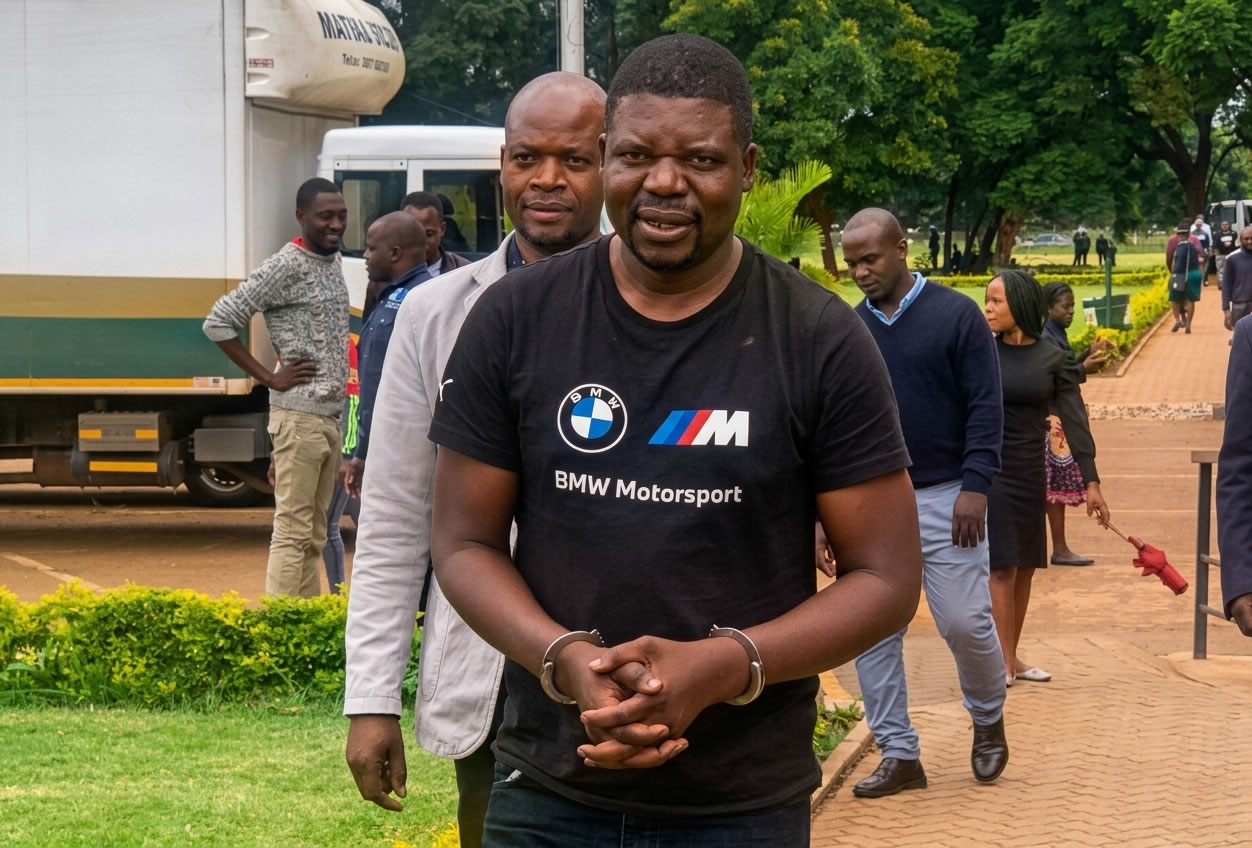
Jaison Muvevi: The Ex-Policeman Who Terrorised Zimbabwe, Sentenced to Four Life Terms
Harare – Jaison Muvevi, a former police detective whose brutal killing spree gripped Zimbabwe in fear, has been handed four life sentences by the High Court. The verdict, delivered by Justice Gibson Mandaza, marks the end of a harrowing chapter that saw Muvevi commit four murders and attempt four others across several provinces. His case has drawn stark comparisons to some of Zimbabwe’s most infamous criminals, cementing his place in the nation’s dark criminal history.
Justice Mandaza, in his ruling, unequivocally stated that “society is safer without the accused,” a sentiment echoed by many across the country. The court dismissed Muvevi’s defence of mental instability, asserting that the prosecution had proven its case beyond reasonable doubt. This decision brings a measure of closure to the victims’ families and to a nation that watched in disbelief as a former law enforcement officer turned into a cold-blooded killer.
Muvevi’s descent into infamy began subtly before escalating into a full-blown rampage. His background as a police detective, particularly within the Criminal Investigations Department (CID), adds a chilling dimension to his crimes. This past experience, meant to uphold law and order, was instead perverted to evade capture and execute his violent acts with a disturbing degree of precision.
The initial murder linked to Muvevi occurred on 19 November 2022, in Harare’s Eastlea suburb. The victim, Nyarai Round, was shot once in the head without apparent provocation. This incident, initially shrouded in mystery, led to the wrongful arrest of another man, Nyasha Eusen. Eusen spent two months in remand prison before charges against him were withdrawn, as investigations eventually pointed to Muvevi as the true culprit. According to court documents, Eusen was with Round when Muvevi approached them, drew his pistol, and shot Round. Eusen attempted to flee but was forced into Muvevi’s vehicle before managing to escape later in Chitungwiza.
The true extent of Muvevi’s depravity became terrifyingly clear on 13 January 2023, when he embarked on a day of unprecedented violence in Wedza. His actions that day would leave three more people dead and several others injured, sparking a massive manhunt that captivated the nation.
The Wedza Rampage: A Day of Terror
The events of 13 January 2023 unfolded with a chilling swiftness, beginning in Negombwe Village, Wedza. Muvevi’s first victim that day was Chrispen Kanerusine, a 62-year-old self-styled prophet. The motive for this brutal killing was reportedly a prophecy delivered by Kanerusine that displeased Muvevi. Incensed, Muvevi retrieved a firearm from his vehicle and shot the prophet once in the head, killing him instantly. This unprovoked act of violence set the stage for the chaos that would follow.
Responding to reports of the shooting, armed police officers swiftly moved to apprehend Muvevi. They cornered him at an area known as Matsine, strategically blocking his vehicle. However, Muvevi, displaying a shocking disregard for authority and human life, opened fire on the officers. Inspector Maxwell Hove, the officer-in-charge of Wedza Police Station, who was unarmed and seated in the front passenger seat of the police truck, was shot three times and tragically succumbed to his injuries.
The attack continued as Muvevi targeted Detective Constable Tendai Mugova, who had sought cover under the police truck. Mugova sustained three gunshot wounds to his left hip, stomach, and right shoulder but miraculously survived the ordeal. In a brazen act, Muvevi disarmed the injured police officers, seizing their weapons before speeding off towards Goto, leaving a scene of carnage and despair.
His rampage was far from over. Muvevi then drove to Murambinda business centre, where he encountered 20-year-old bartender Munashe Majani. For reasons still unclear, Muvevi shot and killed Majani, adding another innocent life to his growing list of victims. The sheer randomness and brutality of these killings underscored the terrifying nature of his spree.
The Desperate Flight and International Manhunt
Following the Murambinda murder, Muvevi made a desperate dash towards the Mozambican border, attempting to escape justice. Along his escape route, he was also accused of the attempted murder of Raphael Nyahwema at Mutare Boys High School. Nyahwema, the son of the school’s caretaker, recounted a harrowing encounter where Muvevi, seeking food, fired three shots at him after he confronted the rogue ex-policeman. Nyahwema narrowly escaped, fleeing for his life as bullets whizzed past him.
The incident at Mutare Boys High School further highlighted Muvevi’s erratic and dangerous behaviour. Witnesses described him as barefooted and wearing a blue work-suit, demanding food and asking for directions to Mozambique. He even spun a tale about being on a mission to kill baboons to explain the gunshots. His presence instilled fear, and his sudden disappearance into the thicket after being confronted by other workers marked his final act of violence on Zimbabwean soil before crossing the border.
An international manhunt was launched, with Zimbabwean authorities collaborating with their Mozambican counterparts. Muvevi’s flight into Mozambique was short-lived. His luck ran out on 16 January 2023, when he was identified attempting to board a commuter omnibus in Manica, Mozambique. A scuffle ensued, and he was apprehended by Mozambican police officers with the assistance of alert civilians. Viral images circulated showing a cornered Muvevi being wrestled to the ground during this brave citizen’s arrest. He was subsequently extradited back to Zimbabwe to face the full force of the law.
The Trial and Verdict: Justice Served
During his trial, Muvevi, through his lawyer Blessed Matandire, pleaded not guilty to all charges, arguing that he was suffering from a mental illness and was being tormented by “evil spirits and goblins”. His defence team claimed that his mother had even taken him to a shrine due to these alleged torments. They sought a special verdict of not guilty by reason of insanity, suggesting he was not criminally responsible for his actions.
However, the High Court, after hearing compelling evidence from 30 state witnesses and considering testimony from prosecutors Caroline Mutimusakwa and Tapiwa Kasema, rejected the insanity plea. Justice Mandaza ruled that the state had successfully proven its case beyond a reasonable doubt, concluding that the defence of mental instability did not apply to the accused.
In aggravation, the prosecution emphasised the premeditated nature of the attacks, their occurrence in public places, the unprovoked violence, and the use of firearms in all instances. They also highlighted that one of the victims was a serving police officer killed in the line of duty. These factors contributed to the court’s decision to impose the maximum effective punishment.
Justice Mandaza’s sentencing of four life terms for each murder conviction, coupled with 10 years’ imprisonment for each of the four attempted murder counts, reflected the gravity of Muvevi’s crimes. The judge’s pronouncement that “society is safer without the accused” resonated deeply, acknowledging the profound impact of Muvevi’s actions on the community and the need for stringent justice.
A Troubling Precedent: Ex-Police and Criminality
Muvevi’s case is particularly disturbing given his background as a former police detective. The trust placed in law enforcement officers makes their involvement in such heinous crimes a profound betrayal of public confidence. While isolated, such incidents raise questions about vetting processes and mental health support within security forces. The Zimbabwe Republic Police (ZRP) has, in the past, dealt with cases of officers engaging in criminal activities, though none have reached the scale of Muvevi’s rampage.
Historically, Zimbabwe has grappled with notorious criminals whose reigns of terror have left indelible marks on the nation’s psyche. Figures like Stephen Chidhumo and Edgar Masendeke, who operated in the mid-1990s, became synonymous with armed robbery, murder, and daring prison breaks. Their story, detailed by the ZRP, involved a series of violent crimes across Masvingo and Manicaland Provinces, repeated evasions of arrest, and even a dramatic escape from Chikurubi Maximum Prison. Chidhumo and Masendeke were eventually apprehended in Mozambique and executed in 2002, bringing an end to their violent careers.
While the scale and nature of Muvevi’s crimes differ in some aspects from those of Chidhumo and Masendeke, the comparison highlights a recurring theme of individuals, often with a history of evading capture, inflicting widespread fear and loss of life. Muvevi’s ability to elude capture for a period, and his eventual arrest in a neighbouring country, draws parallels to the earlier notorious duo, underscoring the challenges faced by law enforcement in tracking down determined criminals.
The Lingering Impact and the Path Forward
The sentencing of Jaison Muvevi closes a painful chapter for Zimbabwe. The memories of his brutal acts, particularly the unprovoked killings and the attack on police officers, will undoubtedly linger. The case serves as a stark reminder of the unpredictable nature of violence and the critical role of justice in restoring order and providing solace to victims.
The community, still reeling from the shock and grief, can now begin the arduous process of healing. The swift and decisive action of the courts, coupled with the collaborative efforts of law enforcement and the public in apprehending Muvevi, reinforces the principle that no one is above the law, regardless of their past affiliations. As Zimbabwe moves forward, the Muvevi case will stand as a grim testament to the importance of vigilance, community cooperation, and an unwavering commitment to justice.