


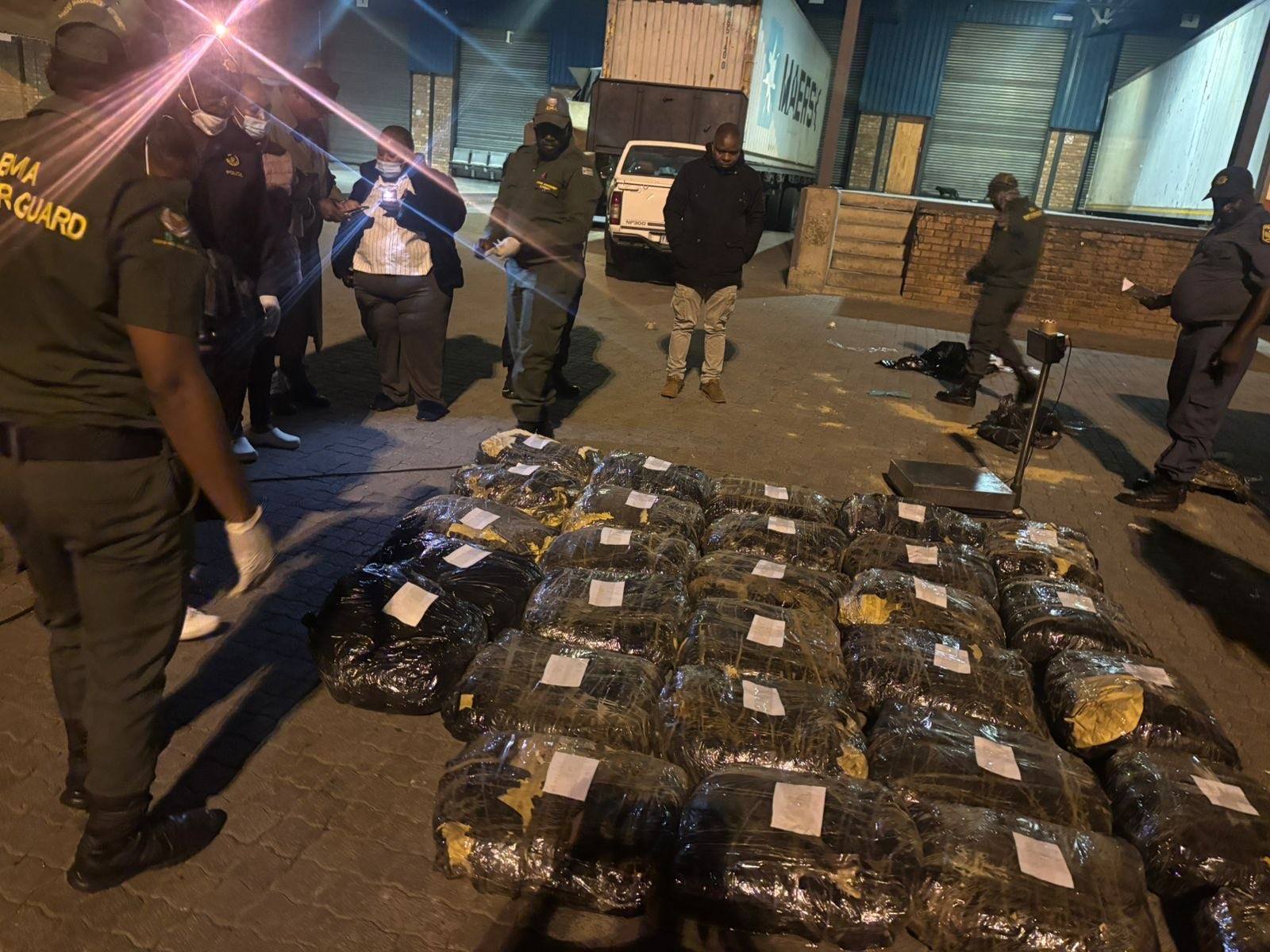
Beitbridge – A recent, colossal seizure of methaqualone, commonly known as “ABBA” powder, at the Beitbridge border post has ripped open the veil on an intricate and highly lucrative drug pipeline that funnels illicit substances through Southern Africa. Valued at nearly R1 billion, this bust by South Africa’s Border Management Authority (BMA) is not merely an isolated incident but a stark revelation of the industrial-scale drug precursor movement, exposing the vulnerabilities of regional borders and the audacious methods employed by international syndicates.
On a recent Wednesday, BMA officers at the Beitbridge Port of Entry intercepted a truck travelling from Malawi, through Zimbabwe, and into South Africa. What began as an intelligence-driven operation culminated in an arduous eight-hour dismantling of the vehicle, revealing a sophisticated false compartment. Inside, authorities discovered a staggering 713,000 grams of methaqualone. This chemical is the primary ingredient for Mandrax, a potent sedative-hypnotic drug that continues to devastate communities across Southern Africa.
The initial valuation of the consignment by Home Affairs Minister Leon Schreiber and BMA Commissioner Michael Masiapato placed its street value at approximately R998.2 million. Minister Schreiber underscored the significance of the seizure, stating, “We are here to provide more information on what is likely the single biggest breakthrough against the drug trade in South African history. What is important to emphasise is that the substance, methaqualone, commonly known as ABBA, is a precursor or an ingredient in Mandrax, which means that the ultimate value of this interception is likely far more than the billion-rand value assigned to this particular.” However, a notable discrepancy emerged when the case appeared in the Musina Magistrate’s Court, where the prosecutor presented a significantly lower valuation of R34 million. This disparity raises critical questions about the methodologies used for drug valuation and the precise stage at which the substance’s value is assessed—whether as a raw precursor or its potential street value once processed into Mandrax tablets.
The journey of this illicit cargo, traversing hundreds of kilometres through Zimbabwe undetected before reaching the South African border, points to a deeply entrenched “conspiracy of the borders.” It compels an examination of how such a massive, high-value shipment could navigate an entire country without official interception. This suggests a well-oiled machine, potentially benefiting from “high-level protection” and exploiting systemic weaknesses within border controls. International syndicates, it appears, perceive the Zimbabwe-South Africa route as a “soft target” for their multi-million dollar operations, leveraging corruption and porous checkpoints to ensure their consignments reach their intended markets.
The term “ABBA” powder, a street name for methaqualone, hints at the clandestine nature of this trade. Methaqualone itself has a complex history. First synthesised in India in 1951 as a potential anti-malarial drug, its sedative properties quickly became apparent. By the 1960s and 70s, it was widely marketed under brand names like Quaalude and Mandrax, gaining notoriety as a recreational drug. Its high potential for abuse and dependence led to its eventual classification as a Schedule 2 psychotropic substance, making its production and distribution illegal. Today, methaqualone is predominantly manufactured in clandestine laboratories, often using relatively simple chemical reactions. A key precursor in its synthesis is anthranilic acid, a chemical also used in the legitimate production of dyes, perfumes, and colourants, making its diversion for illicit purposes a significant challenge for law enforcement.
The impact of Mandrax on Southern African communities is profound. Xolani Khumalo, a crime activist and anti-drug campaigner from ActionSA, articulated the devastating consequences: “The 713,000 grams of methaqualone stopped at Beitbridge would have been turned into Mandrax and flooded townships and informal settlements. Every intercepted consignment saves lives, but many communities are already drowning in addiction, violence and drug-related crime.” He further highlighted the social decay, noting, “Young people drop out of school, parents lose children to addiction, and entire households are torn apart by drugs and criminal activity.” The drug is often smoked in a “white pipe”—a mixture of Mandrax and cannabis—exacerbating its addictive properties and destructive reach.
This recent bust is not an isolated incident but part of a larger, ongoing battle against sophisticated criminal networks. Previous incidents underscore the persistent nature of this threat. In July 2025, a R6 million drug bust occurred at the Groblersbrug Port of Entry, leading to the arrest of a 45-year-old male truck driver. Earlier, in October 2024, a Mandrax laboratory valued at R4 million was uncovered in Makotse village, Lebowakgomo. These events, alongside investigations by the South African Revenue Service (SARS) into “ghost trucks”—vehicles that enter the customs system but are never officially recorded as exiting, allowing them to offload illicit cargo—paint a grim picture of the challenges faced by authorities.
The sheer scale of the R1 billion valuation, even with the court’s lower figure for the precursor, is staggering. To put it into perspective, such an amount could fund an entire political campaign or even a private army, illustrating the immense power and influence wielded by these criminal organisations. Yusuf Abramjee, founder of Tax Justice South Africa (TJSA), emphasised this broader threat: “Illicit trade fuels criminal syndicates, deprives the fiscus of revenue, undermines legitimate businesses, destroys jobs and contributes to a culture of lawlessness that affects every South African.” He added that these syndicates are often intertwined with corruption, money laundering, human trafficking, and extortion, posing a multifaceted threat to national security and economic stability.
BMA Commissioner Dr Michael Masiapato, while commending the success of the operation, acknowledged the ongoing struggle: “This interception sends a strong message that South Africa’s borders are not a safe passage for organised criminal activities. The BMA remains committed to strengthening border security, combating transnational crime, and protecting the country from illicit activities that threaten our communities and economy.” However, critics like Khumalo argue that while such seizures are vital, they represent only a fraction of the drugs infiltrating the country. He stressed that securing borders requires more than just deploying additional officers; it demands advanced technology, rigorous vetting of officials, and severe consequences for corruption.
The Beitbridge bust serves as a critical juncture, forcing a deeper inquiry into Zimbabwe’s role as an unwitting, or perhaps complicit, transit hub for global narcotics. The “shadow war” being fought at our borders involves not only visible seizures but also the invisible chemicals that, once processed, become instruments of destruction in countless lives. This incident is a potent reminder that the fight against organised crime is a continuous, complex endeavour, requiring sustained intelligence, inter-agency cooperation, and an unwavering commitment to dismantle the sophisticated networks that profit from human misery.