


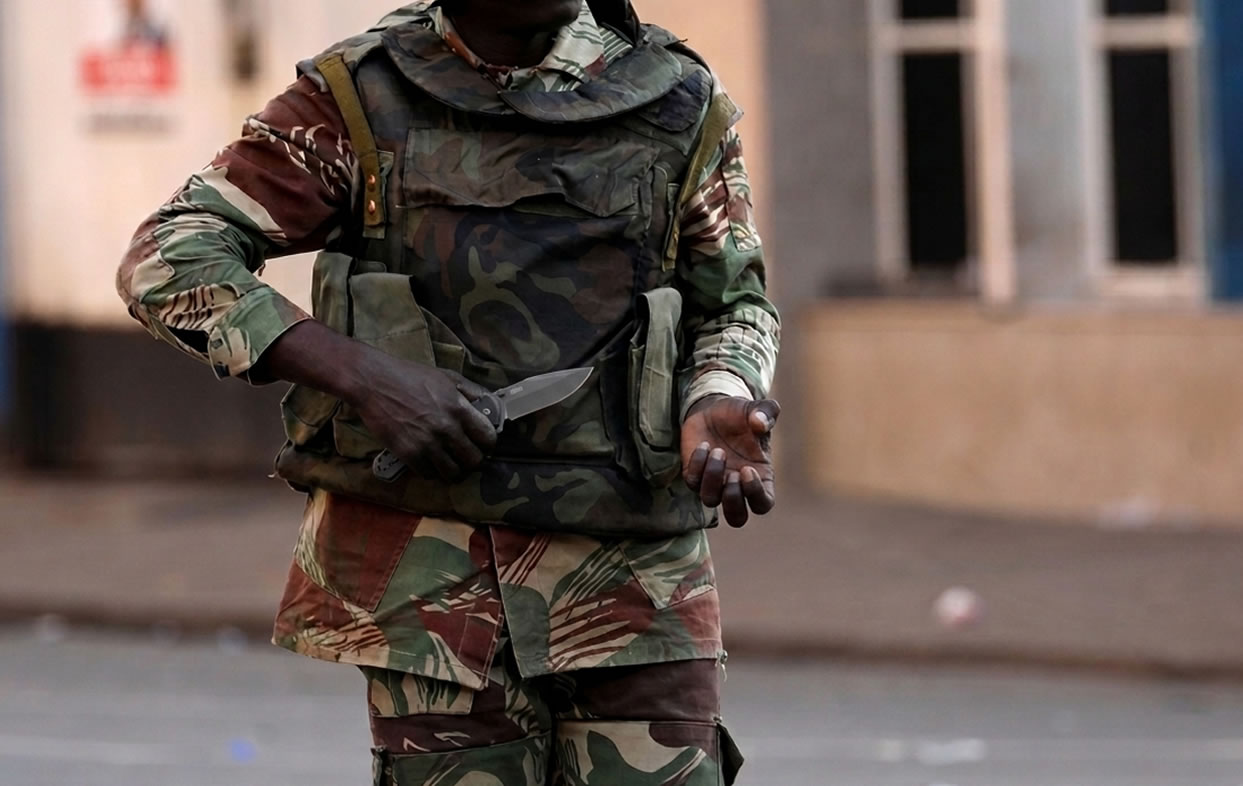
A chilling incident has cast a long shadow over Zimbabwe, as a serving soldier from the elite One Commando Regiment, Learnmore Gwenyaya, has been incarcerated for four years following a brutal knife-point robbery of a Roman Catholic priest, Father Kanisious Mashati, in Headlands. The audacious crime, which saw Gwenyaya and two accomplices invade the priest’s residence armed with an iron bar, a shovel, and an okapi knife, has ignited serious questions regarding discipline within the armed forces and the wider issue of law and order in the nation.
The incident, which unfolded on 8 December 2025, saw Gwenyaya arrested within hours, while his two accomplices remain at large, fuelling concerns of a more extensive criminal network at play. This is not merely an isolated case of robbery; it hints at a more profound societal problem where individuals entrusted with national security appear to be resorting to violent crime. The involvement of a soldier in such a heinous act inevitably erodes public trust in the very institutions designed to safeguard citizens.
According to reports from The Manica Post, 31-year-old Learnmore Gwenyaya, who resides at One Commando Regiment Block 5 in Harare, appeared before Rusape provincial magistrate Tendai Mahwe. He pleaded guilty to the robbery charges, leading to a sentence of five years in prison, with one year suspended on condition of good behaviour, resulting in an effective four-year jail term.
Prosecutor Faith Mutukwa detailed the harrowing events in court. She explained that on the evening of 7 December 2025, at approximately 9pm, Father Mashati had retired to bed, having secured his bedroom door and the main entrance. A domestic worker, Ms Margret Mafeni, had ensured all windows were closed. However, in the early hours of the following morning, Gwenyaya and his accomplices approached the property, armed with their assortment of weapons.
The court heard that the intruders allegedly gained entry to the house using duplicate keys before forcing their way into the priest’s bedroom. “The accused persons assaulted him using an iron bar and a shovel as the complainant fought back,” Mutukwa stated. Father Mashati, demonstrating remarkable courage, resisted his attackers, even managing to injure Gwenyaya with a wine bottle during the struggle. Despite his valiant efforts, the priest was eventually overwhelmed and forced to surrender after one of the suspects allegedly threatened him with an okapi knife. The robbers then ransacked the room, making off with an Itel A70 mobile phone. The full extent of Father Mashati’s injuries was not disclosed during the court proceedings.
The swift response of law enforcement led to Gwenyaya’s capture. Police officers on night patrol intercepted the suspects at Halfway House along the Harare-Mutare Road at around 3:30am, roughly two hours after the robbery. “Police officers approached the three, and two of his accomplices fled, while Gwenyaya was arrested,” Mutukwa informed the court. A subsequent search of Gwenyaya’s satchel revealed a live cartridge. This ammunition was later examined by ZRP Ballistics, confirming it to be live. For the unlawful possession of ammunition, Gwenyaya was fined US$300 or faced four months’ imprisonment in default of payment. The court also ordered the forfeiture of the ammunition to the State. Meanwhile, the two suspects who evaded capture during the police operation remain at large, with investigations ongoing.
This incident is not an isolated anomaly but rather a symptom of a disturbing trend that has seen a rise in armed robberies involving both serving and former members of the Zimbabwe National Army (ZNA). The recurrence of such crimes compels a critical examination of the socio-economic pressures that might be driving even uniformed personnel, sworn to uphold peace and order, to engage in criminal activities. It also raises serious questions about the effectiveness of internal disciplinary mechanisms within the military.
Again, December last year, three soldiers were apprehended in Bulawayo for a robbery spree in Fort Rixon. Iphithule Mlotshwa (24), Hamlet Mlotshwa (21), and Haulezwe Mlotshwa (25) appeared before magistrate Shingirai Mutiro, facing multiple robbery charges. Prosecutor Nkanyezi Xaba told the court that on 24 December, the trio stormed the Claremont mining area in Fort Rixon, armed with axes, knives, electric shock devices, handcuffs, and torches. They allegedly broke into the bedroom of Qondisani Moyo, assaulted him, handcuffed him, and stole US$2,800. The gang then proceeded to the home of Trust Ndlovu, where they reportedly stole a smartphone worth US$100. They also robbed Bukhosi Mkandla of US$350 after entering his bedroom. At Claremont Business Centre, the suspects allegedly attacked Atila Nyathi and took US$1,200. The court heard that they also severely assaulted Press Luphahla after finding him without any valuables. These soldiers, wearing ZNA uniforms, were remanded in custody until 9 January of the following year.
Another incident in April 2024 saw police arresting nine suspected armed robbers, including four serving soldiers, in connection with a spate of robberies across Harare, Murehwa, and Shamva. The pattern of military personnel being implicated in violent crimes is deeply troubling. These incidents underscore a growing concern among the populace: how can those tasked with protecting the nation become perpetrators of violence against its citizens?
The proliferation of such cases points to underlying issues that extend beyond individual culpability. Reports and discussions within Zimbabwean society have frequently highlighted the challenging living conditions and low remuneration faced by soldiers, leading to speculation that economic hardship could be a significant factor in driving some to crime. While poverty can never justify criminal acts, understanding the root causes is crucial for addressing the problem effectively. The integrity of the protective forces is paramount for any nation, and when that integrity is compromised by those within its ranks, it demands a thorough and transparent response.