


Midnight Seizures and Silent Panic: Inside the Clandestine Crackdown on Harare’s Elite
HARARE — The neon lights of the capital’s high-end bars and the quiet, manicured streets of Borrowdale have long served as a stage for Zimbabwe’s “big toys”. For years, the sight of a brand-new Mercedes-Benz G63 AMG or a sleek Lamborghini Urus tearing down Enterprise Road was a symbol of untouchable wealth. But in the cold, dark hours of recent nights, that symbol has turned into a liability. The Zimbabwe Revenue Authority (ZIMRA), in a series of unprecedented midnight raids, has begun a clandestine probe that is shaking the foundations of Harare’s social hierarchy.
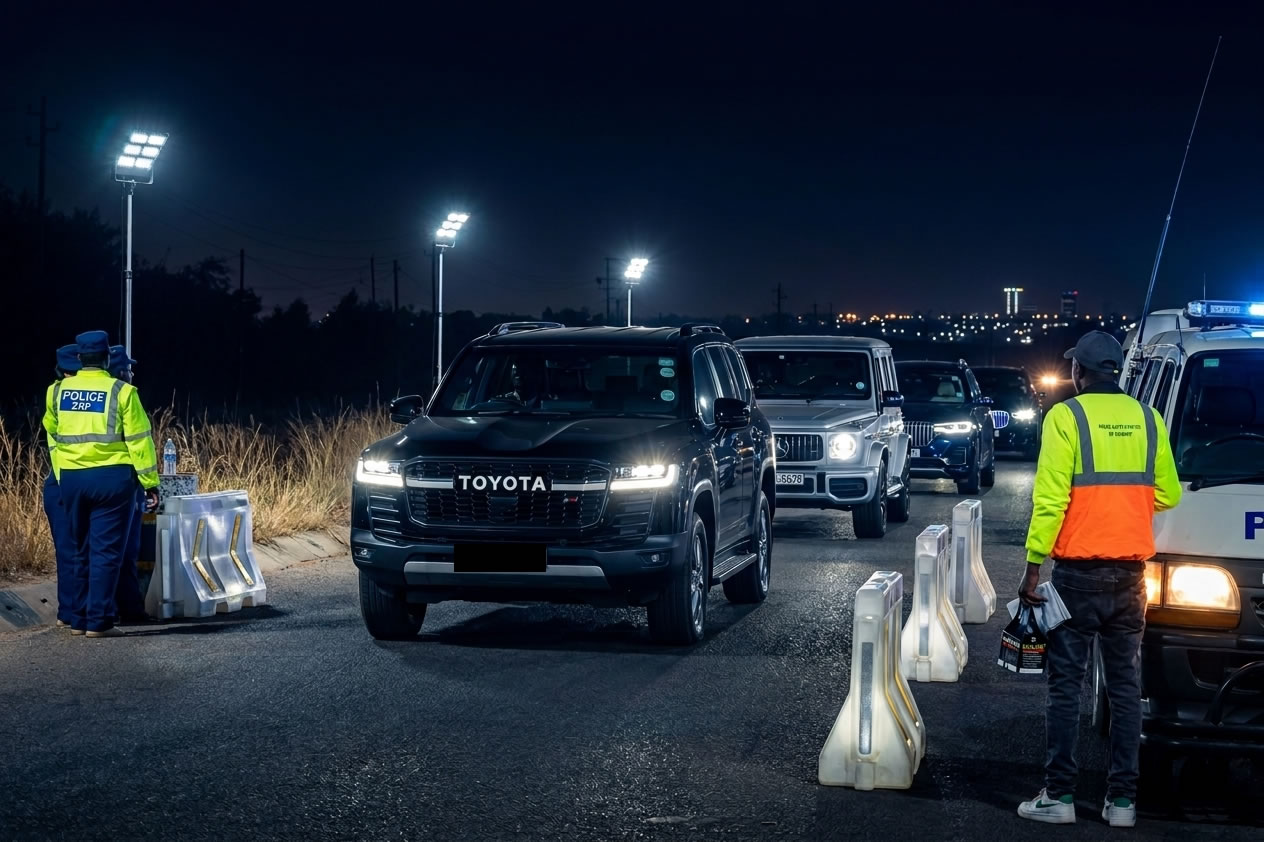
What started as a whisper in exclusive WhatsApp groups has escalated into a full-blown crisis for the city’s business moguls and politically connected figures. Under the cover of darkness, ZIMRA officials, reportedly supported by specialised units from the Zimbabwe Republic Police (ZRP), have been setting up mobile checkpoints and conducting targeted “snatch-and-grab” operations. Their mission: to uncover a multi-million-dollar tax evasion scheme that has allowed the country’s ultra-wealthy to bypass the very customs duties that keep the national treasury afloat.
The Mechanics of the “Document Laundry”
At the heart of this investigation is a sophisticated smuggling ring that exploits the Temporary Import Permit (TIP) system. Originally designed to allow visitors from neighbouring countries like South Africa or Botswana to bring their personal vehicles into Zimbabwe for a limited stay, the TIP has been weaponised by local residents. Investigative sources suggest that high-flyers are purchasing luxury vehicles abroad, bringing them across the border under the guise of a visitor’s permit, and then simply never taking them back.
“It is a classic case of document laundry,” says one clearing agent who spoke on the condition of anonymity, fearing retribution from both the taxman and his former clients. “A car comes in on a TIP, which is meant for three months. Instead of leaving, the owner pays a fixer to forge local registration papers and customs clearance certificates. Suddenly, a car that should have paid US$100,000 in duty has a local number plate for a fraction of the cost. These guys thought they were above the law because they had the right phone numbers in their contacts list.”
The scale of the fraud is staggering. ZIMRA investigators believe that hundreds of vehicles currently roaming the streets of Harare are “ghost cars”—legally non-existent in the tax database but physically present on the roads. The loopholes being exploited range from forged paperwork to the blatant abuse of duty-free vehicle import schemes originally intended for civil servants. Recent reports indicate that more than 50 vehicles, worth an estimated US$2 million, were recently recovered by the Zimbabwe Anti-Corruption Commission (ZACC) following a similar probe into the misuse of government perks.
The “Minefield” of Harare’s Streets
The atmosphere in the capital has shifted from one of flamboyant display to one of paranoid caution. The streets of Harare, once a showcase for the latest luxury models, have become a minefield for those with questionable car titles. Witnesses in Belgravia and along Lomagundi Road have described scenes of “big toys” being pulled over and loaded onto flatbed trucks while their owners stand helplessly on the pavement.
“They are pulling out only the expensive vehicles,” noted one witness who saw a late-model Range Rover being impounded near a popular shopping centre. “It’s not the usual traffic stop for a fire extinguisher or a spare wheel. They are looking at the chassis numbers; they are checking the digital footprints of the registration. If the papers don’t match the system, the car is gone.”
Many of these impounded vehicles are being ferried to the Manica Container Depot and other secure locations like Bak Storage. The depot, usually a hub for legitimate trade, has been transformed into a high-stakes car park for the rich and infamous. Rows of Ferraris, Bentleys, and top-of-the-range SUVs sit under guard, their fate hanging on whether their owners can produce genuine customs clearance documents—something many are reportedly scrambling to do.
The Silent Taxman
One of the most unsettling aspects of the operation for Harare’s elite is the lack of official statements from ZIMRA. The authority has maintained a stony silence, neither confirming nor denying the specific targets of the probe. This secrecy has only added to the tension, fueling speculation that this is not just a routine revenue-collection exercise, but a strategic move to exert pressure on certain segments of the elite.
Is this a genuine effort to restore fiscal discipline, or is there a deeper political undercurrent? In a country where wealth and politics are often inextricably linked, the “Massive Midnight Raids” are being viewed through multiple lenses. For the average Zimbabwean struggling with the rising cost of living, the sight of the wealthy being held to account is a rare moment of fiscal justice. For those in the crosshairs, however, it feels like a betrayal of the status quo.
“The silence from ZIMRA is the loudest part of this whole thing,” says a local economic analyst. “By not saying who they are targeting, they are making everyone with a luxury car feel like a target. It’s a psychological game as much as it is a legal one. The taxman’s shadow has never loomed larger.”
A Pattern of Illicit Wealth
This current crackdown does not exist in a vacuum. It follows a string of high-profile incidents that have highlighted the porous nature of Zimbabwe’s borders and the audacity of smuggling rings. In 2025, a Zimbabwean couple residing in East London was arrested in connection with a multi-million-pound luxury car smuggling operation that saw stolen high-end vehicles shipped from the UK to Southern Africa. Such cases have provided ZIMRA with the intelligence needed to map out the local networks that receive and “regularise” these vehicles.
Furthermore, the recent “Public Notice 37 of 2025” gave motorists a moratorium to regularise improperly cleared vehicles. That window has long since slammed shut. ZIMRA’s message was clear: regularise now or face forfeiture. It appears that many chose to gamble, betting that their connections would shield them from the consequences. They were wrong.
The probe has also turned its gaze toward the internal corruption within the revenue authority itself. In previous years, forensic audits have led to the suspension of senior executives over the very same issues—undervalued imports and the fraudulent clearance of luxury cars. The current “Midnight Raids” suggest that ZIMRA is now trying to clean its own house while simultaneously hunting down the beneficiaries of past corruption.
The Fallout for the “High-Flyers”
For the business moguls and politically connected figures caught in the net, the fallout could be devastating. Beyond the loss of their “big toys,” there is the looming threat of criminal prosecution for tax evasion and fraud. Under the Customs and Excise Act, the penalties for such offences are severe, including heavy fines and the permanent forfeiture of the vehicles to the state.
As the investigation continues, the social scene in Harare has taken a noticeable hit. The usual convoys of luxury cars that grace high-profile weddings and “all-white” parties have thinned out. Some owners have reportedly opted to hide their assets in private garages or move them to rural estates, hoping to wait out the storm. But with ZIMRA’s reach extending into digital registration systems and international databases, there are few places left to hide.
The multi-million-dollar tax evasion scheme being uncovered is a stark reminder of the massive revenue leakages that have plagued the country. While the elite enjoyed the prestige of their imported luxury, the national treasury was being deprived of the funds needed for public services. This probe, regardless of its underlying motivations, is a direct challenge to the culture of impunity that has allowed such schemes to flourish for decades.
Conclusion: A New Era of Accountability?
As the sun rises over Harare, the question remains: is this the beginning of a new era of accountability, or just a temporary disruption in the lives of the rich? The streets may be quieter, and the “big toys” may be under lock and key at the Manica Container Depot, but the true test will be in the courtrooms and the final revenue tallies.
For now, the message to Harare’s high-flyers is unmistakable. The days of bypassing official channels and utilizing forged paperwork are numbered. The taxman is no longer just waiting at the border; he is patrolling the streets at midnight, and he is armed with the facts. For those who thought they were above the law, the “Massive Midnight Raids” are a chilling reminder that in the eyes of the revenue authority, even the most expensive car can be reduced to a pile of impounded metal if its papers are not in order.
The investigation delves deeper every night, and as more names surface, the panic among the elite shows no sign of subsiding. In the battle between the taxman and the “rich guys,” the shadow of the law is finally catching up to the speed of the luxury engines.