


Bribes, Betrayal, and the Battle for Zimbabwe’s Soul: The Dark Underbelly of CAB3
HARARE – The hallowed halls of Zimbabwe’s Parliament, usually a theatre of rehearsed rhetoric and partisan posturing, have been transformed into a marketplace of a far more sinister kind. As the nation teeters on the edge of a constitutional precipice, explosive allegations of a massive bribery scheme have emerged, threatening to dismantle what remains of the country’s democratic integrity.
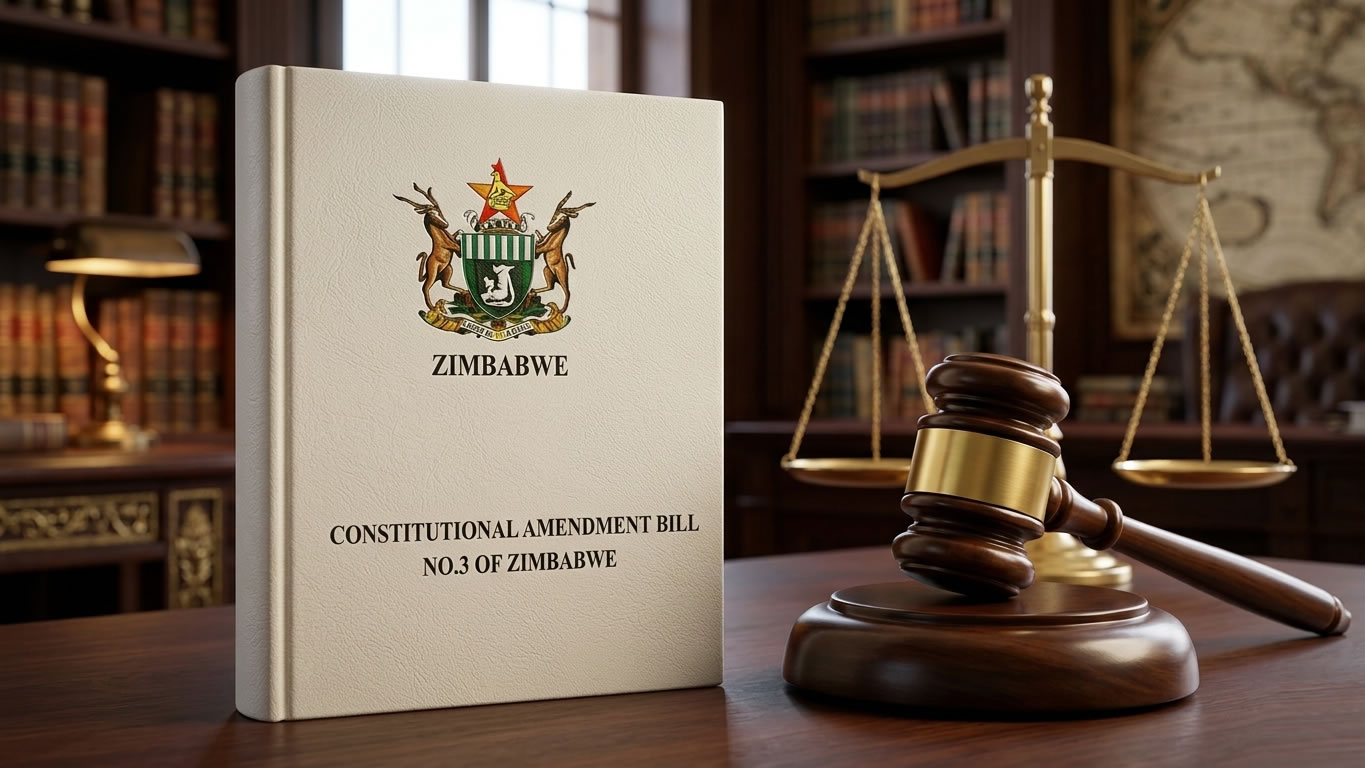
At the heart of the storm is the Constitutional Amendment Bill No. 3 (CAB3), a piece of legislation so contentious that it has forced the ruling Zanu PF party to pause its legislative steamroller. Reliable sources within the corridors of power have revealed that a staggering US$10,000 has been dangled before legislators to secure their support for the bill. In a country where the economy remains in a state of perennial fragility, such a sum is not merely an incentive; it is a life-changing windfall, and for some, a price tag for their political soul.
The vote, which was widely expected to be a formality this week, has been abruptly postponed until next week. While official channels cite the need for “further engagement,” the reality on the ground suggests a frantic effort by the authorities to manage the fallout from the bribery claims. The delay is a rare admission of friction in a process that was supposed to be a swift consolidation of power.
The Seven-Year Itch and the Price of Influence
The CAB3 is not a mere administrative tweak. It is a radical restructuring of Zimbabwe’s political landscape. If passed in its current form, the bill would extend the presidential and parliamentary terms from five to seven years. Perhaps more critically, it seeks to transfer the power to elect the President from the general electorate to Parliament itself – a move critics argue is a direct assault on the principle of universal suffrage.
The bill also aims to restructure the Zimbabwe Electoral Delimitation Commission, further centralising control over the electoral process. To many observers, these amendments are the blueprints for a one-party state, designed to entrench the current administration’s grip on power indefinitely. The US$10,000 figure, a substantial sum in the Zimbabwean context, highlights the desperation of those pushing for the bill’s passage. Citizens are demanding answers: who is behind these alleged bribes, and what are they truly trying to achieve by fast-tracking such a controversial bill?
The scandal not only undermines public trust in democratic institutions but also casts a long shadow over the legitimacy of any future constitutional changes. This incident is a stark reminder of the constant battle against corruption and the urgent need for transparency in Zimbabwe’s political arena, as the nation grapples with the potential long-term consequences of a compromised legislative process.
Adding another layer of controversy to the already fraught process, outspoken former Norton legislator Temba Mliswa has sharply criticised tenderpreneur Wicknell Chivayo for rewarding opposition lawmakers who support CAB3. Mliswa warned that these gifts risk undermining the credibility of the legislative process, suggesting that such actions were unnecessary and potentially harmful. He questioned why Chivayo continued to involve himself in efforts surrounding the constitutional amendment, arguing that Zanu PF already possesses sufficient numbers in Parliament to secure the Bill’s passage without external intervention.
Mliswa, addressing Chivayo by his totem, Moyo (Gono – Chirandu), asserted that the ruling party’s 194 MPs were more than enough to secure the two-thirds majority required to pass the Bill, even if all 86 opposition legislators voted against it. He further contended that some opposition MPs support aspects of CAB3 because they stand to benefit from provisions such as extending parliamentary and presidential terms. “Who among them would decline an opportunity to extend their tenure in office without the burden of costly elections?” Mliswa wrote, implying that some parliamentary opposition to the Bill was little more than political theatre.
The former MP accused Chivayo of seeking recognition for helping secure support for the amendment, warning that public gifts and financial rewards created the perception that lawmakers were being influenced through inducements, thereby exposing the constitutional amendment process to allegations of bribery. “The party has already done its homework and these extravagant incentives only undermine the legitimacy of the process,” Mliswa stated. While acknowledging Chivayo’s wealth-generating abilities, Mliswa expressed disagreement with the manner in which the businessman deployed his resources in political matters, cautioning that such public displays of generosity could become a liability for the Bill’s supporters. He reminded politicians that accepting gifts did not necessarily guarantee political loyalty, emphasising that elected representatives would ultimately have to act according to the wishes of the people.
These comments from Mliswa come amidst growing controversy over Chivayo’s rewards for MPs who have publicly endorsed CAB3. Notably, Citizens Coalition for Change (CCC) proportional representation MP Samantha Mureyani was announced to receive a brand-new 2026 Toyota Fortuner 2.8 GD6 and US$50,000 for constituency development after she backed the Bill during debate in the National Assembly. Mureyani, who entered Parliament in 2024 through an appointment by self-declared Secretary General Sengezo Tshabangu, argued that electing a president through Parliament could reduce political violence, lower election costs, and promote greater cooperation between the executive and legislature. She also supported proposals to extend presidential terms from five to seven years, citing the need for greater policy continuity for long-term national development projects.
Mureyani is not an isolated case. Budiriro North MP Susan Matsunga was previously awarded a new Toyota Fortuner 4×4 and US$50,000 after publicly praising President Emmerson Mnangagwa and government development initiatives. Chivayo described Matsunga’s actions as evidence of “political maturity” and stated that the financial support was intended to assist community development projects and programmes aimed at empowering women and young people. As debate over CAB3 intensifies, Chivayo’s involvement has become a new flashpoint, with critics arguing that the gifts raise ethical concerns while supporters insist they are legitimate acts of recognition and philanthropy.
The Unlikely Kingmaker
Sources familiar with the negotiations said discussions took place on Wednesday between senior Zanu PF officials and Tshabangu ahead of an anticipated vote in the National Assembly. These talks have already yielded some concessions. Negotiators have reportedly agreed to remove Clause 18 of the Bill, which sought to abolish the Zimbabwe Gender Commission.
Chalton Hwende, a prominent political figure, confirmed that the commission would remain intact. “The Gender Commission will now remain as it is in the Constitution, following strong public opposition to the amendment,” Hwende said. “I had submitted an amendment, which is on the Order Paper, against the disbandment of the commission. This issue is now settled.”
Tshabangu’s spokesperson, Nqobizitha Mlilo, has been vocal in defending this engagement. “We are actively engaged in getting meaningful concessions from Zanu PF,” Mlilo said. “The discussions have been frank, cordial and respectful.” He went on to praise Justice, Legal and Parliamentary Affairs Minister Ziyambi Ziyambi for his willingness to listen. “Where we have persuaded him and he has found our input reasonable, he has so far made concessions,” Mlilo added, arguing that “we must be at the negotiating table with Zanu PF for a broad-based political settlement.”
However, many in the opposition see this not as a settlement, but as a surrender. Tshabangu’s strategy, which Mlilo claims “history would ultimately judge favourably,” is viewed by critics as the final nail in the coffin of a genuine opposition.
A House Divided
The external pressure is matched by internal fissures within Zanu PF. The most significant voice of dissent belongs to Vice-President Constantino Chiwenga. The former army general, who led the 2017 military intervention that ended Robert Mugabe’s 37-year rule, has publicly voiced his opposition to extending presidential terms.
Chiwenga’s stance is not merely ideological; it is deeply personal. Political analysts view him as the figure most affected by proposals that could reshape succession dynamics within the ruling party. Having waited in the wings since the 2017 “Operation Restore Legacy,” Chiwenga sees the proposed extension as a direct threat to his own presidential ambitions.
The Vice-President has previously warned Zanu PF against repeating mistakes associated with the final years of former President Robert Mugabe, whose removal from office in 2017 followed growing internal divisions within the ruling party. His warnings have resonated with a segment of the party that fears a return to the chaotic factionalism of the Mugabe era.
This internal rift was further highlighted by the intervention of retired military officers and senior civil servants. A group represented by Henry Muchena has argued that the changes are being driven by individuals pursuing narrow political interests rather than broader national objectives. This rare public dissent from the security and bureaucratic establishment suggests that the bill has touched a nerve deep within the state apparatus.
The Mechanics of Power
The negotiations have also touched upon the very mechanism of presidential elections. Under proposals reportedly advanced by Tshabangu’s faction, parliamentary candidates would declare their preferred presidential candidate when filing nomination papers with the Zimbabwe Electoral Commission. Furthermore, a presidential candidate would need to secure more than 50 per cent of parliamentary votes to be elected.
This shift would fundamentally alter the relationship between the executive and the legislature, making the President beholden to the party machinery rather than the people. It is a system that favours stability over accountability, and party loyalty over public will.
Despite the reports of these detailed discussions, Zanu PF chief whip Pupurai Togarepi has moved to downplay any formal agreements. He dismissed reports that formal arrangements had been reached, stating that no such arrangements had been discussed. This denial suggests a party still trying to project a unified front while privately horse-trading for its survival.
The Ghost of 2017
The current crisis cannot be understood without the context of the 2017 coup. The alliance between Emmerson Mnangagwa and Constantino Chiwenga was always a marriage of convenience, born of a shared need to oust Mugabe. Now, that alliance is being tested by the very thing it sought to control: the succession.
The CAB3 is seen by many as Mnangagwa’s attempt to bypass the informal agreement that would have seen him serve two terms and then hand over the reins to Chiwenga. By extending the terms and changing the election method, Mnangagwa is effectively rewriting the rules of the game mid-match.
The bribery allegations add a layer of desperation to this power struggle. If legislators are indeed being bought, it suggests that the ruling party no longer trusts its own internal discipline or its ability to persuade. It is a governance by transaction, where the currency is US dollars and the commodity is the country’s future.
A Nation in Waiting
As Parliament prepares to resume debate next week, the atmosphere in Harare is one of guarded anticipation. The delay has provided a brief window for public discourse, but the weight of the state remains formidable. The removal of the clause affecting the Gender Commission shows that the government is sensitive to public pressure, but the core of the bill – the term extensions and the electoral changes – remains on the table.
The alleged bribery scheme, if proven, would expose a dark underbelly of political manipulation, where national interests are sacrificed for personal gain and power consolidation. The US$10,000 figure, while significant, is a small price for those who stand to gain decades of unchecked authority.
For the ordinary Zimbabwean, struggling with triple-digit inflation and a crumbling infrastructure, the machinations in Parliament seem a world away. Yet, the consequences of this vote will be felt in every home. Whether Zimbabwe continues on its path toward a one-party state or finds a way to preserve its democratic aspirations depends on what happens in the coming days.
The seasoned investigative journalist knows that in Zimbabwe, the story is never just what is on the Order Paper. It is in the whispered conversations in the corridors, the brown envelopes exchanged in the shadows, and the silent battle between two men who once stood side by side to “restore legacy,” but now find themselves on opposite sides of a constitutional divide.
As the sun sets over the balancing rocks of Epworth, the question remains: is Zimbabwe’s constitution a sacred document to be protected, or merely a piece of paper to be edited by the highest bidder? The answer, it seems, is currently being negotiated for US$10,000 a vote.