


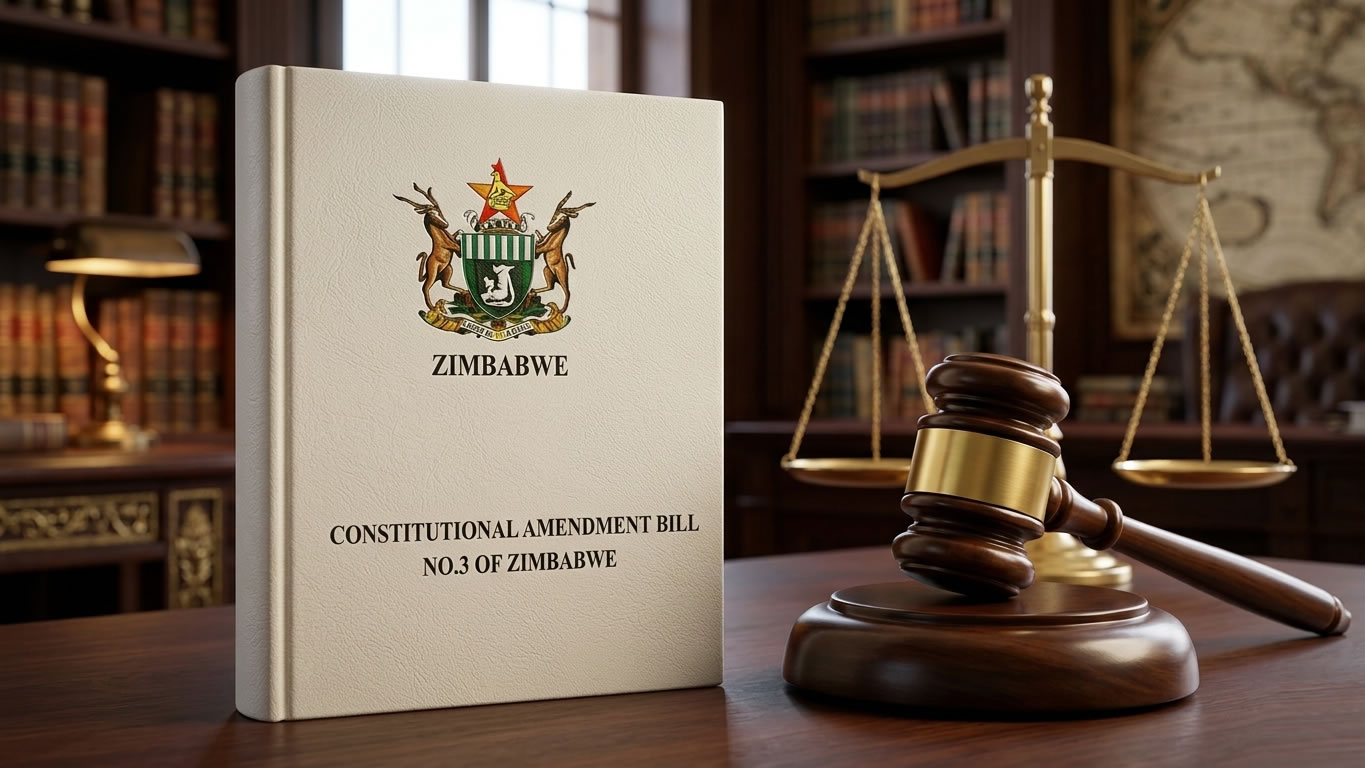
The Price of Power: Inside the Brazen Campaign to Rewrite Zimbabwe’s Constitution
HARARE — Inside the high-ceilinged chambers of the National Assembly in Mt Hampden this June, the air has been thick with more than just the winter chill. A historic struggle for the soul of Zimbabwe’s 2013 constitution is unfolding. As the ruling Zanu PF party moves to consolidate power through the Constitution of Zimbabwe Amendment (No. 3) Bill, known widely as CAB 3, a courageous cohort of opposition lawmakers has emerged as the final line of defence against what they describe as a “monumental democratic regression.”
The controversy comes amid allegations of vote-buying involving legislators from across the political divide. Critics say these inducements are meant to secure the votes to pave the way for President Emmerson Mnangagwa’s term extension by two years to 2030. Under the proposed changes, lawmakers and councillors would also benefit from the term extension, effectively lengthening their stay in office without a fresh mandate from the electorate.
The stakes could not be higher. While the government benches argue that these changes are necessary for “stability” and the achievement of “Vision 2030,” the opposition has successfully framed the bill as an existential threat to the Republic. Leading the charge, Dzivarasekwa MP Edwin Mushoriwa stripped away the government’s administrative veneer, declaring that the bill is about “one thing and one thing alone, which is the accumulation and the preservation of political power.” He argued that while the 2013 constitution was designed to limit politicians, CAB 3 seeks to “reverse every democratic gain,” transferring sovereignty from the people back to the political elite.
The Billionaire’s Bounty
At the heart of the scandal is a series of high-profile donations that have blurred the lines between private philanthropy and political bribery. Tenderpreneur Wicknell Chivayo and special presidential investment adviser Paul Tungwarara have been central to these gestures, which critics say are designed to drum up support for CAB 3.
Last week, Chivayo gifted two MPs — Remigious Matangira and Samantha Mureyani — luxury vehicles and cash following their contribution to debate in the National Assembly in support of the bill. Reports suggest that legislators supporting the amendment received as much as US$50,000 in cash. Chivayo had previously pledged US$3.6 million to all 360 Members of Parliament, though he later withdrew the offer following criticism from Zanu PF deputy national secretary for youth affairs John Paradza.
The controversy deepened when Tungwarara donated a car and US$200,000 to Zanu PF loyalist-turned-critic Rutendo Matinyarare. Observers say this was an attempt to neutralise Matinyarare, who has been a vocal critic of CAB 3 and Mnangagwa. Matinyarare claimed he was not paid for work done in defending Zimbabwe’s image and lobbying against sanctions. The gesture drew fire from Zanu PF loyalists, who accused the presidential adviser of rewarding a man for attacking the President.
Former MP Temba Mliswa, now president of the Zimbabwe Village Heads Association, took to social media to condemn the gifting of vehicles during a critical constitutional debate. He warned that such donations risk undermining democratic processes. “Parliament is an institution of the people. It represents the people and provides oversight over the Executive,” Mliswa said. He argued that lawmakers should not be exposed to inducements while performing their constitutional duties. However, the saga took another turn when Chivayo hit back, claiming Mliswa himself had accepted a Ford Raptor truck worth US$107,000.
A Bill of Contradictions
CAB 3 is not a simple administrative update; it is a sweeping overhaul of how Zimbabwe is governed. Harare West legislator Joana Mamombe delivered a blistering rejection of the legislation, telling Parliament that it weakens democracy and erodes sovereignty. “Our Constitution is not an ordinary statute. It is the supreme law and a social contract between citizens and the State,” she told the House. “The fundamental question is: does this Bill strengthen the sovereignty of the people, or does it take power from the people and concentrate it in the Executive?”
One of the most contentious points is Clause 2, which moves voter registration and custody of the voters’ roll from the Zimbabwe Electoral Commission (ZEC) to the Registrar-General’s office. “Whoever controls the voters’ roll controls a critical part of our electoral process. This weakens electoral independence and places it under an office without the same constitutional safeguards,” Mamombe argued.
Even more alarming to the opposition is Clause 3, which proposes that Parliament elect the President instead of a direct public vote. Mamombe described this as “one of the most dangerous” provisions. “The people of Harare West are clear: the President must be elected directly by the people. One person, one vote. Why should an elected few decide for the majority?” she asked. She warned that the clause invites patronage, bribery, and intimidation, potentially allowing a person rejected by the voters to become President.
The bill also seeks to extend presidential and parliamentary terms from five to seven years. On Clauses 4, 9, and 10, Mamombe noted that no candidate in the 2023 election sought a seven-year mandate. “To extend the term after an election is to alter the people’s mandate after it has been given. Section 328 (7) is a constitutional firewall against self-serving amendments,” she said.
Bread vs. Politics
While politicians haggle over clauses and terms, the reality on the ground for ordinary Zimbabweans remains grim. In the Chikanga constituency, MP Lynette Karenyi-Kore has fired a salvo at the bill, declaring she will not support a law that ignores the cries for jobs and food.
“When I travel across my constituency, I do not hear people asking for constitutional amendments, I do not hear mothers asking for CAB 3, I do not hear unemployed youths demanding CAB 3… Mr Speaker, what I hear are cries for jobs… calls for affordable education, pleas for food on the table Mr Speaker,” Karenyi-Kore said during a recent debate. She argued that the timing is wrong as families battle poverty, school dropouts, and drug abuse. “Mr Speaker, people want bread, not political engineering, they want opportunities and not constitutional experiments, they want service delivery, not extension of political power.”
This sentiment is shared by Ropafadzo Makumire, the MP for Chiredzi Central. He recounted how his constituents asked why the government was focused on “adding two more years” when patients in local hospitals were “giving birth on hospital floors” and medication was non-existent. He dismissed the bill as a “cover-up for failure,” noting that poverty will only increase if the current administration extends its stay without addressing the economic quagmire.
The Price of Dissent
Opposing the bill has come at a high cost. Public hearings held across the country were marred by violence and intimidation. In Harare, human rights lawyer Doug Coltart was assaulted by suspected Zanu PF supporters as he tried to leave a public hearing at the City Sport Centre. His phone was snatched, and his spectacles were broken. One of the alleged assailants was later identified as Luckmore Tinashe Gapa, a member of the Zanu PF Central Committee.
Inside Parliament, the environment has been described as a “political pressure cooker.” Opposition MPs have faced relentless interjections and accusations of being “possessed by evil spirits.” They have also been threatened with ejection by the sergeant-at-arms.
Corban Madzivanyika, the MP for Mbizo, reminded the House of the personal stakes. He noted that Zimbabwean MPs are among “the poorest middle-class people in the world,” earning roughly US$275 per month. This extreme poverty makes them vulnerable to bribes from “billionaires” or political handlers. By opposing a bill that would grant them an automatic two-year extension of their own terms, these MPs are effectively voting against their own material benefit in favour of constitutional principle.
Internal Fractures
The push for CAB 3 has also exposed deep rifts within the ruling party. Zanu PF has announced plans for an “All Citizens Solidarity Rally” at Robert Mugabe Square in Harare, intended to demonstrate public backing for the amendments. The rally, themed “People Have Spoken,” is modelled on the million-man march held in support of the late Robert Mugabe.
However, the “donations” from Chivayo and Tungwarara have sparked internal tensions. Zanu PF chief whip Pupurai Togarepi said it was difficult to respond to social media claims but noted that any impropriety would be dealt with through proper channels. “However, should there be anything untoward about the said donations, both the donor and the recipient will be guided on the correct procedure to be followed,” he said.
Prominent lawyer Thabani Mpofu suggested the donations are politically motivated and linked to internal factional tensions. The fear among some party loyalists is that the visible display of wealth and the “rewarding” of critics like Matinyarare sends the wrong message to the rank and file.
A Question of Legitimacy
The recurring demand from the opposition and civil society is for a referendum. “The people made this Constitution. The people must decide if it must be fundamentally altered,” Mamombe argued. Proportional representation MP Gladys Hlatywayo echoed this, citing a “process and substance deficit” in how the bill has been handled.
Goodrich Chimbaira of Zengeza East used a football analogy to shame those seeking extensions: “90 minutes is 90 minutes… you don’t go and ask for a time extension.” He characterised the hunger for more years as a “demon of not wanting to give up power.”
As the vote in Parliament approaches, the lines are clearly drawn. The government insists that the amendments are about modernisation and stability. The opposition sees a brazen power grab that threatens to dismantle the democratic gains of the 2013 constitution.
In his concluding remarks to the people of Dzivarasekwa, Edwin Mushoriwa captured the gravity of the moment: “I refuse to be an accomplice in dismantling [the constitution]… Posterity will judge us.” For now, the people of Zimbabwe watch as their national charter is weighed against the influence of cars, cash, and the ambition of a few.
Timeline of Recent Incidents:
- March 21, 2026: Residents of Harare West meet in Marlborough to reject CAB 3.
- April 1, 2026: Violence erupts at a public hearing in Harare; lawyer Doug Coltart is assaulted.
- June 2, 2026: Justice Minister Ziyambi Ziyambi formally tables CAB 3 in Parliament.
- June 9, 2026: Intense debate in the National Assembly as opposition MPs challenge the bill’s constitutionality.
- June 12, 2026: Reports emerge of MPs receiving US$50,000 bribes to support the bill.
Key Provisions of CAB 3:
- Voter Registration: Moves control from ZEC to the Registrar-General.
- Presidential Election: Changes from a direct public vote to a parliamentary vote.
- Term Limits: Increases presidential and parliamentary terms from five to seven years.
- Senate Appointments: Allows the President to appoint additional senators.
- Traditional Leaders: Removes the requirement for traditional leaders to be non-partisan.
The debate remains ongoing, but as Gladys Hlatywayo noted, “History has no blank pages.” The outcome of this vote will determine whether Zimbabwe moves toward a more consolidated executive or preserves the fragile democratic safeguards of its current constitution.