


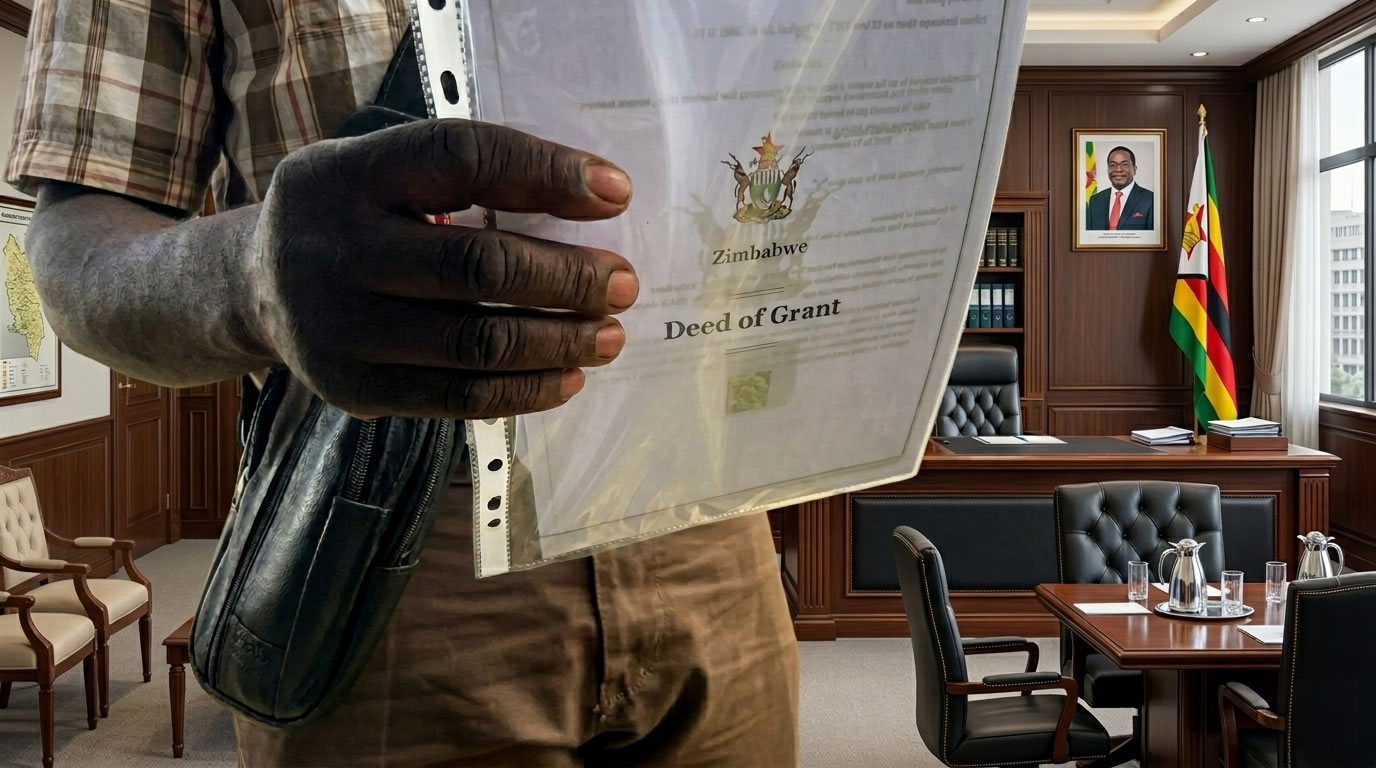
For decades, the thick, cream-coloured parchment of a title deed was the ultimate symbol of security for the Zimbabwean homeowner. It was the “castle’s” foundation, a physical proof of ownership that could be tucked away in a safe or a bank vault, gathering dust but never losing its legal weight. That era is over. A quiet but firm announcement from the Chief Registrar of Deeds has effectively placed every property in the country on a countdown. There are now just twelve months left before those old paper deeds are, for all intents and purposes, “deleted” from the formal economy.
The government’s ultimatum is simple: validate and “securitise” your title deeds now, or risk holding a document that is legally unrecognised for any future transaction. While the authorities frame this as a necessary leap into the digital age, our investigation suggests that for the ordinary citizen, this “digital transition” is a financial and bureaucratic minefield that many are ill-equipped to cross.
The Registrar’s Warning
Willie Mushayi, the Chief Registrar of the Department of Deeds, Companies and Intellectual Property, has been the face of this sweeping reform. He is quick to dismiss the growing anxiety that has gripped suburbs from Borrowdale to Highfield. Mushayi insists that the initiative is designed to protect property rights, not to strip them away.
“We gave people 24 months and we have already gone through the first 12 months. They have the next 12 months within which action must take place,” Mushayi stated recently. He is aware of the fear simmering in the streets. “I know some people are apprehensive and ask what happens if they do not comply in time. You do not lose your rights in property. Neither does it change hands. It remains your property.”
However, there is a massive “but” attached to that reassurance. Mushayi cautioned that title deeds that have not undergone validation and securitisation could eventually “cease to be legally recognised for future property transactions.” In plain English, this means that while you may still sleep under your roof, you cannot sell your house, you cannot use it as collateral for a bank loan, and you cannot legally pass it on to your children until the state has “securitised” it.
The Catalyst: A System Rotted by Fraud
To understand why the government is moving with such urgency, one must look at the wreckage of the old system. For years, Zimbabwe’s Deeds Office has been a playground for sophisticated fraud syndicates. The manual, paper-based registry was highly susceptible to tampering, and the consequences were often devastating.
The most high-profile case that exposed this rot was the “Mutumbuka House Scam” in 2024. Dr Dzingai Mutumbuka, a former education minister and a respected figure, discovered that his house had been sold without his knowledge. A clerk at the Deeds Office had allegedly handed over his original title deed to a fraudster. The document was forged, and the property was sold to an unsuspecting buyer for a fraction of its true value.
If a man of Mutumbuka’s stature could have his property rights “deleted” by a corrupt official and a photocopier, what hope did the average homeowner have? The market has been flooded with fake deeds, with lawyers and officials often acting as the architects of these thefts. The new digital system, backed by Statutory Instrument 76 of 2025, is intended to kill these syndicates by replacing “old paper” with a securitised digital file featuring advanced anti-forgery technology.
The Hidden Costs of ‘Validation’
While the goal of stopping fraud is noble, the “leg work” required to reach this digital promised land is proving to be a heavy burden. The process is not as simple as walking into an office and getting a stamp. It requires the engagement of professional conveyancers—lawyers who specialise in property law.
For many Zimbabweans already struggling with a volatile economy, the cost of hiring these experts is the first major hurdle. Conveyancing fees are often calculated as a percentage of the property’s value, meaning that a family in a modest high-density suburb could still be looking at a bill of hundreds, if not thousands, of dollars just to prove they own what they already bought years ago.
Then there is the issue of “compliance.” To validate a deed, the property owner must ensure that all municipal rates are paid up to date and that they have a valid Capital Gains Tax clearance from the Zimbabwe Revenue Authority (ZIMRA). For those who have fallen behind on their bills during the country’s various economic crises, the “validation” process is less of a security measure and more of a debt collection trap.
The Bureaucratic Nightmare of Deceased Estates
Perhaps the most complex and heart-wrenching aspect of this ultimatum involves the estates of deceased relatives. In many Zimbabwean families, the family home remains in the name of a late father or grandfather. Under the old system, families often lived in these homes for decades without formalising the transfer of the title, put off by the high costs of deceased estate administration.
Now, those families are facing a crisis. They cannot validate a deed for a person who is no longer alive. They must first navigate the labyrinthine process of the Master of the High Court, appoint an executor, and pay estate duties before they can even begin the securitisation process. With only twelve months left on the clock, many fear that these “family castles” will be the first to fall through the digital cracks.
A Digital Registry: Progress or Control?
The Chief Registrar describes the transition as a way to “improve the ease of doing business.” He paints a picture of a modern, efficient office where the physical movement of files is replaced by the click of a button.
“An ordinary transfer with no complications could take two to three weeks. It involved a lot of leg work. With this digital platform, the conveyancer does not move. He uploads documents from his office, I receive them in my inbox and then we process them,” Mushayi explained.
But this efficiency brings its own set of fears. In a country where trust in state institutions is often low, the idea of a centralised digital registry that can be “manipulated at the click of a button” is a source of deep suspicion. If a physical deed could be stolen and forged, what is to stop a digital file from being altered or deleted by a high-level hacker or a corrupt official with administrative access?
Furthermore, there is a growing whisper that this “validation” exercise is a thinly veiled precursor to a massive, state-led land audit. By forcing every property owner to register their assets in a searchable digital database, the government is creating a powerful surveillance tool. Critics argue that this will allow the state to monitor wealth, target political opponents, or identify properties for future “re-allocation” under the guise of land reform.
The 24-Month Conspiracy
The timing of the ultimatum has also raised eyebrows. The 24-month window was opened with little fanfare, and it is only now, with the clock halfway run down, that the public is beginning to grasp the magnitude of the task. Why the two-year limit? Why the rush?
Some analysts suggest that the government is looking to unlock “dead capital”—the billions of dollars tied up in properties that cannot be used for credit because their titles are questionable. By forcing a clean-up of the registry, they hope to stimulate bank lending and foreign investment. Others, however, see a more cynical motive: a way to flush out “absentee landlords” in the diaspora, whose properties might be targeted if they cannot return home in time to navigate the physical verification requirements.
The Road Ahead
As the 12-month deadline looms, the Deeds Office says it is preparing. Information centres are being established, and staff are undergoing intensive re-training. Mushayi insists that the department has spent three years preparing the technological infrastructure to handle the load.
“We have been preparing for the past three years for this to happen and we have most of our people properly trained and others are going through re-training just to make sure we have the necessary critical mass,” he said.
But for the homeowner in Chitungwiza or the pensioner in Bulawayo, these assurances provide little comfort. The reality is a race against time, a scramble for cash to pay conveyancers, and a nervous wait to see if their paper history will survive the digital fire.
The message from the authorities is clear: the paper deed is a relic of the past. Whether this transition will truly safeguard property rights or simply create a new, more efficient way for the state to control the land remains to be seen. What is certain is that for every Zimbabwean who believes their home is their castle, that castle is now a digital file away from disappearing. The clock is ticking, and the time bomb is set for June 2027.
How to Validate Your Deed: A Simple Guide
- Locate Your Original Deed: Ensure you have the physical, original parchment document. Photocopies will not suffice for forensic authentication.
- Engage a Conveyancer: You are free to choose any registered legal practitioner. Shop around, as fees can vary significantly.
- Clear Your Debts: Ensure your municipal rates and ZIMRA obligations are up to date. You will need “clearance certificates” for the process.
- Physical Verification: Your conveyancer will submit your documents to the Deeds Registry for forensic checks to ensure they are not part of the “fake deed” pool.
- Digital Migration: Once cleared, your property data is uploaded to the new system, and you will be issued a securitised, digital-ready document.
- Act Now: Do not wait for the final month. The backlog is expected to be massive, and the “12-month” window is closing every day.