


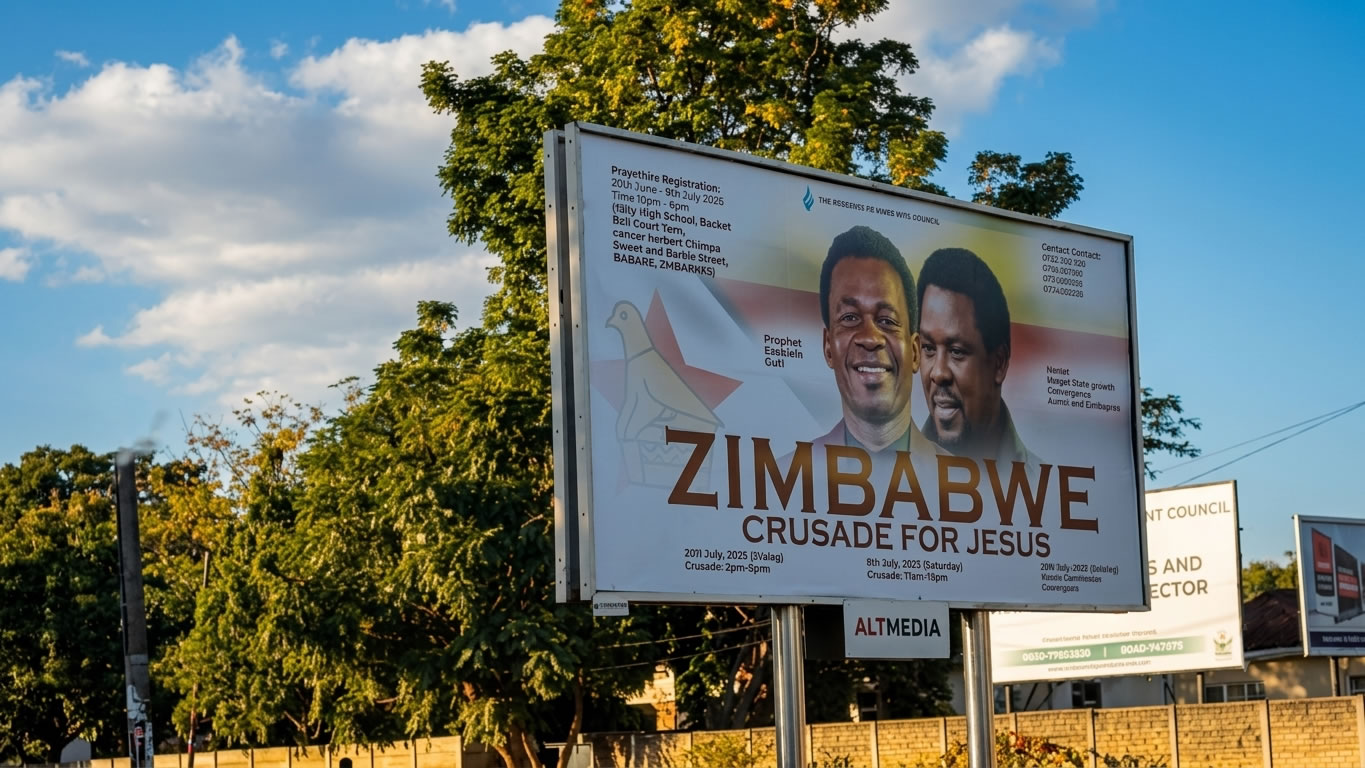
Legal Storm Brews Over TB Joshua’s Image in Zimbabwe Crusade
Harare – A significant legal challenge has emerged in Zimbabwe, as The Synagogue Church Of All Nations (SCOAN) initiates legal proceedings to prevent the unauthorised use of its late founder, Prophet TB Joshua’s image on promotional billboards for an upcoming religious crusade. The dispute pits the Nigerian-based church against Roadmap to Jesus International Ministries, led by Prophet Godstime Adah, a former disciple of the charismatic televangelist.
Billboards prominently featuring Prophet Godstime Adah alongside a photograph of the late TB Joshua have been erected in key Zimbabwean cities, including Harare and Gweru. These advertisements promote a crusade organised by Roadmap to Jesus International Ministries, an event that has already seen members of the public registering for prayer sessions at a local school in Harare.
However, the use of TB Joshua’s image has sparked outrage within SCOAN. Violet Masuku, the SCOAN coordinator in Zimbabwe, confirmed that the church was neither consulted nor informed about the billboards prior to their erection. “As the SCOAN coordinator, I was not informed about this billboard,” Masuku stated, further clarifying that the church’s head office in Nigeria was equally unaware of the advertising campaign.
Attempts by Masuku to engage with the organisers of the crusade proved futile. She recounted confronting representatives of Roadmap to Jesus International Ministries, but the discussions failed to yield an agreement, with a representative reportedly becoming angry during the engagement. This impasse has compelled SCOAN to pursue legal avenues to resolve the matter. The church has clarified that its legal action is not aimed at stopping the crusade itself, but rather at compelling the organisers to remove TB Joshua’s photograph from all promotional materials.
The controversy extends beyond the unauthorised use of an image. Reports indicate that the crusade is offering one-on-one prayer sessions at a substantial cost: US$300 for couples, with single individuals reportedly being charged half that amount. This practice has raised eyebrows, particularly given the historical context of religious ministries and their financial dealings.
The Enduring, Yet Contentious, Legacy of TB Joshua
Prophet Temitope Balogun Joshua, widely known as TB Joshua, was a globally recognised Nigerian charismatic pastor, televangelist, and philanthropist. He was the founder of The Synagogue Church Of All Nations (SCOAN), which attracted thousands of worshippers from around the world to its headquarters in Lagos. His ministry was characterised by claims of miraculous healings, prophecies, and deliverance from evil spirits, broadcast globally through his Emmanuel TV channel.
Following his death in June 2021, aged 57, a vacuum was created within SCOAN, leading to significant internal restructuring and leadership disputes. His wife, Evelyn Joshua, eventually assumed leadership of the church, a transition that was not without its challenges, as some of his former disciples and evangelists departed to establish their own ministries. This period has been marked by a struggle to maintain the unity and legacy of SCOAN, with various individuals and factions asserting their connection to the late prophet.
Prophet Godstime Adah is one such figure, described in various online sources as a
“devoted son” and “evangelist” who served under TB Joshua’s mentorship at SCOAN. His current ministry, Roadmap to Jesus International Ministries, positions itself as a continuation of the spiritual work initiated by TB Joshua, often using imagery and narratives that directly link back to the late prophet’s legacy. This close association, however, appears to be at the heart of the current legal conflict.
The Battle for a Spiritual Brand: SCOAN’s Stance
SCOAN’s decision to pursue legal action underscores a broader effort to protect the intellectual property and spiritual legacy of TB Joshua. The church has consistently sought to control the narrative and representation of its founder, especially in the wake of his passing. This is not an isolated incident; there have been previous instances where SCOAN has taken steps to address what it perceives as the unauthorised use of TB Joshua’s name, image, or teachings by former associates or independent ministries.
The church’s coordinator, Violet Masuku, emphasised that the legal challenge is not an attempt to stifle religious gatherings or crusades. Instead, it is a matter of principle and proper conduct. The core of their demand is the immediate removal of TB Joshua’s photograph from all promotional materials associated with Prophet Adah’s crusade. This suggests a clear demarcation of spiritual authority and brand ownership that SCOAN is keen to enforce.
The Commercialisation of Faith: US$300 for a Prayer Session
Perhaps one of the most contentious aspects of the upcoming crusade in Zimbabwe is the reported charging of significant fees for one-on-one prayer sessions. The sum of US$300 for couples and US$150 for singles for a personal prayer session has ignited debate and concern among observers. While the practice of charging for religious services is not new, such explicit pricing for prayer sessions often draws criticism and raises questions about the commercialisation of faith.
This practice is not unique to Prophet Adah’s ministry. Across Africa, and indeed globally, various religious leaders and ministries have faced scrutiny for charging for spiritual services, including prophecies, healings, and personal consultations. Critics argue that such fees exploit vulnerable individuals seeking spiritual solace or intervention, turning faith into a commodity. Proponents, however, often justify these charges as necessary to cover administrative costs, support charitable activities, or sustain the ministry’s operations.
In Zimbabwe, the issue of financial dealings within religious organisations has been a recurring theme. There have been instances of other prominent religious figures facing public outcry or even legal challenges related to their financial practices. For example, reports have surfaced in the past about other Zimbabwean prophets allegedly selling items like
anointed oil or water at inflated prices, or soliciting large donations for personal prophecies. These incidents contribute to a public discourse around the ethics of religious fundraising and the potential for exploitation within faith-based organisations.
The Post-TB Joshua Era: A Church Divided?
TB Joshua’s passing left a considerable void, not just for his immediate family but for the millions of followers worldwide and the vast SCOAN organisation. The transition of leadership to his wife, Evelyn Joshua, was a complex process, marked by internal power struggles and the departure of several prominent disciples who had served under the late prophet. These former disciples, often referred to as
“wise men” or “evangelists,” often went on to establish their own ministries, many of which continue to reference their association with TB Joshua. This has led to a complex landscape where the spiritual lineage of TB Joshua is claimed by various independent entities, sometimes leading to friction with the official SCOAN leadership.
The current legal action against Roadmap to Jesus International Ministries can be seen as part of SCOAN’s broader strategy to consolidate its authority and protect the brand identity of its founder. The church, under Evelyn Joshua’s leadership, has been working to re-establish its structure and ensure that the legacy of TB Joshua is managed according to its directives. This includes controlling the use of his image, which is a powerful symbol for millions of followers.
Legal Precedents and Image Rights in Zimbabwe
The legal battle over the use of TB Joshua’s image raises pertinent questions about intellectual property rights, particularly the rights associated with a deceased public figure. In many jurisdictions, including potentially Zimbabwe, the estate or designated representatives of a deceased individual retain certain rights over their image and likeness. This is often covered under personality rights or publicity rights, which prevent unauthorised commercial exploitation of an individual’s identity.
For SCOAN, the use of TB Joshua’s image on billboards for a crusade organised by another ministry could be interpreted as an infringement of these rights, suggesting an endorsement or affiliation that does not exist. It also potentially misleads the public into believing that the crusade is officially sanctioned or organised by SCOAN. The church’s insistence on the removal of the photograph, rather than a cessation of the crusade itself, highlights this focus on image control and brand protection.
Zimbabwean law, like many legal systems, grapples with the intersection of religious freedom, commercial advertising, and intellectual property. While religious organisations generally enjoy freedom of expression, this freedom is not absolute and can be limited when it infringes upon the rights of others or misleads the public. The outcome of this legal challenge could set a significant precedent for how the images and legacies of religious leaders are managed and protected in Zimbabwe.
Religious Advertising and Public Scrutiny in Zimbabwe
The broader context of religious advertising in Zimbabwe also warrants attention. The country has a vibrant and diverse religious landscape, with numerous churches and ministries actively engaging in public outreach. Billboards, like those erected by Roadmap to Jesus International Ministries, are a common form of advertising for religious events.
However, religious advertising has not been without its controversies. There have been discussions and even attempts by regulatory bodies in Zimbabwe to impose regulations on religious advertising, particularly concerning claims of miracles, healings, or financial solicitations. For instance, reports from 2024 indicated that the Broadcasting Authority of Zimbabwe had banned advertising content from churches and traditional healers, citing concerns about misleading claims and exploitation. While this specific ban might primarily affect broadcast media, it reflects a broader regulatory interest in ensuring ethical practices in religious outreach.
The reported charges for one-on-one prayer sessions by Prophet Godstime Adah’s ministry further fuel this scrutiny. The commercial aspect of religious services often attracts public debate, with some arguing it is a legitimate means of funding ministry activities, while others view it as exploitative. The significant fee of US$300 for couples and US$150 for singles for a personal prayer session stands in stark contrast to the traditional understanding of spiritual guidance being freely accessible.
Prophet Godstime Adah and Roadmap to Jesus International Ministries
Prophet Godstime Adah, as a former disciple of TB Joshua, represents a segment of the late prophet’s spiritual progeny who have established independent ministries. His ministry, Roadmap to Jesus International Ministries, appears to leverage its connection to TB Joshua as a foundational element of its identity and appeal. This is evident not only in the use of the image on billboards but also in the ministry’s online presence, which often references its spiritual lineage to SCOAN and TB Joshua.
While Prophet Adah’s direct response to SCOAN’s legal action has not been widely publicised, the continuation of the crusade and the presence of the billboards suggest a disagreement with SCOAN’s demands. The impasse, as described by Violet Masuku, indicates a firm stance from both sides, leading to the current legal confrontation. The motivation behind using TB Joshua’s image is likely multifaceted, encompassing a desire to honour a spiritual mentor, attract followers who revered the late prophet, and establish credibility within the broader charismatic Christian community.
The Path Forward: Implications for Faith and Law
The legal battle between SCOAN and Roadmap to Jesus International Ministries is more than just a dispute over an image; it is a microcosm of larger issues facing charismatic ministries in the post-founder era. It touches upon questions of succession, brand management, intellectual property, and the commercialisation of faith.