


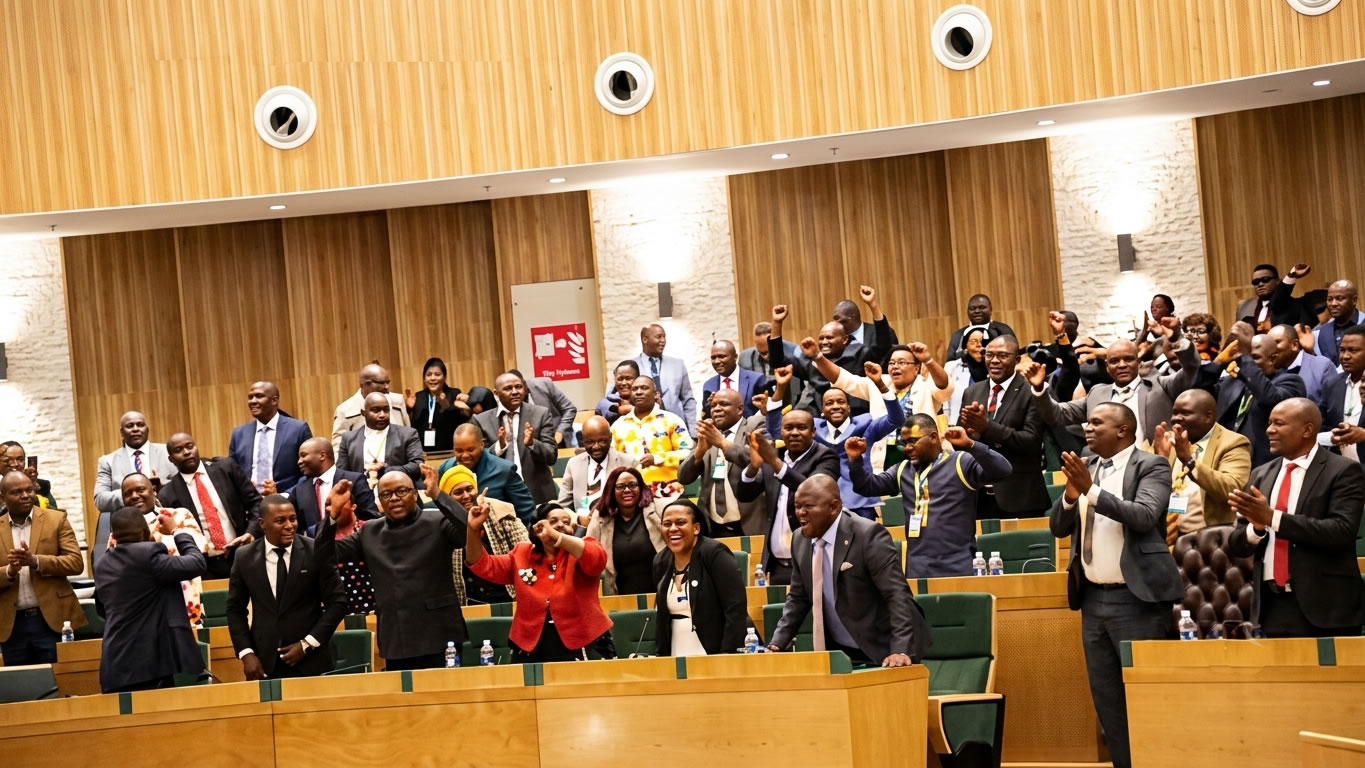
HARARE – Zimbabwe’s political landscape has been profoundly reshaped this week following the Senate’s official approval of Constitutional Amendment Bill No. 3 (CAB3). While the government’s public relations machinery has been working tirelessly to present this as a mere administrative update aimed at enhancing judicial efficiency, a deeper investigation suggests a far more calculated and strategic motive. The Bill, which garnered a significant majority in both the National Assembly and the Senate, effectively paves the way for President Emmerson Mnangagwa to potentially remain in power beyond the constitutionally mandated limit of 2028.
This controversial legislative manoeuvre has not only delayed the crucial “running mate” clause but also granted the President the power to personally extend the tenure of senior judges. Critics argue that this move by the “New Dispensation” systematically dismantles one of the key checks on executive power, raising serious concerns about the future of democracy and the rule of law in the Southern African nation. The implications of CAB3 extend far beyond judicial reforms, touching upon presidential term limits, electoral processes, and local governance structures, all of which have ignited a fierce debate across the country.
The timing of this amendment is a hidden detail that many citizens may have overlooked. With the 2028 elections looming on the horizon, the ability to hand-pick judges for the Supreme Court and Constitutional Court is being viewed as a masterstroke in political survival. Should any election result be challenged, the ultimate decision would rest with a judiciary whose careers are, to a significant extent, dependent on the President’s signature. This, constitutional experts contend, is not merely about “judicial efficiency”; it is about constructing a legal fortress around the presidency. Investigative analysis reveals that the “2030 vision,” once primarily a development slogan, has now morphed into a political deadline, signalling a potential long-term hold on power.
Furthermore, the amendment’s impact on local governance is equally profound and concerning. By delaying the implementation of elected mayors in certain areas, the central government retains its firm grip on urban resources. These urban centres, such as Harare and Bulawayo, have historically been strongholds for the opposition. This “top-down” control ensures that even if the ruling party were to lose the popular vote in these key cities, they could still control the purse strings and local administration through appointed commissioners, thereby undermining local democratic processes and accountability.
Constitutional law expert and opposition leader, Lovemore Madhuku, did not mince words when describing the parliamentary process. He stated, “Whether it is 216 v 42 or 75 v 4, Parliament has confirmed what we knew and expected all along – useless, anti-people and always ready to abuse its power.” Madhuku vowed that the resistance would continue, asserting, “CAB 3 has been rejected by the people, it will remain rejected. We have two strategies: courts and people power. We will win.” His sentiments were echoed by Jameson Timba, leader of the Defend the Constitution Platform (DCP), who insisted that the battle against the Bill would persist through legal channels and constitutional activism. Timba declared, “The Senate’s passage of CAB3 does not mark the end of the struggle to defend Zimbabwe’s Constitution. Our fight has never been confined to Parliament.” He further urged citizens to remain vigilant, stating, “The citizens of Zimbabwe are the last line of defence for the Constitution.”
The passage of CAB3 has been met with mixed reactions, even within the ruling party’s circles. While Senator Mike Bimha of ZANU PF expressed strong support, stating, “I therefore fully support the amended, the strengthened and… the Bill is a home-grown initiative shaped through extensive public consultation and designed to respond to the country’s current development needs,” others have voiced dissent. Nick Mangwana, Permanent Secretary in the Ministry of Information, defended the Bill’s passage as a sign of “democratic maturity” and “bipartisanship on matters of national interest.” However, these claims are sharply contrasted by reports of internal divisions. Notably, Vice President Constantino Chiwenga, a key figure in the 2017 military intervention that brought Mnangagwa to power, is reported to be leading a “military faction” that “openly opposes Mnangagwa’s term extension.” Some accounts even suggest that Chiwenga had previously “forced” Mnangagwa to publicly abandon the third-term project, highlighting the deep-seated power struggles within the ruling elite.
Opposition leader Nelson Chamisa has been particularly vocal in his condemnation of CAB3. He characterised the Bill as “the wrong move, a misguided initiative and a selfish national mistake.” Chamisa warned of severe repercussions, stating, “I have always opposed the constitutional amendment from the word go. What Mnangagwa is doing is going to be a catalyst for change. He is digging his own grave.” He further emphasised his commitment to constitutionalism, asserting, “I don’t agree with the mutilation of a constitution. I’m a constitutionalist, I believe in constitutionalism.” Another prominent opposition figure, Job Sikhala, has also publicly stated that the “2030 plot” should be unequivocally rejected.
The proposed changes within CAB3 are extensive and fundamentally alter the nation’s governance framework. The Bill seeks to change the presidential and parliamentary terms from five years to seven years, a move that would directly enable President Mnangagwa to remain in office until 2030, two years beyond his current term’s expiry in 2028. Furthermore, the method of electing the President is set to shift from a direct popular vote to an election by a joint sitting of Parliament, a change that critics argue centralises power and diminishes the direct mandate of the people. The controversial “running mate” clause, which would have seen presidential candidates choose their running mates, has been delayed or repealed, allowing the President to appoint Vice Presidents at his discretion. This provision, in particular, has been a point of contention, as it removes a layer of democratic accountability from the executive.
The judicial system, a cornerstone of any democratic state, is also significantly impacted. The Bill allows the President to extend the tenure of senior judges, including those in the Supreme Court and Constitutional Court, beyond the age of 70. This move draws parallels with the contentious case of Chief Justice Luke Malaba in 2021, whose tenure extension was initially ruled illegal by the High Court before being circumvented. This precedent has set a worrying tone for judicial independence, with constitutional experts describing the current amendments as a “slow-motion coup” against the 2013 Constitution, a document once celebrated as a beacon of democratic progress. The Church in Zimbabwe has also weighed in, issuing a pastoral statement in April 2025 with a clear message: “No to Third Term!”
The political climate surrounding CAB3 has not been without incident. Reports from October 2025 indicated outbreaks of violence linked to the third-term bid, including the torching of a hall in Harare. Public hearings conducted in March 2026, though presented by state media as overwhelmingly supportive, revealed significant public opposition in areas such as Zaka. These incidents underscore the deep divisions and tensions simmering beneath the surface of Zimbabwean politics. As the nation grapples with these profound constitutional changes, the future of its democratic institutions and the aspirations of its people hang in the balance. The “2030 Plot” is no longer a distant possibility but a rapidly unfolding reality, demanding close scrutiny and sustained engagement from all stakeholders.