


On a quiet Tuesday of 7 July 2026, while most Zimbabweans were preoccupied with the soaring price of basic commodities and the daily struggle for transport, a single stroke of a pen altered the course of the nation’s history. President Emmerson Mnangagwa, the man who referred to himself as a “constitutionalist” and a “listening leader,” signed Constitutional Amendment Bill No. 3 (CAB3) into law. To the casual observer, the headlines were predictable: the presidential term has been extended to 2030. But beneath the surface of this legislative manoeuvre lies a far more chilling mathematical reality.
If you are a young Zimbabwean voter today, you might want to hold onto your registration card as a souvenir. According to the mechanical reality of this new law, you may not cast a meaningful vote for a President again until the year 2044.
The “2030” slogan, which has been chanted at ZANU-PF rallies for the past year, was merely the opening act of a much longer game. While the public’s attention was fixed on the two-year extension of the current term, the chief architects of the system were quietly building a fortress that effectively locks out the electorate for nearly two decades. By abolishing direct presidential elections and moving to a parliamentary-voted presidency, the ruling party has ensured that the will of the people is no longer a factor in the highest office of the land.
The Unravelling of a Promise
To understand how we arrived at this junction, one must look back to February 2025. At the time, the air was thick with rumours of a third-term bid. President Mnangagwa, speaking with his characteristic measured tone during a visit to Mutare, attempted to douse the flames of suspicion. He famously declared, “I will persuade the persuaders not to persuade me so that I remain constitutional.” He insisted that he was a stickler for the law and would retire at the end of his second term in 2028. “I have no intention of going beyond my two terms,” he added, a statement that was broadcast across state media and archived by hopeful citizens.
It was a statement that brought a temporary sense of relief to the nation. The Zimbabwe Heads of Christian Denominations (ZHOCD) even issued a statement at the time, noting they took “relief from the consistent remarks made by His Excellency… affirming his commitment to the constitution.” Even the international community, often wary of Zimbabwe’s political transitions, seemed to take him at his word.
However, as the months rolled by, the “persuaders” grew louder. From the dusty streets of Epworth to the manicured lawns of Borrowdale, ZANU-PF structures began a coordinated campaign. “ED 2030” became the mandatory chant at every provincial meeting. The President’s resolve to be “persuaded” became increasingly evident as he remained silent while his subordinates dismantled the very constitution he claimed to protect. The promise of retirement began to unravel. What we are witnessing now is not a simple term extension; it is a “constitutional coup” that has transformed the very nature of Zimbabwean democracy. The man who promised to be a constitutionalist has become the chief architect of a system that ensures his faction’s control for a generation.
The 2044 Mathematical Lockout
How does the math lead us to 2044? It is a cold, calculated progression of law that bypasses the ballot box entirely.
Under the previous system, established by the hard-won 2013 Constitution, Zimbabweans voted directly for their President every five years. CAB3 has dismantled this foundation. Firstly, it extends the current presidential electoral cycle from five to seven years. This retroactively moves the 2028 election to 2030.
Secondly, and most crucially, the amendment removes the right of the general public to vote for the President. Instead, the President will now be elected by a joint sitting of Parliament. In a country where the ruling party holds a crushing majority—often secured through methods that international observers have repeatedly questioned—the outcome of a parliamentary vote is a foregone conclusion.
Let us break down the mechanical reality of the timeline:
- The 2030 Extension: The current term, which was supposed to end in 2028, is stretched to 2030. This is the “bonus” period already secured.
- The First Seven-Year Term (2030-2037): In 2030, instead of a national election, the ZANU-PF-dominated Parliament will sit to “elect” the President. Under the new law, this term lasts seven years. The winner — be it the incumbent or a designated successor — is locked in until 2037.
- The Second Seven-Year Term (2037-2044): In 2037, the process repeats. The same parliamentary machinery, insulated from the direct pressure of the voting public, will select the leader for another seven years.
For sixteen years beyond the original 2028 departure date, the electorate will be reduced to spectators. Your vote was quietly legislated away while the nation slept, replaced by a system where the ballot box is replaced by a show of hands in a whipped Parliament. The mathematical reality is that a child born during the “New Dispensation” of 2017 will be nearly 30 years old before they are allowed to vote in a direct presidential election—if such a thing is ever allowed to return.
Warnings from the Barracks and the Pulpit
This legislative heist did not happen without resistance, though the warnings were largely ignored by those in the corridors of power. In March 2026, as the bill began its rapid ascent through the National Assembly, an unexpected source of dissent emerged: the military establishment.
Retired generals and war veterans, the very individuals who were instrumental in the 2017 transition that brought Mnangagwa to power under “Operation Restore Legacy,” began to voice their alarm. Reports surfaced of a private meeting where senior retired figures warned that “tinkering with the supreme law for personal gain” would invite instability. They alleged that the push for CAB3 was being fuelled by a $31 million bribery fund aimed at ensuring MPs would vote in favour of the amendment without question. One retired colonel, speaking on condition of anonymity, stated: “We did not march in 2017 to replace one life president with another. The constitution is not a piece of scrap paper to be rewritten every time a leader fears the people.”
The churches were equally vocal. The ZHOCD issued a scathing pastoral statement, warning that the amendments would “weaken democratic accountability and reduce citizens’ participation in the political process.” They argued that the move to a parliamentary-voted presidency was a direct assault on the agency of the Zimbabwean person.
“The people’s right to choose their leader is a God-given right that no Parliament should have the power to seize,” one prominent bishop remarked during a heated public hearing in Harare. “To take away the vote is to take away the soul of the nation. We are returning to a system where the leaders choose the people, rather than the people choosing the leaders.”
Chaos and Coercion: The “Public” Hearings
The public hearings for CAB3, held across the country in early 2026, were intended to show popular support but instead highlighted the deep divisions in the country. In Bulawayo and Gweru, hearings erupted in chaos as “hired thugs” reportedly disrupted citizens who tried to speak against the bill. In one incident in Mutare, a grandmother was shouted down by youths in party regalia when she asked why her grandchildren would no longer be allowed to vote for the President.
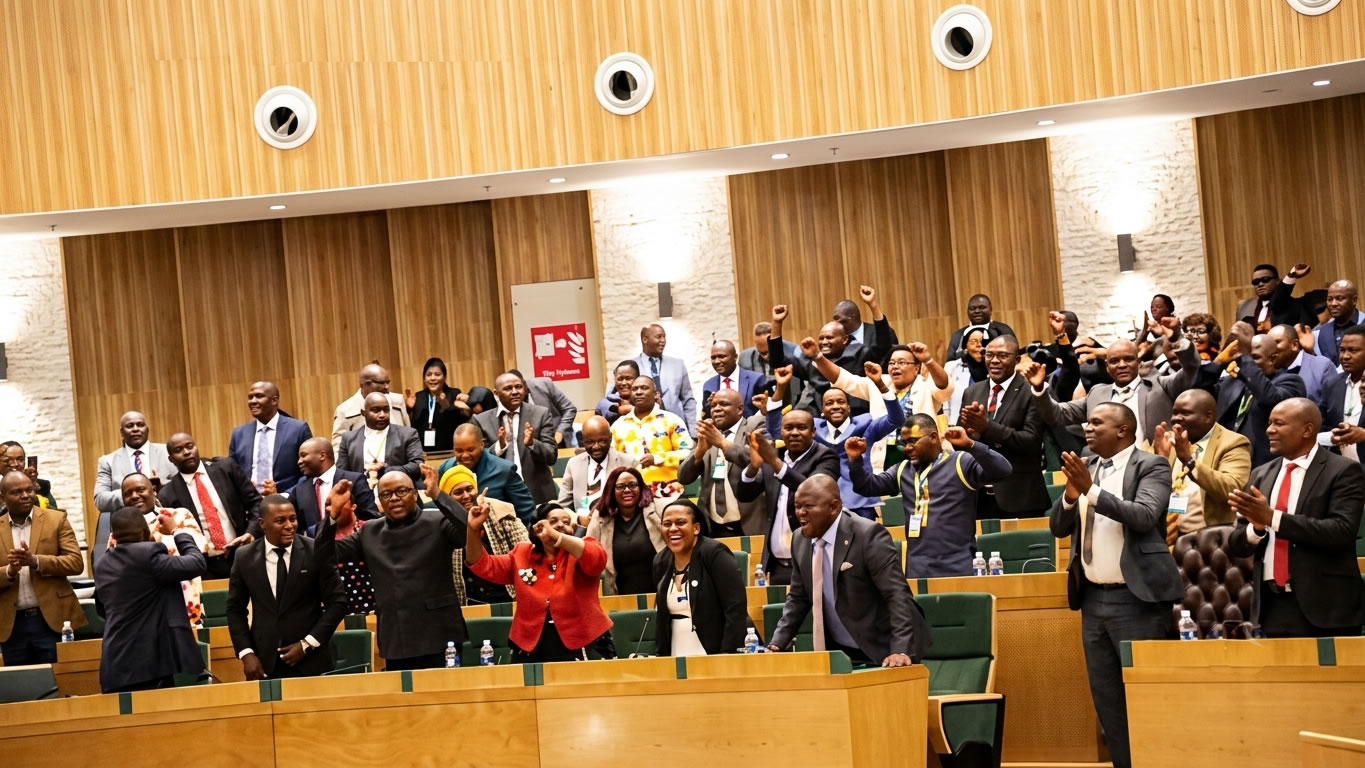
In Harare, the hearings were packed with supporters who arrived in buses and were given pre-written scripts. They drowned out any dissenting voices with songs of praise for the “Vision 2030” agenda. Despite the visible and vocal opposition from civil society, legal experts, and ordinary citizens, the Bill sailed through the National Assembly on 18 June 2026, with 216 votes to 42. The Senate followed suit on 24 June.
The speed at which the constitution was altered stood in stark contrast to the years of delay in aligning existing laws with the 2013 Constitution. It seems that when it comes to the consolidation of power, the wheels of government turn with remarkable efficiency, while the wheels of justice and reform remain stuck in the mud.
The Death of the Direct Vote
The move to a parliamentary-voted presidency is perhaps the most insidious part of CAB3. Proponents of the bill, led by Justice Minister Ziyambi Ziyambi, argue that it brings in “technical expertise” and “enhances parliamentary oversight.” They claim it is a move toward a more “stable” parliamentary system similar to those found in other developed nations.
But in the Zimbabwean context, this is a transparent veil. By removing the direct vote, the President is no longer accountable to the grandmother in Chipinge or the graduate in Bulawayo. He is accountable only to the party caucus. The “social contract” has been shredded. The President is no longer the representative of the people; he is the appointee of the party.
This shift ensures that the factional battles within ZANU-PF will now be the only “elections” that matter. The general public has been disenfranchised, relegated to voting for local councillors and MPs who will then, in turn, select the head of state behind closed doors. The parliamentary system, in this guise, is not about stability; it is about insulation. It protects the leader from the unpredictability of a hungry and frustrated electorate.
A Generation Sidelined
The implications for Zimbabwe’s youth are profound and tragic. A teenager who is 16 today, full of hope and looking forward to their first vote in 2028, will be 34 by the time they are allowed to participate in a meaningful presidential election, should the current trajectory hold. A whole generation is being told that their voice does not matter, that the “mathematical reality” of the law is more powerful than their aspirations.
The “constitutionalist” who once promised a new dispensation has delivered a system that is more rigid and less accountable than the one it replaced. The “unravelling of the promise” is complete. President Mnangagwa’s claim that he would “persuade the persuaders” now sounds like a cruel joke played on a hopeful nation. It was not the persuaders who were persuaded; it was the constitution that was broken.
As the sun sets on the 2023-2028 term, the shadows of 2044 loom large over the Zimbabwean landscape. The legislation is signed, the math is clear, and the lockout is in place. Zimbabweans are left to wonder: how did a promise of “democracy and transparency” end in a mathematical formula for perpetual rule?
The answer lies in the silence of the night and the efficiency of the pen. While the nation slept, the architecture of a generation-long presidency was completed. The ballot box has not been removed, but it has been emptied of its power. Until 2044, the “persuaders” have won, and the electorate is left to count the years of their displacement. The “New Dispensation” has become the “Old Reality,” and the road to 2044 looks very long indeed.
Timeline of the Constitutional Shift:
- February 2025: President Mnangagwa promises to “persuade the persuaders” to let him retire in 2028.
- January 2026: Cabinet approves the principles of Constitutional Amendment Bill No. 3.
- March 2026: Public hearings erupt in chaos; retired generals warn against the extension and allege bribery.
- June 2026: Parliament passes CAB3 with a two-thirds majority in record time.
- July 2026: President Mnangagwa signs the bill into law, extending his term and moving to a parliamentary-voted presidency.
- 2030-2044: The projected “Mathematical Lockout” period for the Zimbabwean electorate.