


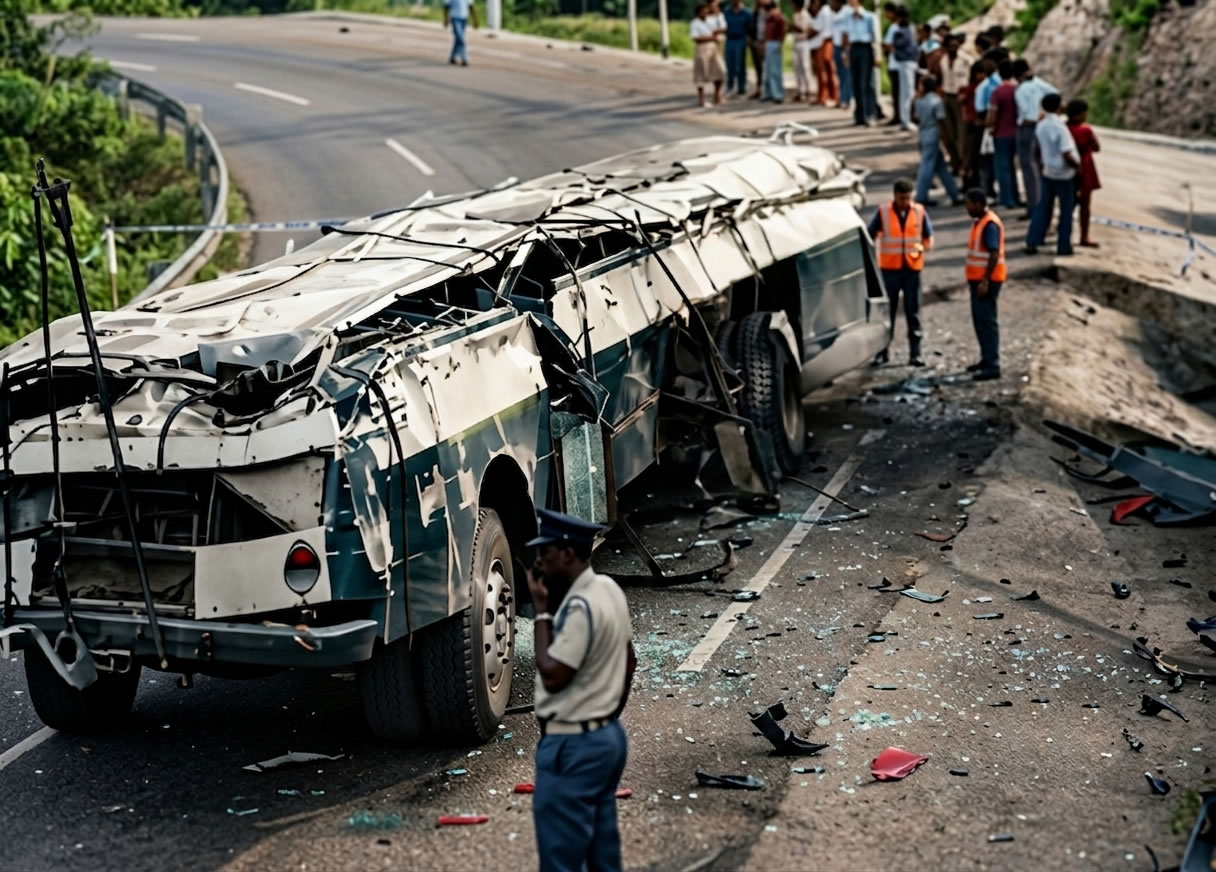
NYANGA – The morning mist still clings to the jagged peaks of the Nyanga mountains, much as it did thirty-five years ago. On the winding road that snakes between Nyanga and Ruwangwe, there is a particular bend—a sharp, unforgiving curve that locals simply call the “dark spot.” It is a place where time seems to stand still, and where the echoes of a thousand screams still linger in the mountain air.
Yesterday, 3 August 2026, marked the anniversary of the Nyanga Bus Disaster, the darkest day in the history of Zimbabwean transport. As families gathered at the Regina Coeli Mission to light candles and lay wreaths, the atmosphere was thick with more than just grief. There was a palpable sense of betrayal. A recent investigative report by ZTN Prime has peeled back the layers of our current road safety standards, revealing a terrifying truth: the “death traps” that claimed 89 lives in 1991 are not only still on our roads, but they are now being driven with the tacit approval of the state.
The 1991 tragedy remains a wound that refuses to heal. It was a cold Saturday evening when a BnC bus, carrying 97 passengers — mostly students from Regina Coeli High School returning from a sports trip — lost its brakes and hurtled into a deep gorge. Eighty-two school children were extinguished in a matter of seconds. Only twelve survived.
B & C Bus Services (historically known as B & C Luxury Coaches) is a legendary, pioneering passenger transport company in Zimbabwe that is no longer in active operation. Founded in 1958 by Buddy and Cecilia Hall, the company was a staple of Zimbabwe’s transport sector, linked to family-run operations. Starting from humble beginnings with a single bus, it grew into a prominent operator in the 1980s and 90s. Historical Operations and RoutesBased in Mutare, B & C dominated routes in Manicaland, connecting Nyanga, Rusito, and surrounding areas before expanding into cross-border travel. The Nyanga Bus Disaster and DeclineThe company’s legacy was marked by the tragic 1991 Nyanga bus disaster, which claimed 89 lives. Following this incident and subsequent succession challenges, the company ceased operations.
Ignatius Bukuta, one of those twelve, still carries the physical and emotional scars of that night. Speaking about the moments before the crash, he recalled the innocence of his classmates. “When we left St Killian’s Mission, gaiety and excitement was high. We were singing all the way,” he said. “The driver was not the one who had taken us to St Killian’s.” That change of driver, combined with a bus that was severely overloaded and mechanical failures, created a perfect storm of death.
Yet, as we stand in 2026, the question that haunts every Zimbabwean is simple: why are we still mourning the same tragedies?
Our investigative team spent weeks embedded at various roadblocks across the country, and what we found was a systemic “conspiracy” of corruption that has turned our highways into a “Highway to Hell.” At a roadblock along Harare-Mutare road, we watched as a heavily overloaded “chicken bus” — with its tyres bald and its chassis groaning under the weight of passengers and luggage — was flagged down by police. Instead of a rigorous inspection, there was a brief exchange of words and a folded note of cash. Within thirty seconds, the “death trap” was back on the road, and its driver waving a friendly hand to the officers.
This is the “privatisation of risk” in its most lethal form. In the decades since 1991, the government has largely abdicated its responsibility for public transport. The once-reliable Zimbabwe United Passenger Company (ZUPCO) has been allowed to crumble, replaced by a chaotic fleet of private operators and “mushikashika” (unlicensed taxis) whose primary motive is profit, not passenger safety. When the state steps back, the poor are left to the mercy of those who view a human life as nothing more than a five-dollar fare.
The statistics for 2025 and early 2026 are nothing short of a national emergency. According to ZimStat, over 12,800 road traffic accidents were reported in the first quarter of 2025 alone. By the second quarter, that number had spiked by nearly 20 per cent. The 2025 festive season was particularly bloody, with police reporting that road deaths had doubled to 100 in just a twelve-day period.
Even in the last week, the carnage has been relentless. On 31 July 2026, President Mnangagwa had to declare a State of Disaster after a Munenzwa bus crash killed eleven Zimbabweans travelling from South Africa. Years earlier, in November 2018, a horrific collision between two buses on the Harare-Mutare road claimed 47 lives. The catastrophic incident took place on November 7, 2018, where a head-on collision between two speeding long-distance buses (involving Smart Express and Bolt Cutter buses) at the 166-kilometre peg on the Harare-Mutare highway near Rusape claimed 47 lives and injured over 60 others. Each time, the government issues a statement of “sincere condolences” and promises a “full investigation.” Each time, the public is told that “lessons will be learned.”
But the lessons of 1991 have not been learned; they have been commodified. The current transport regulations, such as Statutory Instrument 118 of 2023, which mandated speed limiters and monitoring devices for all public service vehicles, have become a “paper tiger.” While the law looks impressive on a shelf in Harare, it is routinely ignored on the ground. Operators have found ways to bypass the limiters, often with the help of the very technicians meant to install them.
“The regulations are there, but they are a joke,” says a veteran bus driver who asked to remain unnamed for fear of losing his job. “The owners tell us to make three trips a day on a route that should only take two. If we don’t speed, we don’t get paid. If the police stop us, the owner has already paid the ‘toll’ at the office. We are told to just keep driving.”
This culture of impunity starts at the top. The “Highway to Hell” is not just a metaphor for our crumbling infrastructure—it is a description of the political landscape. While billions of dollars are touted in “infrastructure deals,” the roads that ordinary Zimbabweans use every day are disintegrating. The road to Nyanga, despite its history, remains a treacherous gauntlet of potholes and narrow verges. The politicians who look the other way are the same ones who travel in armoured convoys, shielded from the reality of the “death traps” they have allowed to flourish.
The comparison between 1991 and 2026 reveals a terrifying decline in oversight. In 1991, the disaster was seen as a freak accident that demanded a national response. In 2026, mass casualty events on our roads have become so common that they are relegated to the middle pages of the newspapers within forty-eight hours. We have become desensitised to the sight of mangled metal and white body bags.
The “hidden details” of our road safety crisis are not hidden at all; they are hidden in plain sight. They are in the $5 bribe, the bald tyre, the unlicensed driver, and the politician who prioritises a new luxury SUV over a functional public transport system. The “conspiracy” is not a secret cabal, but a collective failure of will.
As the sun sets over the Regina Coeli Mission, the names of the 82 children are read out once more. Their faces, captured in grainy black-and-white photographs, stare out at a country that has failed them. They died because a bus was overloaded. They died because a driver was reckless. They died because the systems meant to protect them failed.
Thirty-five years later, we are still driving those same buses on those same roads, governed by those same failures. The “Highway to Hell” is open for business, and until we stop the privatisation of risk and the nationalisation of grief, the Nyanga Road will continue to claim its tithe of blood.
The lessons of 1991 are not forgotten; they are being actively ignored. And in that silence, the next disaster is already gathering speed, just around the next bend.