


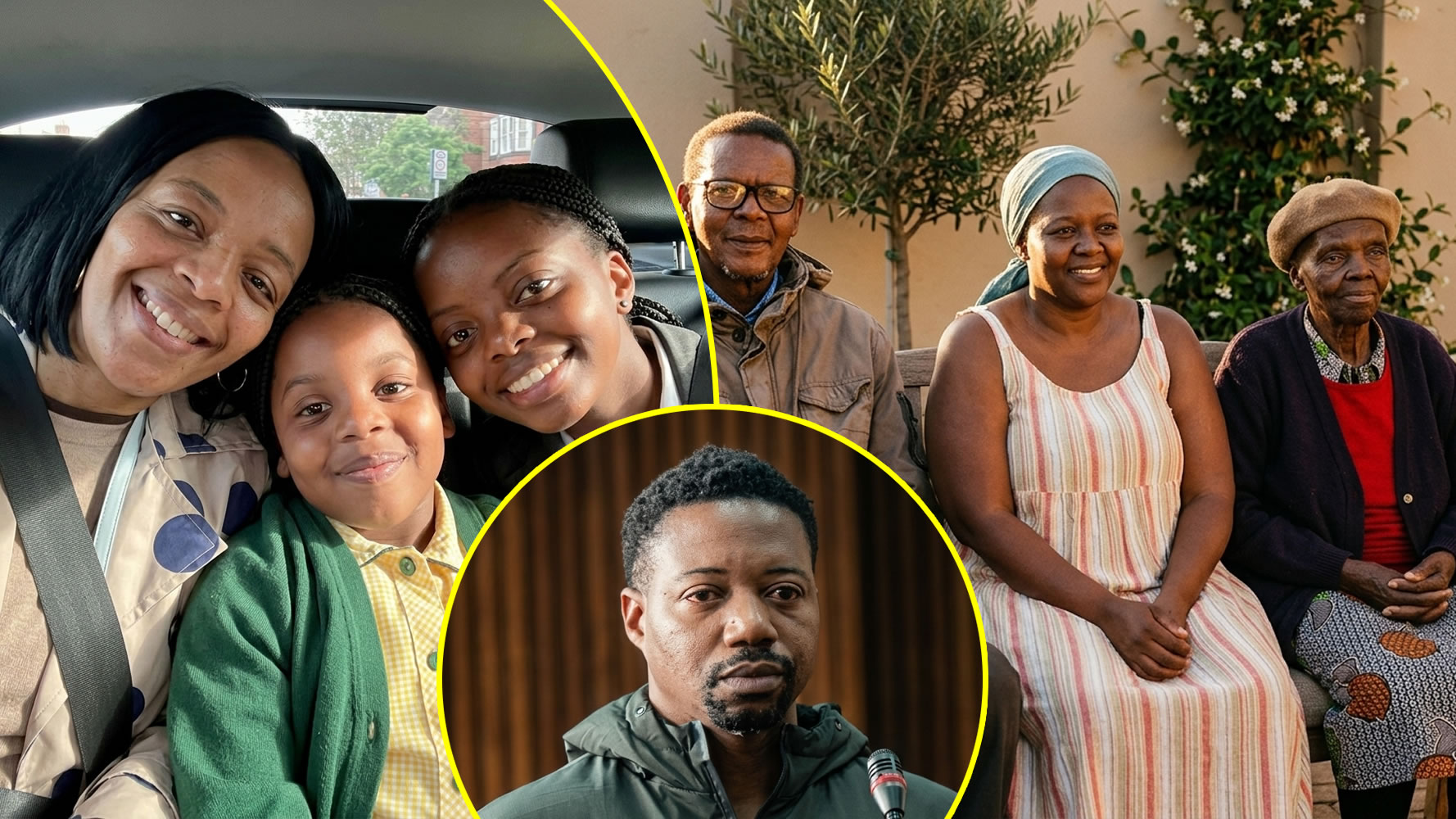
BEYOND THE STARS: THE BITTER BURIAL OF THE GREAT DENHAM TRIPLE MURDER VICTIMS
BULAWAYO – The red earth of Old Luveve Cemetery is accustomed to the quiet finality of death, but on Tuesday, it received a burden that felt uniquely heavy. Under a searing winter sun, three white coffins were lowered into the ground side by side. They contained the remains of Nothabo Zandile Tshuma, 42, and her two young daughters, 15-year-old Natalie and five-year-old Nala. They had come home to Bulawayo not as the triumphant successes of the Zimbabwean diaspora, but as victims of a brutality that has left two families at war and a community searching for answers.
The burial marked the end of a harrowing month-long journey that began in the affluent English village of Great Denham, in Bedfordshire, and ended in the dusty suburbs of Matabeleland. Yet, as the soil was shovelled over the caskets, the atmosphere was not one of simple mourning. It was charged with a palpable, icy resentment. The Khumalo family, Nothabo’s kin, stood in a phalanx of grief, while the absence of a formal apology from the family of the accused killer — Nothabo’s husband, Ndodana Mkhanyisi Tshuma — was described by many as a final, metaphorical “middle finger” to the deceased and her family.
The Silence at the Gate
In Zimbabwean culture, the bonds of marriage are supposed to unite two lineages in a permanent pact of mutual respect. When that bond is severed by violence, the traditional protocol is clear: the family of the perpetrator must approach the victims’ home, kneel at the gate, and offer a sincere apology. According to the Khumalo family, this never happened.
Dr Ntsika Dakamela who was representing the Magonya family (Nothabo’s maternal side), did not mince his words during the service at the Brethren in Christ Church in New Lobengula.
“The Tshuma family has not come to apologise to us. They were supposed to come to the gate, kneel down and say they were sorry because what happened was not of their doing,” he told the hundreds of mourners who had filled the church to the brim. “We don’t want people to speculate. We expected them to come, but they did not. They took it lightly.”
This perceived lack of remorse has curdled into a bitter impasse. Just days before the burial, a delegation from the Tshuma family arrived at the Khumalo residence in Gwabalanda. They reportedly sought to discuss funeral arrangements and requested that the burial be handled at their family home in Waterford. They were met with a cold, hard rejection.
The Horror in Great Denham
To understand the depth of this animosity, one must look back to the morning of July 6, 2026. In Great Denham, a village where £1.3 million homes usually offer a shield of security, a darkness had been festering. Nothabo and her daughters had not been seen for days.
The task of discovery fell to Nothabo’s cousin, Thembi Ncube, and her husband, Jabu. They were neighbours in the UK and had grown increasingly concerned. “On Saturday they didn’t see Nothabo and the children, Sunday they were not there and also Monday,” Leon Khumalo, the family spokesperson, recounted to the gasping congregation. “Thembi and her husband Jabu Ncube started looking for them the whole day on Monday. On Tuesday, they broke into the house and found the three dead.”
The scene that confronted them was one of unimaginable horror. Post-mortem examinations later confirmed that Nothabo, Natalie, and Nala had all died from blunt force trauma to the head. They had been beaten to death in the sanctuary of their own home.
Ndodana Mkhanyisi Tshuma, a 45-year-old British citizen known to his associates as “Mark,” was a successful businessman on paper. He operated Nexus Trove Holdings, a property firm with assets reportedly exceeding £1 million. But beneath the veneer of professional success lay what friends described as an environment of “intense coercive control and toxicity.” The couple was in the midst of a bitter separation—a period that criminologists identify as the most dangerous time for victims of domestic abuse.
A Fugitive’s Cowardly Exit
While his family lay dead in their home, Ndodana Tshuma was already orchestrating his escape. On July 4, less than twenty-four hours after the murders are believed to have occurred, he boarded a flight from London Heathrow to Johannesburg, South Africa, via Dubai.
He vanished into the urban sprawl of Johannesburg, staying at a high-end hotel in Sandton under a pseudonym. But the weight of his actions seemed to be closing in. Investigations by the South African Police Service (SAPS) revealed that he travelled to the Alexandra township to purchase an unlicenced 9mm pistol.
“It is our suspicion that this particular firearm was going to be used to end his life,” confirmed Brigadier Athlenda Mathe, the SAPS national spokesperson. “It is commendable that our teams worked quickly to arrest him before that process could unfold so that he can answer to the crimes that he committed in the UK.”
Tshuma was arrested on July 10 in a coordinated strike involving Interpol. He now faces a dual legal battle: charges of illegal firearm possession in South Africa and an extradition process to the UK to face three counts of murder.
The Pattern of “Family Annihilation”
The tragedy in Great Denham is a gruesome addition to a rising trend of “family annihilation” within the diaspora community. It mirrors the chilling case of Nicholas Prosper in Luton, who in September 2024 murdered his mother, Juliana Falcon, and his two siblings, Kyle and Giselle, with a shotgun. Prosper, who was just 18 at the time, had even planned a school shooting before his arrest. He was sentenced to life imprisonment in March 2025.
These incidents are not isolated anomalies. According to the Office for National Statistics, there were 111 domestic homicides in England and Wales in the year ending March 2025. For the Zimbabwean diaspora, these cases often highlight a breakdown in traditional support systems. The “silent pandemic” of gender-based violence (GBV) often thrives in the isolation of life abroad, where the cultural pressure to maintain a “perfect” image prevents victims from seeking help.
Judith Ncube, the Bulawayo Minister of State for Provincial Affairs, addressed this directly at the funeral. “Marriage is supposed to be a little heaven on earth, but many homes have become places of fear and suffering,” she said. She called for unity between the families, though her words seemed to struggle against the tide of resentment in the room. “To the Tshuma family, you gave birth to flesh, but not to the soul. Come closer to the Khumalo and Magonya families.”
Tributes to the Lost
The tragedy is magnified by the potential of the lives extinguished. Nothabo was an Associate Director at Forensic Risk Alliance, described by colleagues as a respected professional whose “dedication, integrity, and warmth left a lasting impression.”
Her daughters were described as “God’s little flowers.” Natalie, a student at Bedford Girls’ School, was a gifted sportswoman who had represented her school 107 times across cricket, hockey, and tennis. Her teachers remembered a smile that “shone through her eyes and lit up the room.”
Five-year-old Nala, a pupil at Pilgrims Pre-Prep School, was remembered for her “legendary hugs” and her love for music and dancing. “From the very moment she arrived, we knew there was something very special about her,” her school’s tribute read.
Theophilous Khumalo, representing the family, spoke of the deep silence their departure has created. “Nothabo Zandile Khumalo and her precious daughters Natalie and Nala, their departure has created a silence so deep that only the voice of God can comfort us. Her daughters were her ministry. She poured herself into them, nurturing their minds, their hearts and their faith.”
The Long Road to Justice
As the legal machinery in Johannesburg and London begins to grind, the Khumalo family is left to pick up the pieces of a shattered lineage. The extradition of Ndodana Tshuma is expected to be a complex process that could take months. In the meantime, he remains in a South African cell, a man who allegedly chose to destroy everything he had built rather than face the reality of a failed marriage.
For the community in Bulawayo, the burial was a moment of reckoning. Bulawayo Mayor David Coltart described the deaths as “a tragedy beyond human comprehension.” He noted that such moments force people to confront the limits of understanding. “Our minds are simply too small to comprehend the enormity of God, and it is from that understanding that we have to approach tragedies like this,” he said.
But for Nothabo’s 76-year-old mother, Velile Khumalo, the philosophy matters less than the absence. She had been counting down the days until her daughter and granddaughters were due to visit Zimbabwe this December. “If I had one more chance to talk to her, I would advise her to leave everything and come home,” she lamented. “Makhu (Zandile) had the two sweetest daughters ever, my grandchildren. They are all gone, just like that.”
As the mourners dispersed from Old Luveve Cemetery, the three graves remained—a stark, silent testament to a betrayal that crossed oceans. The Khumalo family has brought their daughter home, reclaiming her from a marriage that ended in blood. But the “middle finger” from the in-laws, the lack of a traditional apology, and the horrific details of the Great Denham murders ensure that this is a story that will be told in hushed, angry tones for generations to come. The quest for justice continues, but for Nothabo, Natalie, and Nala, the only peace to be found is in the soil of the city they once called home.
“Nothabo was my favourite cousin and we grew up together. Two years ago, my family moved to the United Kingdom and it was her who received us. It is difficult, my sister, to address you in the past tense. The past two years have been a gift seeing you and I last saw her a week before she was found dead.” — Thembi Ncube, Cousin of the deceased.