


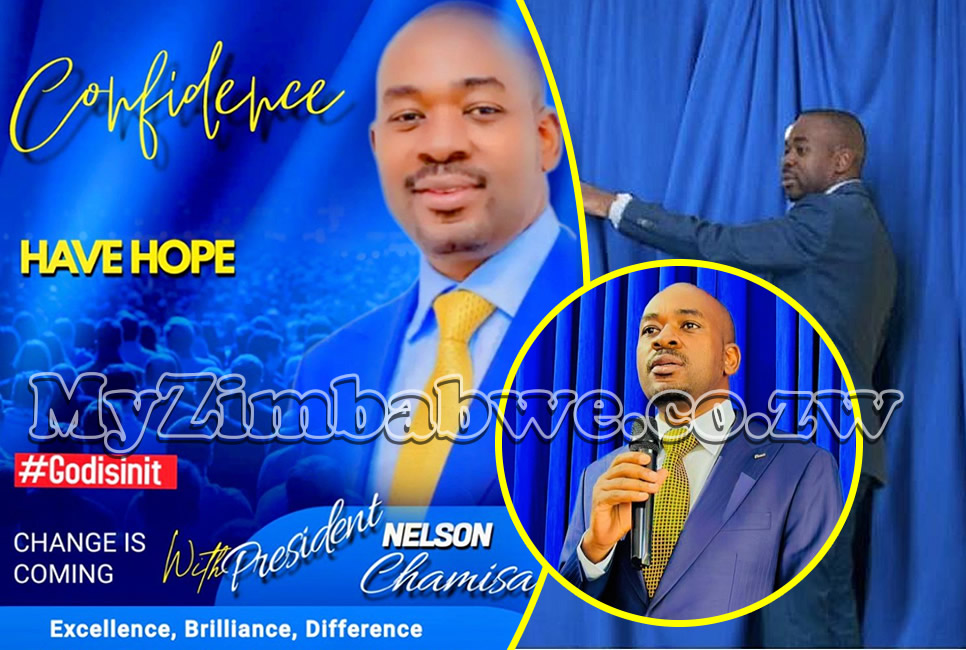
Nelson Chamisa’s return to Zimbabwean politics is being presented as a fresh beginning. But behind the language of renewal lies a harder question: can the former opposition leader build a movement strong enough to challenge ZANU-PF without recreating the organisational weaknesses that helped destroy his last one?
Chamisa announced Agenda 2026 in January after almost two years away from active party politics. He described it not as a conventional political party, but as a citizens’ movement designed to cross party, tribal, racial and class lines. He also promised that its first phase would be built through grassroots organisation, legal work and institutional preparation rather than the large rallies that have traditionally defined Zimbabwean opposition politics.
The timing matters. Zimbabwe’s next major electoral contest is being shaped by a dispute over the country’s political timetable, the unresolved legitimacy questions surrounding the 2023 election and a proposed extension of President Emmerson Mnangagwa’s term. Chamisa has rejected the reported 2030 plan and has argued that the deeper issue is not simply the date of the next vote, but the condition of the constitutional order itself.
“Zimbabwe is gripped by a disputed national processes cycle, deepening economic hardship, political uncertainty, social collapse and moral decay,” Chamisa said in a statement reproduced by The Zimbabwean.
Agenda 2026 is therefore both a political programme and an attempt to draw a line under the collapse of the Citizens Coalition for Change, or CCC. That collapse exposed a weakness that had been visible from the beginning: a movement could mobilise large numbers of voters around a popular leader, yet remain vulnerable when its internal authority, membership records and succession arrangements were challenged.
The lesson of the CCC collapse
The most damaging episode involved Sengezo Tshabangu, who presented himself as the CCC’s secretary-general and wrote letters to Parliament seeking the recall of opposition lawmakers. The party’s members disputed his authority, but the letters triggered a constitutional and parliamentary crisis. In one reported round, 13 National Assembly members and five senators were recalled. Earlier, 15 MPs and nine senators had been removed after another letter attributed to the party.
The episode was not merely an internal quarrel. It turned control of party structures into control of elected seats. The CCC argued that Tshabangu was self-appointed and had no power to recall legislators. The Speaker of Parliament, Jacob Mudenda, asked the party to produce a court injunction blocking the declarations. Chamisa described the author of the letter as an “impostor” who claimed that the recalls had been approved by the opposition hierarchy.
The dispute produced a political result even while the legal arguments continued. Seats were declared vacant, by-elections followed and the opposition’s parliamentary strength was weakened. For Chamisa and his supporters, the affair became evidence of what they describe as infiltration: the alleged use of internal actors, legal procedures and administrative mechanisms to dismantle an opposition organisation from within.
That allegation is politically powerful, but it must be handled carefully. Public reporting confirms the recalls and the dispute over Tshabangu’s authority. It does not, by itself, establish that he was directed by state intelligence or that every person involved was a state agent. The language of infiltration has become central to Chamisa’s explanation of the CCC’s failure, yet the evidence available in the public record does not prove every part of that explanation.
This distinction is important because it shapes the design of Agenda 2026. A movement that believes it was defeated by internal penetration will naturally seek tighter vetting, less public disclosure and more decentralised organising. But secrecy can protect a movement from interference while also making it harder for supporters to know who is in charge, how decisions are made and how money is raised.
A hostile political environment
Chamisa’s suspicion did not emerge in a vacuum. Zimbabwe’s 2023 election was criticised by several observer missions, including the Southern African Development Community’s Electoral Observation Mission. Its preliminary statement raised concerns about the voters’ roll, constituency delimitation, restrictions on freedom of assembly and expression, the high cost of presidential nomination, judicial independence, the relationship between the ruling party and the state, and the conduct of state media.
The Africa Center for Strategic Studies also reported that ballot papers arrived almost 12 hours late in parts of Harare, an opposition stronghold where many voters were forced to wait or abandon the process. It described the deployment of Forever Associates Zimbabwe as a further concern, while noting that the organisation was believed by some observers to be linked to state intelligence. That is an allegation and should not be treated as an established finding.
The disputed election was followed by pressure on opposition and civic groups. Human Rights Watch reported that more than 160 people were arrested ahead of the August 2024 SADC summit in Harare, including elected officials, political activists, students, trade unionists and journalists. On 16 June that year, police arrested 78 CCC members at a gathering at the home of interim party leader Jameson Timba. Amnesty International said 77 remained in remand and reported allegations that some detainees had been tortured.
“The arrest and continued arbitrary detention of 77 opposition members who had peacefully gathered at a private residence is part of a disturbing pattern of repression against people exercising their rights to freedom of peaceful assembly and expression,” Amnesty’s deputy regional director for Southern Africa, Khanyo Farisè, said.
Human Rights Watch also documented the arrests of 44 student-union members, the detention of opposition politician Jacob Ngarivhume and the removal of four activists from a plane at Harare airport. Lawyers alleged that the four were held for hours, tortured and threatened. These incidents do not prove that every opposition organisation faces intelligence penetration, but they help explain why a political movement might value compartmentalised organising and avoid publishing a complete map of its activists.
What Agenda 2026 is — and what it is not
Chamisa has been explicit that Agenda 2026 is not being introduced as another ordinary party. In remarks reproduced in full by The Zimbabwean, he said:
“This is not about personalities or political parties. It is about citizens. It is about purpose, not positions. Renewal, not recycling.”
He outlined five broad priorities: building a new national consensus, restoring citizen agency, preparing for a future citizens’ government, leading what he called a moral revolution and re-engaging the international community. He also placed the diaspora at the centre of the project, describing Zimbabweans abroad as the “backbone” of the economy and promising them a more active role in advocacy and organisation.
The movement’s public language is broad enough to appeal to people who have lost faith in party politics. It also gives Chamisa room to organise outside a formal structure that can be challenged through party law, parliamentary procedures or competing claims to office. He has said that the next 180 days would focus on “institutional fortification and grassroots resilience”, rather than rallies and political showmanship.
Yet the same flexibility creates a serious accountability problem. A party constitution can define membership, discipline, leadership and the process for replacing officials. A citizens’ movement can be more inclusive, but it can also become dependent on personal trust. If the movement is deliberately opaque, supporters may be unable to distinguish a genuine organiser from a rival, a provocateur or an opportunist. If it is too open, Chamisa fears that the CCC experience may be repeated.
This is the central tension in the new strategy. Decentralisation can make it harder for authorities or hostile actors to remove one leader and thereby cripple the entire organisation. However, decentralisation without verifiable rules can also produce rival chains of command. The question is not simply whether Agenda 2026 has cells or committees. It is whether those structures will have lawful, transparent and trusted ways to settle disputes before they become another national crisis.
The SADC question
Chamisa has said that he engaged SADC and other international platforms during his absence from frontline politics. The Zimbabwean reported his claim that domestic legal routes were blocked and that he had sought regional solidarity over the disputed election. There is, however, no public evidence in the sources reviewed that a secret diplomatic operation has secured a coordinated SADC strategy for Agenda 2026.
SADC has already shown both the importance and the limits of regional pressure. Its 2023 observer mission issued unusually critical findings, and civil-society groups later petitioned the bloc for inclusive negotiations, electoral reform and changes to institutions seen as compromised. But regional criticism has not automatically produced a new election, a transition or an end to repression. Harare retains its sovereignty arguments, and member states have often preferred quiet diplomacy to open confrontation.
For Chamisa, international engagement may help keep Zimbabwe’s electoral questions alive. It cannot substitute for domestic organisation. Nor can foreign sympathy resolve the practical problems of funding, communications, candidate selection, voter registration and protection for activists. A movement that wants to win power must eventually show how it will make decisions in public, not only how it will avoid being detected in private.
A masterstroke or a last stand?
Agenda 2026 is best understood as an attempt at political survival under unusually difficult conditions. Chamisa retains name recognition and a powerful narrative of electoral grievance. The opposition retains a deep reservoir of public frustration over economic hardship, corruption and weak public services. But the opposition is divided, the state has demonstrated its willingness to restrict civic space and the memory of the CCC collapse remains fresh.
The movement’s success will depend on whether it can turn suspicion into durable institutions. Vetting may prevent infiltration, but excessive vetting can discourage ordinary supporters. A decentralised network may protect local organisers, but secrecy can weaken trust. International advocacy can raise pressure, but it cannot build branches, register voters or settle internal disputes. And a movement built around one charismatic figure may mobilise quickly while still struggling to outlive that figure.
Chamisa’s own words capture the ambition of the project: “The journey to a new great Zimbabwe does not begin when we become government. It begins with the foundation we lay today.” That foundation will be tested not by the language of a launch, but by the movement’s handling of money, membership, leadership and disagreement.
The fear of infiltrators may be justified in part by Zimbabwe’s recent history. It is not, however, a complete political programme. If Agenda 2026 is to reclaim the state, it must do more than hide from the state. It must persuade Zimbabweans that it can build a more open, credible and resilient public order than the one it seeks to replace.