


Tragedy on the Chirundu Road: Four Lives Extinguished in Chinhoyi Head-On Horror
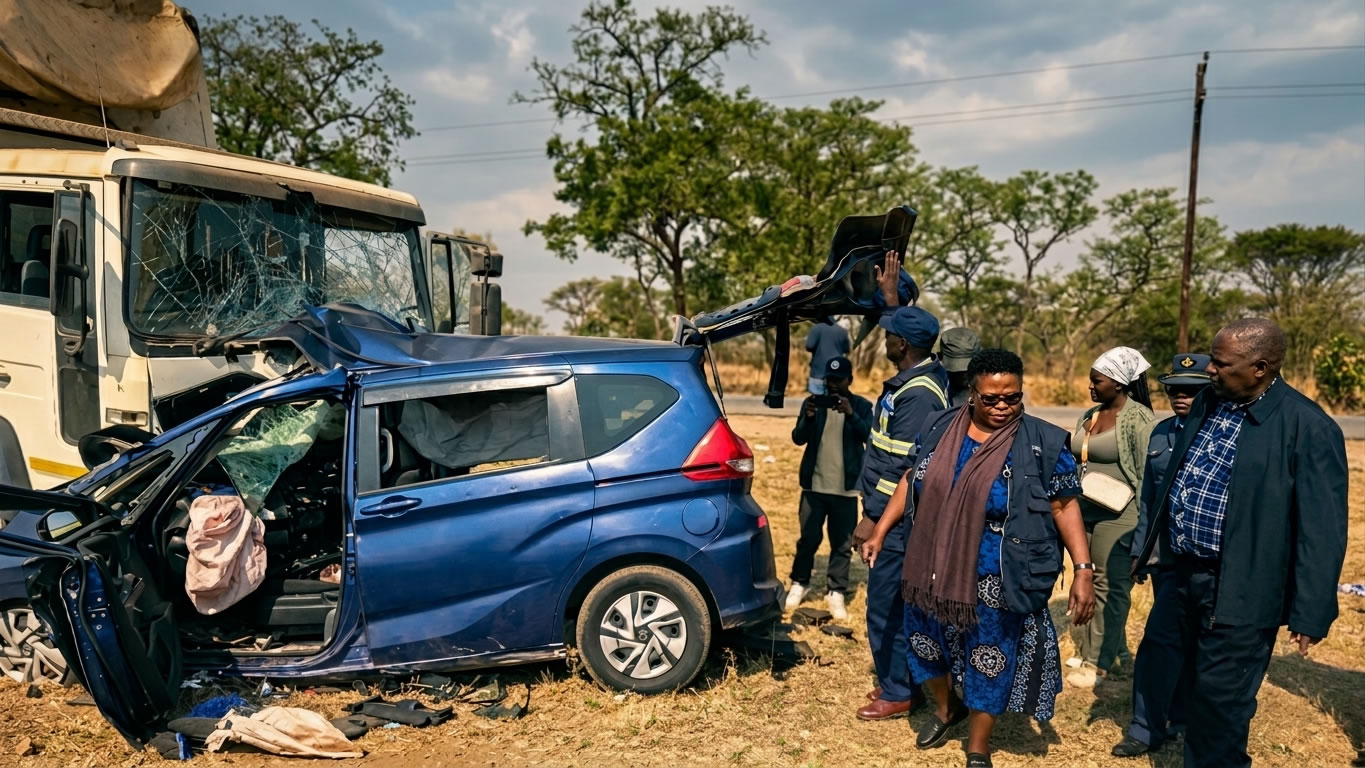
CHINHOYI — The stillness of Saturday night on the outskirts of Chinhoyi was shattered by the screech of tyres and the sickening crunch of metal as a Honda Fit and a heavy-duty lorry collided head-on, leaving four people dead and another fighting for life in intensive care. The tragedy, which occurred near the Provincial Heroes Acre, has once again cast a dark shadow over Zimbabwe’s roads during a season already marred by a relentless series of fatal accidents.
The incident, which took place at approximately 9:00 pm on Saturday, involved a lorry travelling from Harare towards Chinhoyi and a Honda Fit headed in the opposite direction towards the capital. The small passenger vehicle was carrying individuals on a journey of grief that ended in their own untimely demise.
A Journey of Mourning Ends in Death
Among the victims were a couple who had travelled all the way from Zambia. They were reportedly accompanying the body of a deceased relative to Harare for a funeral. In a cruel twist of fate, the mourners became the mourned before they could reach their destination.
Inspector Effort Chapoto, the officer in charge of traffic in Chinhoyi, confirmed the grim details of the crash. He noted that the driver of the Honda Fit and the couple from Zambia died on the spot. A pedestrian, whose presence on the road at that hour remains under investigation, was also struck and killed in the chaos of the collision.
“The driver and a couple who were on their way to a funeral in Harare,” Inspector Chapoto stated, describing the victims. He further added, “A pedestrian also died in the accident.”
The driver of the lorry survived the impact and was reported to be in a stable condition despite his injuries. However, the scene inside the Honda Fit was one of utter devastation. One passenger survived the initial impact but sustained life-threatening injuries.
“The other passenger, in the Honda Fit, sustained serious injuries and was admitted in the intensive care unit at Chinhoyi Provincial Hospital,” said Chapoto.
A Shrine of Sorrow
The location of the accident, near the Provincial Heroes Acre, is becoming increasingly notorious as a “black spot” for motorists. The shrine, meant to honour the nation’s fallen heroes, has instead become a site where new tragedies are frequently recorded.
Mashonaland West Minister of State for Provincial Affairs and Devolution, Marian Chombo, visited the scene of the crash to offer condolences and assess the situation. Her words reflected a growing frustration with the carnage on the province’s highways.
“There have been a lot of accidents that have happened near this shrine, maiming a lot of people,” Minister Chombo observed. “It’s sad because these people were coming from Zambia, with a body, going to Harare for a funeral and, unfortunately, met this tragedy.”
The Minister was visible shaken by the irony of the victims’ mission. The fact that they were already in the process of grieving a loved one when they were killed has added a layer of profound sadness to the incident.
The Perils of the Night
As the investigation into the cause of the Saturday night crash continues, officials are pointing towards the inherent dangers of night-time travel on Zimbabwe’s major arteries. The Harare-Chirundu highway, a vital link for regional trade and travel, is often plagued by poor visibility, stray livestock, and the presence of heavy haulage trucks.
Minister Chombo issued a stern warning to the public following the visit to the crash site. “I want to urge people not to travel at night and, if travelling, motorists must exercise caution,” she said. “I want to urge the people of Zimbabwe, especially those from this province, to travel during the day. We must not drive while under the influence of alcohol and we should not over speed as we are losing a lot of lives.”
The Minister’s plea for daylight travel comes at a time when the Zimbabwe Republic Police (ZRP) is struggling to curb a surge in road traffic accidents. The month of July and the beginning of August have been particularly bloody on the nation’s tarmac.
A Pattern of Carnage: July and August Incidents
The Chinhoyi accident is not an isolated event but part of a disturbing trend of road fatalities across Zimbabwe this winter. Just weeks prior, the Chinhoyi community was rocked by another horrific incident that raised serious questions about police conduct and road safety enforcement.
On July 18, a police officer took over the steering of a commuter omnibus (kombi) that had been impounded for a traffic violation. In a bizarre and tragic turn of events, the officer lost control of the vehicle, leading to a head-on collision with another car at the 109km peg along the Harare-Chirundu road. That accident claimed seven lives and left ten others injured. The sight of a law enforcement officer involved in a fatal crash while operating an impounded vehicle has sparked intense debate regarding the protocols followed by the ZRP when dealing with non-compliant motorists.
The carnage has not been restricted to Mashonaland West. On August 9, just a day after the Honda Fit tragedy, the Harare-Mutare highway claimed the lives of four members of the Zimbabwe National Army (ZNA). Three others were seriously injured when their vehicle was involved in a crash, further stretching the resources of emergency services already reeling from a busy weekend.
In late July, another horror crash was recorded at the 9km peg along a major highway, where six people died after a kombi veered off the road and plunged into a concrete gully. Around the same time, in Buhera, a kombi carrying passengers rolled into a dam, resulting in multiple fatalities and leaving a village in mourning.
The Regional Dimension
The involvement of a Zambian couple in the Chinhoyi crash highlights the regional nature of Zimbabwe’s road safety challenges. Many travellers from neighbouring countries like Zambia and South Africa use Zimbabwe’s roads as a transit corridor.
Recent statistics from the Zambia Police Service indicated that during the 2026 Heroes and Unity Holiday period in July, Zambia recorded 409 road traffic accidents, resulting in 43 deaths. The cross-border movement of people and goods means that road safety in one country directly impacts the citizens of another. The couple who perished in Chinhoyi were part of this regional flow, seeking to bring a loved one home for a final rest, only to have their own lives cut short on foreign soil.
Investigative Insight: Why the Roads are Bleeding
As a seasoned observer of Zimbabwe’s transport sector, one cannot ignore the systemic issues contributing to these “bloody accidents.” While human error—such as speeding and driving under the influence—is frequently cited by the police, the state of the infrastructure and the mechanical fitness of vehicles cannot be overlooked.
The Honda Fit, often referred to as “mushikashika” when used for illegal public transport, is a common sight on Zimbabwean roads. While economical, these small vehicles are often overloaded and driven at excessive speeds to maximise profit. When they encounter heavy lorries on narrow highways like the one passing through Chinhoyi, the results are almost always catastrophic.
Furthermore, the lack of adequate street lighting and the presence of pedestrians on high-speed highways at night create a recipe for disaster. The pedestrian killed in Saturday’s accident is a testament to the dangers faced by those on foot near major roads.
A Call for Action
The words of Minister Marian Chombo resonate with a population that is weary of hearing about the latest “head-on crash” or “horror collision.” However, warnings alone have proven insufficient to stop the flow of blood on the tarmac.
The ZRP has been urged to increase patrols and strictly enforce speed limits, but the incident involving the officer in Chinhoyi in July suggests that even the enforcers are not immune to the risks of the road. There is a pressing need for a comprehensive review of road safety policies, better driver training, and urgent repairs to notorious black spots like the stretch of road near the Provincial Heroes Acre.
As the families of the Zambian couple and the other victims begin the painful process of arranging funerals—this time for those who were supposed to be the mourners—the nation is left to wonder when the cycle of tragedy will end. The four lives extinguished on a Saturday night in Chinhoyi are more than just statistics; they represent families torn apart and a future lost to the unforgiving nature of the road.
For now, the wreckage has been cleared, and the traffic continues to flow past the Provincial Heroes Acre. But for the survivor in the ICU and the relatives of the deceased, the road to recovery and closure will be long and fraught with the memory of a night when a journey of grief became a final destination.