


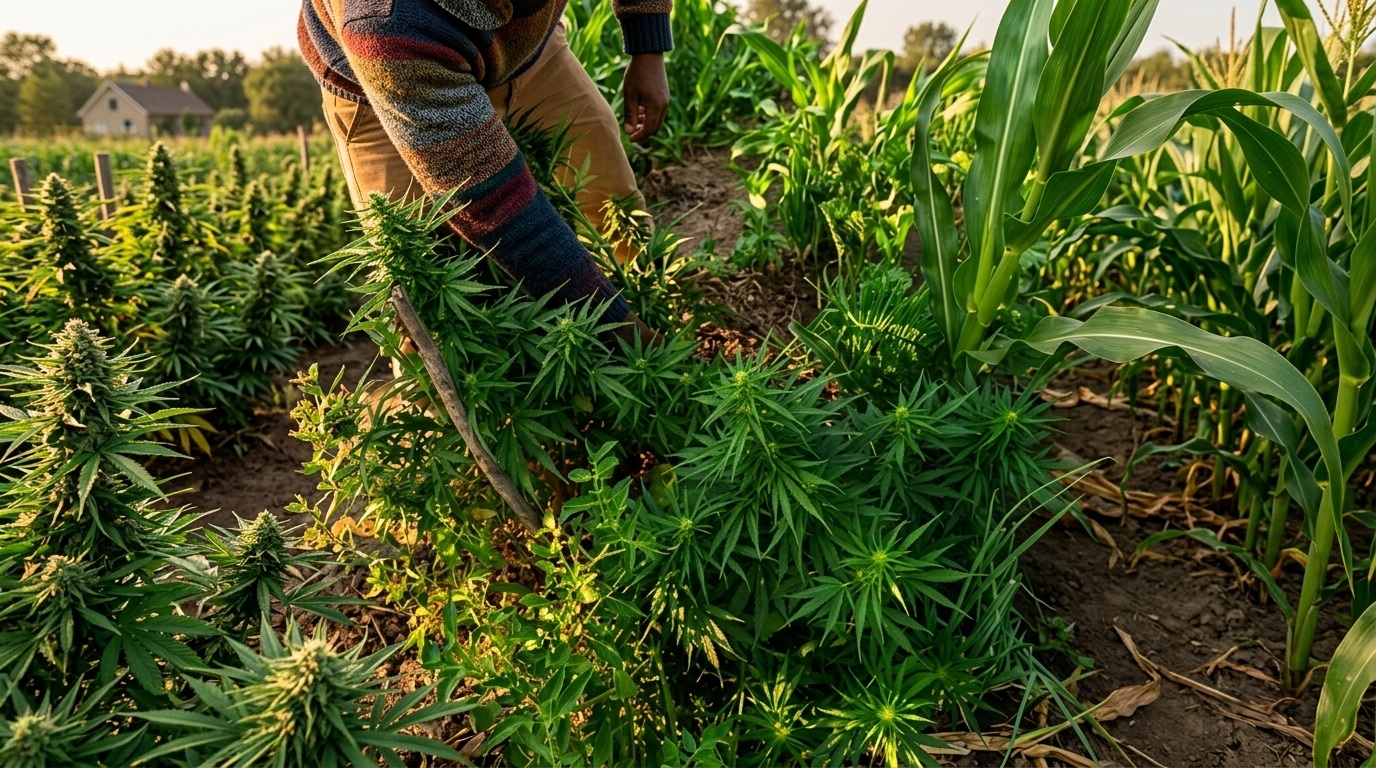
A routine investigation into missing irrigation pipes in Zimbabwe’s Sabi Valley took an unexpected turn when police who were searching a suspect’s homestead discovered a massive cultivated mbanje plantation in his garden.
Cephas Chirume, aged 27, was arrested in Chipinge after officers attended Farm Nine Compound in Middle Sabi to investigate the alleged theft of irrigation equipment. During the search, police found what national police spokesperson Commissioner Paul Nyathi described as “a field of dagga”.
The case is striking because officers were not initially responding to a report about drugs. The alleged cannabis crop was discovered while police were following a separate complaint involving vital farming equipment. In rural areas where irrigation infrastructure is central to production, the loss of pipes can affect an entire operation. In this instance, the search for agricultural property opened the door to a second and potentially more serious investigation.
The theft complaint was made by Blessing Kamhoti of Sabi Bananas at ZRP Sabi. Police then followed the trail to Chirume’s residence at Farm 9 Compound, where he denied involvement in the disappearance of the pipes.
Commissioner Nyathi confirmed the arrest in the following statement:
“On Thursday, July 30, 2026 police in Chipinge arrested Cephas Chirume (27) for unlawful cultivation of dagga at Farm Nine Compound, Middle Sabi. The arrest follows a report of theft in which irrigation pipes were suspected to have been stolen at the farm. Police attended the scene and during a search at the suspect’s garden, a field of dagga was discovered,” he said.
During the search, Kamhoti allegedly identified the missing irrigation pipes at Chirume’s property. Officers also found 27 mature dagga plants in the garden, which were uprooted and seized as evidence.
Chirume was detained at ZRP Sabi and faces allegations relating to both the missing equipment and unlawful cultivation of a prohibited substance. His alleged involvement in the theft and the cultivation charge must still be tested through the legal process. An arrest is not a conviction, and the prosecution will be required to establish the evidence connecting him to each allegation.
Commissioner Nyathi warned the public against dealing in drugs and declared that law enforcement agencies would maintain a zero-tolerance stance towards the problem affecting communities. His warning places the Sabi Valley arrest within a wider series of Zimbabwean cases in which police have found cannabis growing in gardens, homesteads, farms and riverbank plots.
A pattern stretching from gardens to farms
The cases vary considerably in scale. Some involve only a few plants in a private garden, while others have involved thousands of plants and large quantities of processed dagga. Together, they show that police action has targeted alleged cultivation at both household and commercial-looking sites.
In February 2025, police arrested Moleen Mazani, 24, after finding five dagga plants at a homestead in Chitungwiza. Mazani was among 17 people arrested in drug-related cases recorded between January 8 and February 11 that year.
That case is significant because it shows that an alleged crop does not have to reach plantation scale before it attracts police attention. The five plants in Chitungwiza and the 27 mature plants found in Sabi Valley fall at very different points on the scale, but both were treated as alleged unlawful cultivation.
In March 2025, detectives from the Criminal Investigation Department’s Drugs and Narcotics Unit in Mashonaland West arrested Champion Munsaka, 55, at Blackwood Farm in Chinhoyi for allegedly cultivating dagga unlawfully.
The Chinhoyi case has a direct connection with the Sabi Valley investigation because both involved alleged cultivation at farm sites. Police attention is not limited to cannabis being carried on public roads or seized at border crossings. Officers are also investigating where the plant is grown, who controls the land and whether cultivation may be connected to a wider supply chain.
The Plumtree case went a step further. In October 2025, police arrested Melusi Mapolisa of Rangemore Sewage Ponds after discovering a dagga garden at his home. Officers alleged that he had cultivated and sold dagga, planted Indian hemp in the garden and processed it for sale to the public.
An allegation of selling is not established merely by the presence of plants. It must be proved with evidence. Even so, the Plumtree case highlights why investigators distinguish between cultivation, possession, processing and supply. A garden can be alleged to be the source of a crop, but prosecutors must still establish what happened to the plants, who controlled them and whether there was an intention to distribute them.
The largest reported operation involved thousands of plants
One of the most serious cultivation cases recorded in Zimbabwe occurred in Gokwe, where a police operation escalated into a confrontation with villagers. Officers arrested Brian Kuruwa, Talkmore Muzondiwa and Shylet Magigani after receiving information that dagga was being grown along the banks of the Svisvi River.
Police recovered 6,500 plants and 170kg of processed dagga. Kuruwa was allegedly found watering a dagga plot, while further searches led officers to a sack of dried dagga at Muzondiwa’s residence and three sacks in a bedroom hut at Magigani’s homestead.
The operation reportedly became tense when Joseph Kuruwa, the village head and husband of one of the accused, mobilised villagers to confront the officers. Police fired warning shots to disperse the crowd. The three accused people later appeared before a Gokwe magistrate and were convicted of illegal marijuana cultivation and possession.
Kuruwa was sentenced to 4 years in prison, with 1 year suspended on condition of good behaviour. Muzondiwa received a 24-month sentence, with 8 months suspended, while Magigani was sentenced to 3 years.
The Gokwe outcome should not be read as a prediction of what will happen to Chirume. It does, however, underline the difference between an allegation recorded at the point of arrest and a conviction reached after evidence has been presented in court. It also demonstrates how a cannabis investigation can raise wider questions about community protection, access to remote land, processed stock and possible interference with police work.
Earlier cases show that the pattern is not new. In January 2022, police in Hwange responded to a tip-off and arrested Langton Masunda, 57, for allegedly cultivating 11 dagga plants at his garden at Halfway Hotel, Gwayi, in Dete. Officers acted on information and found the plants at the garden.
Zimbabwe’s legal position has sometimes created confusion because the country introduced a regulatory framework for industrial hemp production in 2020. That change did not create a general right for people to grow or possess cannabis without the required authority. A licensed industrial or medicinal operation is different from an unlicensed crop cultivated in a private garden or on a farm.