


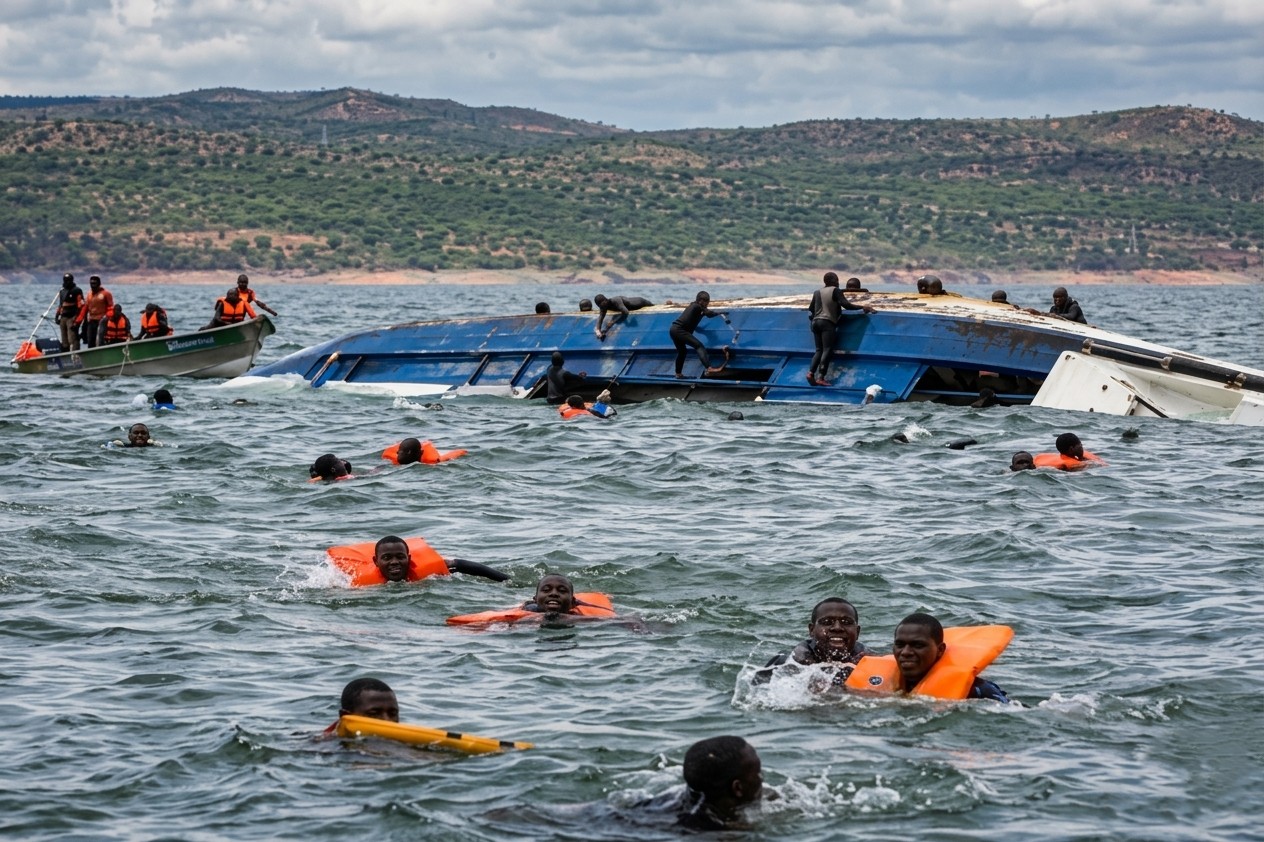
KARIBA — The Lake Kariba ferry disaster has left Zimbabwe with two emergencies: the search for bodies and survivors, and the search for a reliable account of who was on board.
The ferry capsized on Tuesday near Long Island while travelling from Kariba town towards Chalala Fishing Camp. By the time of that report on August 13, 44 people had been confirmed dead, 77 had been rescued and at least 27 remained missing. A separate report, also published during the rescue operation, said the death toll had risen to 46 and that police and the government agency responsible for the vessel had still not provided an official count of how many people were aboard or how many remained missing.
Those figures are not simply a matter of news organisations updating at different speeds. They expose a dangerous information gap at the centre of the tragedy. Authorities have said the ageing ferry was designed to carry 90 people, while estimates of those aboard have reached 153. Zimbabwe’s disaster management agency said the vessel carried at least 114 adult passengers and five crew members, and that 77 people had been rescued. A ticketing official, identified as Anymore Chambati, said he counted 153 people, including crew and infants, before the crossing began. He was one of the two surviving crew members.
The discrepancy may be explained by the difference between tickets sold, people who boarded, crew members, infants and passengers who were not recorded in a conventional ticketing system. It may also reflect the speed and confusion of a search operation in deep and difficult water. But until the figures are reconciled, families cannot know whether a relative is safe, in hospital, among the dead or still missing.
A number can become another form of uncertainty
In a disaster, a passenger manifest is not an administrative luxury. It is the first working document for rescuers, hospitals, mortuaries, police officers and relatives. If it is accurate, it can help establish who should be found and who has been accounted for. If it is incomplete or unavailable, families are forced to create their own lists by telephoning friends, visiting hospitals and searching social media for photographs of the dead.
The public record of the Kariba sinking currently contains several overlapping totals. New Zimbabwe reported 44 confirmed deaths, 77 rescues and at least 27 missing. AP later reported a death toll of 46 while saying the total number aboard and the number missing remained officially unresolved. At first glance, the arithmetic appears to offer an answer: 77 rescued, 46 dead and 27 missing would make 150 people. But that calculation is not proof of a final manifest. The totals may include or exclude crew, children, infants, bodies awaiting identification or people counted twice during the early rescue effort.
The uncertainty is particularly serious because AP reported that ticket sales recorded at least 114 adult passengers and that children below ticketing age may not have been included. The state broadcaster also reported that children were among the dead. A list based only on adult tickets could therefore undercount the people who were actually on the ferry, even before the question of crew and informal boarding records is considered.
The government should now publish one regularly updated public record, with proper safeguards for relatives. It should show the names of confirmed survivors, the names of identified dead, people who remain unconfirmed or missing, and the facility or team handling each case. The record should make clear when a name is provisional, when a body has been identified through family confirmation or forensic evidence, and when a person has been found alive but has not yet been reunited with relatives.
That would not require authorities to release distressing details before families are notified. On the contrary, it would create a formal process for notifying families first and publishing names afterwards. It would also allow officials to explain why a figure has changed instead of leaving relatives to interpret each new announcement as evidence that another person has disappeared from the count.
The people behind the numbers
The human cost of the missing list can be seen in the account of Collen Ndandalika, who was reported by AP, citing Zimbabwe’s state broadcaster ZBC News, to have lost his wife and three children. Two children had been recovered, he said, while his wife and another child were still missing.
“My wife and children all drowned. Two children have been recovered, but my wife and the other child are still missing. I still can’t believe this is a real world I am living in,” he said.
Ndandalika described a family tragedy that remains partly unresolved. Even where a death is almost certain, the absence of an identified body can prevent a burial, delay legal paperwork and keep relatives suspended between mourning and hope.
He said his wife bought goods in town and sold them to people in rural and fishing communities. She had asked the children to help with the business during the school holidays. That detail changes the meaning of the passenger list. The ferry was not only carrying individuals travelling from one place to another; it was carrying a network of small household economies.
“I have my brothers who are checking on the bodies to see if they can identify my wife and child. I am too traumatized to keep looking at dead bodies,” he said.
Other passengers were reportedly travelling with goods for sale in rural and fishing communities around the lake. Their deaths can remove income from households that depend on informal trade, as well as taking parents, spouses and children from their families. School fees, food purchases and medical expenses may all be affected when a trader does not return from a routine journey.
The ferry operated in a region where transport alternatives are limited. AP reported that people in the rural communities and fishing camps depend heavily on fishing and on the vessel for transport because roads are damaged and public transport is scarce or almost non-existent. In that setting, asking why people boarded an ageing ferry or why they carried goods is not enough. The larger question is whether people had a realistic alternative.
Warnings before the sinking
Survivors told AP that passengers pleaded with the captain to turn back as the waves grew stronger. The captain was among those reported dead by the state-run Herald, according to AP. One survivor said people were floating in the water and clutching sacks of goods, while help did not arrive for nearly an hour.
Another survivor told a broadcaster:
“About 30 minutes in, we begged again to abort and return, more goods were falling, the wave was getting worse and water was gushing into one side of the boat, but (the captain) just said, ‘My boat has never sunk anyone.’ He even refused to call for help,”
That account is an allegation from a survivor and must be tested by the investigation. It nevertheless raises questions that a final report should answer. Was the vessel permitted to leave in the prevailing weather? Was its load inspected? Were passengers and goods counted separately? Did the captain have a working means of calling for assistance? Were rescue boats and emergency teams close enough to respond quickly? Were passengers given life jackets, and if so, were there enough for every person on board?
The identity of the operator is also important. New Zimbabwe identified the vessel as the Mbuya Nehanda, operated by the Rural Infrastructure Development Agency, or RIDA. It reported that President Emmerson Mnangagwa acknowledged serious shortcomings in the maritime sector, declared the tragedy a National Disaster and ordered an urgent overhaul of safety systems.
In a condolence message quoted by AP, Mnangagwa said the tragedy had “exposed serious deficiencies in our maritime capabilities which we have to address immediately so that our places of recreation do not become death traps to the innocent.” The statement recognises a national responsibility, but it must now be followed by evidence: inspection records, maintenance histories, crew qualifications, weather decisions, passenger records and a clear account of the rescue response.
Identification is the next test
Recovering bodies is only the beginning of the identification process. In a mass-casualty incident, some victims may be recognisable to relatives, while others may require fingerprints, dental records, personal effects or DNA testing. Authorities should explain which methods are being used and whether families have been asked to provide reference samples where visual identification is impossible.
They should also set out where bodies are being held, how relatives can submit information, and who is responsible for communicating results. The public gathering at Nyamhunga Stadium, where coffins were laid out under tents as mourners and cabinet ministers gathered, showed the scale of the loss. It also underlined the need for a careful system that treats each victim as a named person rather than as part of a changing total.
Families need transport to hospitals and mortuaries, psychological support and practical help with funeral arrangements. New Zimbabwe reported that the president had directed authorities to provide medical, psychological and funeral support. The effectiveness of that promise should be measured by whether relatives can actually reach the relevant facilities, receive timely information and obtain documents needed to bury or care for their loved ones.
Social media can help locate survivors, but it can also spread photographs or names before families have been informed. A public list should therefore be managed by a clearly identified authority, updated at set times and accompanied by a contact line that relatives can use to challenge errors. Changes should be logged. If a person moves from “missing” to “identified dead”, or from “unconfirmed survivor” to “rescued”, the record should say when and why.
The passenger count is also central to the safety investigation. If the ferry carried more people than its stated capacity, investigators must establish how that happened and whether the overloading was visible to the operator or regulator. If the number of passengers exceeded 90, the case is not only about the conditions on the lake that day. It is about ticketing, boarding controls, enforcement and the pressure placed on a service that remote communities rely on.
Zimbabweans deserve a single, transparent answer to the most basic question: who was on the Mbuya Nehanda when it left Kariba? That answer will not bring back the dead, but it can help families locate the missing, identify the recovered and protect the living. The country must investigate how the ferry sank. It must also investigate how, in the aftermath, so many people could remain unaccounted for.