


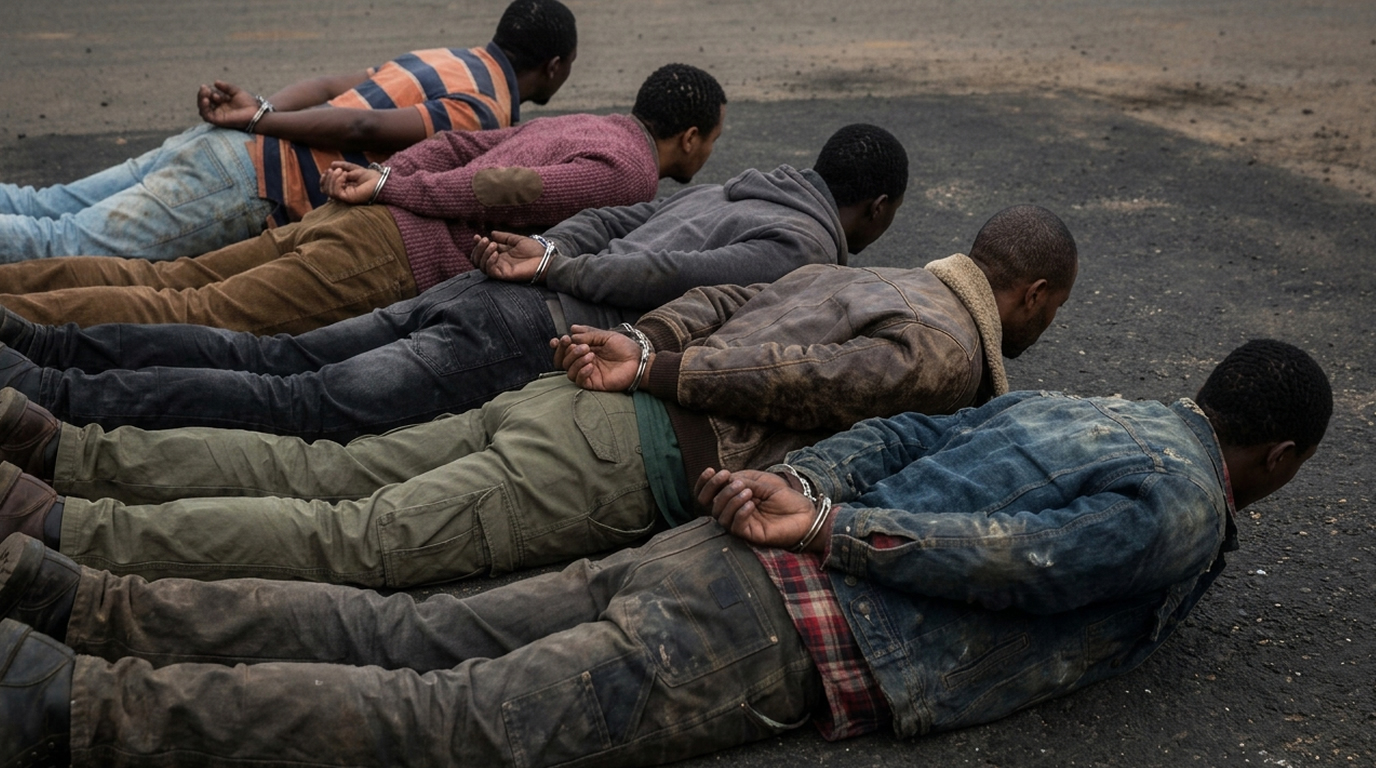
Five of Harare’s most wanted suspects linked to a string of armed robberies across Harare have been arrested after police connected them to seven cases recorded between 17 July and 5 August 2026.
The suspects were identified as Peter Gawa, 31, Billian Magacha, 31, Taurai Badza, 37, Soneni Maruva, 31, and Calvin Tinashe Langa, 36. Police said the group moved around the capital in a blue Toyota Passo and used a Retay pistol during the robbery spree.
Their arrests have brought together a series of attacks in which bars, shops, tuckshops and other businesses were targeted. Investigators said the suspects would confront people at the premises, threaten them with firearms and take cash, phones and other valuables before escaping in the small blue vehicle.
One of the most serious incidents took place at a company along Simon Mazorodze Road in Waterfalls. The suspects allegedly arrived armed with two firearms and attacked two security guards who were on duty. The guards were tied by their hands and legs with pieces of cloth while the robbers searched the premises.
“During the robbery, they attacked two security guards who were on duty, tied their hands and legs with pieces of cloth and stole a generator, three batteries and other valuables with a total value of approximately US$2,500,” said Commissioner Paul Nyathi.
The investigation has so far linked the five men to seven counts of armed robbery. Police have recovered the Retay pistol allegedly used in the offences, clothing believed to have been worn during some of the attacks and two mobile phones stolen from one of the complainants. Clothing worn by the suspects was captured on closed-circuit television (CCTV) footage, giving investigators material to compare with the evidence gathered from the robbery scenes.
“The Zimbabwe Republic Police commends members of the public for their cooperation and urges anyone with information that may assist ongoing investigations to report at any nearest police station,” Commissioner Nyathi said.
The arrests came as police continued to pursue robbery cases in different parts of the country, with several investigations during July and August focusing on groups accused of using guns, knives, machetes, axes and iron bars to force their way into homes and businesses.
In Harare, 31-year-old Melusi Pilile was arrested in July after police linked him to 31 counts of robbery and armed robbery. Investigators said he had been targeting residents in Glen View and Budiriro, two densely populated suburbs where residents had reported a series of violent attacks. The case placed a single suspect at the centre of a wide investigation covering multiple incidents rather than one isolated robbery.
Police said Pilile was suspected of terrorising residents in the two suburbs. The allegations included robberies in which victims were confronted during attacks on homes and other premises. His arrest added to a growing list of cases in which detectives have used information from residents, CCTV footage and recovered property to identify suspects believed to be connected to repeated offences.
Another robbery case reached court in Shurugwi in July after six men were arrested over the alleged attack of a local businessman. The accused were named as Tatenda Musara, 27, Dennis Takavagwisa, 21, Takudzwa Yotamu, 24, MacDonald Chinyowa, 20, Jetro Chiwundura, 28, and Tafadzwa Hove, 22. Each faced a robbery charge before a provincial magistrate in Gweru and was remanded in custody while arrangements were made for a trial date.
The court heard that the complainant, Blessing Saidi, was attacked at his home in Sebanga Extension, Shurugwi, on 10 February. The six men were accused of travelling in a blue Honda Fit, leaving the vehicle some distance from the house and approaching the property on foot. The group allegedly confronted Saidi in his office while armed with a pistol and knives.
The accused were said to have demanded cash and valuables before tying the complainant’s legs with a rope and forcing him to lie face down on the floor. The court heard that the robbers searched the room and fled with US$8,000, a Samsung S23 Ultra mobile phone and a Samsung A14 phone. The total value of the stolen property was put at US$8,800.
“On February 10, at about 1900 hours, the accused persons, who were armed with machetes and a pistol, connived and hatched a plan to rob the complainant at his house in Sebanga Extension, Shurugwi,” said the prosecutor.
“The accused persons took a rope and tied both legs of the complainant together, ordering him to lie face down on the floor before ransacking the entire room,” said the prosecutor.
The arrests followed information received by police on 16 June. Officers intercepted a Toyota Mark X being driven by Yotamu and recovered a 7.65mm Unique pistol, which prosecutors said was linked to the robbery. Yotamu was then interviewed and allegedly implicated the other accused persons. The stolen cash and phones had not been recovered when the matter came before the court.
The Shurugwi case was one of several recent investigations in which detectives followed the movement of suspected gangs after an initial robbery. Vehicles used to approach or leave crime scenes have featured prominently in the cases, with police relying on registration details, witness accounts and information from members of the public to trace suspects.
In Kadoma, three men were convicted and sentenced to a combined 70 years in prison after a series of robbery offences. Misheck Mutetwa, 30, received 30 years, while Lordshare Chimanya, 29, and Kudakwashe Mapfiravana, 27, were each sentenced to 20 years by the Kadoma Regional Magistrates’ Court.
The three men were arrested on 30 April after detectives received information linking them to the offences. Police recovered two laptops, a pellet gun and several mobile phones. A fourth suspect, Jimmy Mutetwa, remained at large and was being sought by police.
Detective Inspector Rachel Muteweri said the group used knives, axes and iron bars as they moved from one target to another.
“The accused persons, together with an outstanding accomplice, Jimmy Mutetwa, embarked on a robbery spree armed with knives, axes and iron bars.
“They later moved to another victim’s residence, forcibly broke the door and gained entry into the house. The gang stole cash, cellphones, a laptop, car keys and other valuables.”
One of the Kadoma robberies involved the theft of US$1,000, along with mobile phones, a laptop and car keys. The men were also accused of forcing their way through the door of a victim’s residence before taking the property. The recovered laptops, pellet gun and phones became part of the evidence presented in the case.
The Kadoma sentences followed a period in which police operations were intensified across the country. A nationwide crime blitz launched in July sought to target offences including murder, attempted murder, robbery and drug-related crimes. More than 2,000 suspects were arrested during the operation, according to police figures released during the campaign.
The arrests in Harare, the Shurugwi court proceedings and the Kadoma convictions have involved different groups, locations and methods, but the cases share a pattern of organised attacks carried out by several people. In Harare, the five suspects were linked to repeated attacks on commercial premises and were allegedly supported by a getaway vehicle and firearms. In Shurugwi, prosecutors described a group that travelled together, approached a house on foot and used a pistol and knives to overpower a victim. In Kadoma, detectives recovered equipment and property after tracing suspects connected to a robbery spree.
For investigators in Harare, the recovery of the Retay pistol and the clothing seen on CCTV footage is expected to help connect the suspects to individual scenes. The two recovered phones also provide a direct link to one of the complainants. Police said the investigation remained active and that further information could assist in identifying other incidents connected to the group.
The arrests have also placed renewed attention on the vulnerability of small businesses and security workers during evening and night operations. Bars, shops and tuckshops often handle cash after dark, while guards at company premises can be left exposed when confronted by several armed attackers. In the Waterfalls case, the two guards were restrained before equipment and other valuables were taken from the premises.
The five Harare suspects are now at the centre of a wider police case involving seven armed-robbery counts. Their names, the blue Toyota Passo, the Retay pistol, the CCTV images and the recovered mobile phones form the main details released so far. Detectives are continuing to examine the alleged robbery spree and are appealing for information that may help them connect the suspects to further offences.
As police pursue the Harare investigation, the recent cases in Kadoma and Shurugwi show how robbery investigations have continued to unfold across Zimbabwe during the winter months. Some suspects have been taken to court after arrests, while others have faced lengthy prison terms after conviction. In Harare, the arrest of Gawa, Magacha, Badza, Maruva and Langa has given investigators the opportunity to examine seven reported attacks as one connected case rather than separate incidents.
The five are Peter Gawa, Billian Magacha, Taurai Badza, Soneni Maruva and Calvin Tinashe Langa. Police have urged anyone with information about the robberies to report it at the nearest police station.