


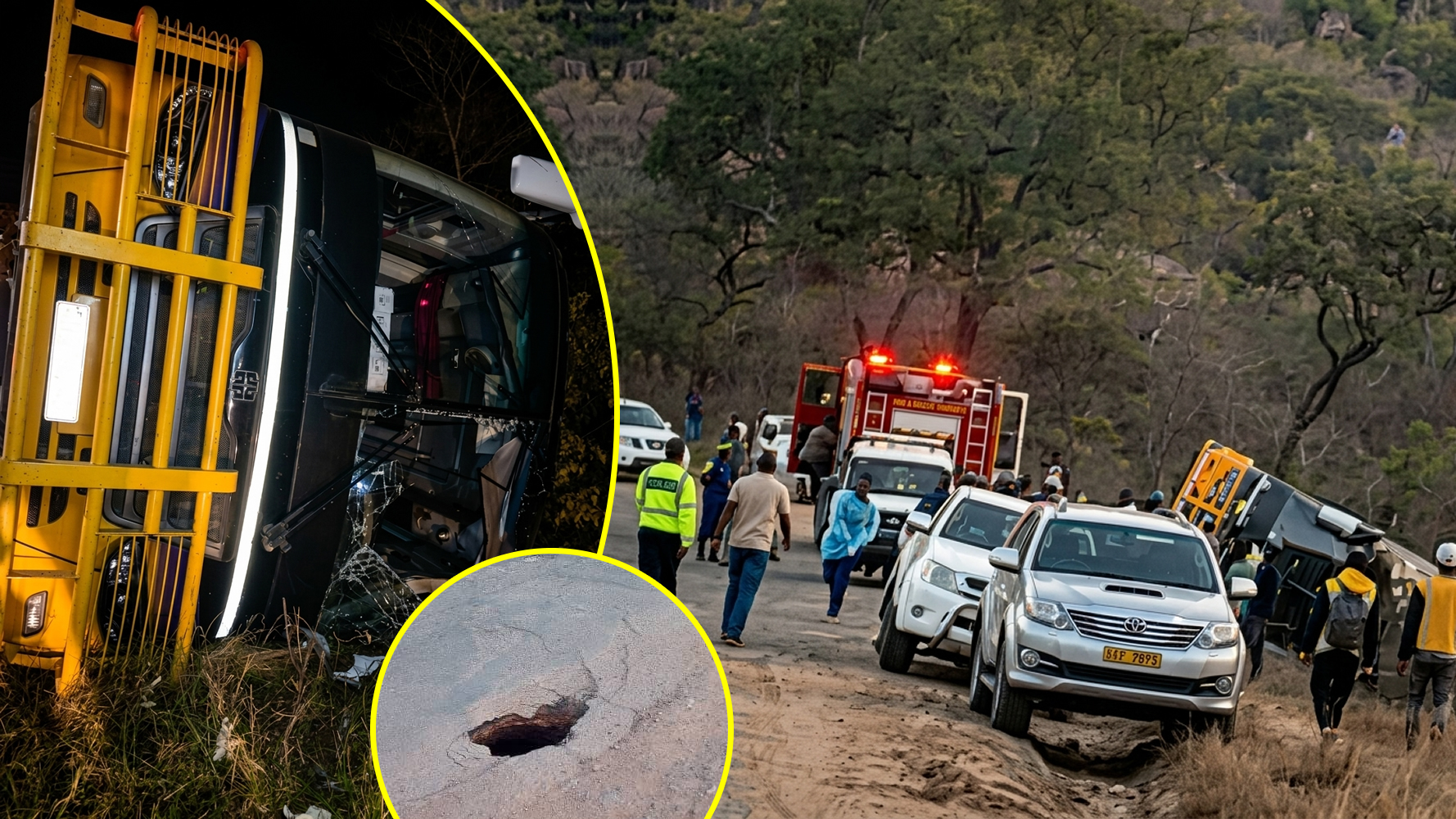
Two people were killed and 22 others injured when an Inter Africa bus overturned at the Boterekwa Escarpment in Shurugwi on Friday evening, renewing concern over the safety of one of the most difficult stretches of road in the Midlands.
The bus, which was carrying 61 passengers and was travelling towards Zvishavane, overturned on the Gweru–Zvishavane Road at about 6pm. The accident happened at the 40-kilometre peg, as the vehicle was negotiating a descent through the steep and winding escarpment.
National police spokesperson Commissioner Paul Nyathi confirmed the deaths and injuries.
“The ZRP confirms a fatal road traffic accident which occurred at the 40-kilometre peg along the Gweru–Zvishavane Road on Friday at approximately 1800 hours,” he said.
According to the police account, the driver lost control of the bus while travelling down the slope. The vehicle veered off the road to the left, overturned and came to rest on its side, leaving passengers trapped or thrown around inside the bus.
“As a result, two passengers died on the spot while 22 others, including the driver, sustained injuries of varying degrees,” he said.
The bodies of the two victims were taken to Shurugwi District Hospital, where they were awaiting post-mortem examinations. The injured passengers, including the driver, were also taken to the hospital for treatment.
The deaths have once again placed the Boterekwa Escarpment under scrutiny. The road is a major link between Gweru, Shurugwi and Zvishavane, carrying buses, haulage trucks, mine workers, commercial traffic and residents travelling between communities. It is also a route used by President Emmerson Mnangagwa when travelling to his rural home in Shurugwi.
The escarpment is marked by sharp bends, steep sections and long descents. Drivers approaching the area must manage their speed while dealing with uneven surfaces, heavy vehicles and limited room for error. The condition of the road has been a continuing concern for people who use it regularly, with residents pointing to potholes, narrow sections and damaged edges.
Some of the early accounts from the scene said the bus struck a pothole before the driver lost control. Residents said the pothole had been in place for a long time and that repeated complaints had not led to repairs.
“The pothole has been there for a long time. We have complained many times but nothing has been done. This is the road that is used by President Mnangagwa to his rural home in Shurugwi,” said a villager who witnessed the accident.
Some survivors also told people at the hospital that they had raised concerns about the speed of the bus before it overturned.
“We cautioned the driver for driving above the speed limit but he did not listen,” said one passenger who was speaking from his hospital bed.
The accounts about the pothole and the speed of the bus form part of the information being considered as investigators establish what happened in the moments before the crash. The police have not announced a final cause of the accident.
Commissioner Nyathi urged motorists to take extra care on steep and mountainous roads, where a small loss of control can quickly become fatal. He said drivers should obey speed limits, maintain their vehicles and avoid carrying more passengers or cargo than permitted.
“Motorists are urged to observe speed limits, service their vehicles regularly and avoid overloading. Drivers should also be vigilant when descending steep slopes and use appropriate gears to maintain control of their vehicles,” he said.
The accident is not the first major tragedy to occur in the wider Boterekwa and Shurugwi area. In February 2014, four Unki Mines employees died when a bus taking them home from work plunged into the Mutevekwi River at Mutevekwi Bridge. The crash happened at about 5am, roughly 9 kilometres from the mine.
The bus was carrying workers who had finished a night shift and were travelling towards Shurugwi and Gweru. It was operated by a contract transport company hired by the mine. The vehicle hit the edges of the narrow bridge, flipped and landed on its roof in the riverbed.
Three of the injured workers were critically hurt and airlifted to Harare for treatment. A further 65 people were treated at hospitals and clinics in Gweru and Shurugwi. Villagers living near the bridge helped rescue passengers trapped inside the wreckage, opening the sun roofs and emergency exit panels to reach them.
The 2014 crash also drew attention to the narrowness of Mutevekwi Bridge and the difficulty of navigating it safely. The tragedy came only weeks after another deadly accident in the same district, when a Zupco bus carrying 28 passengers was swept away after plunging into the flooded Musavezi River along the Shurugwi–Mhandamabwe Road. Four people died in that incident.
The road infrastructure around Boterekwa has faced more than traffic pressure. In June 2020, a section of the Shurugwi–Zvishavane Road collapsed and formed a large crater after small-scale gold miners dug tunnels beneath the highway. One tunnel was reported to be about 15 metres deep and 7 metres wide.
The collapse occurred near the end of the escarpment for vehicles travelling towards Zvishavane. Transport officials moved to fill the crater after the damage threatened motorists and haulage trucks using the route. Local officials described the affected point as a danger zone, while residents said illegal mining had weakened the land beneath the road and damaged the surrounding environment.
The collapse highlighted a danger that is not always visible to motorists. A road may appear passable from the surface while tunnels, erosion or weakened shoulders threaten its stability underneath. In a steep area where vehicles are already negotiating bends and gradients, sudden damage to the carriageway can increase the risk of a serious crash.
The route has also been identified for expansion and improvement because of the volume of traffic moving through the escarpment. The Boterekwa section is narrow and runs through difficult terrain, conditions that have contributed to repeated concerns from motorists, residents and transport operators. Plans to improve the road have been discussed, but people living along the route continue to use the existing carriageway every day.
The latest accident has placed fresh pressure on authorities to address the physical condition of the road and strengthen enforcement of traffic rules. Residents say the danger cannot be separated from the poor state of the surface, while police warnings have focused on speed, vehicle maintenance, overloading and the need for drivers to use lower gears on descents.
The collision occurred after the truck had stopped on the highway. The incident led to renewed calls for greater care around broken-down vehicles and for motorists to remain alert when driving at night, particularly on busy highways where heavy trucks and long-distance buses share the road.
The two Inter Africa crashes occurred in different locations and under different circumstances. The earlier collision involved a stationary truck on a major highway, while the latest accident happened as the bus was travelling down a steep section of the Boterekwa Escarpment. Both incidents, however, involved a large passenger vehicle carrying dozens of people and resulted in multiple deaths and injuries.
At Shurugwi District Hospital, the injured passengers were receiving medical attention after the Friday evening crash. Relatives and fellow travellers were waiting for information about the victims, while the bodies of the two people who died remained at the hospital pending post-mortem examinations.
Police investigations are continuing. Officers will examine the bus, the road surface and the scene of the crash, while statements from the driver, passengers and witnesses will help establish the events leading to the overturning. The condition of the pothole reported by residents, the speed of the bus and the manner in which the vehicle was being driven down the slope will all be important parts of the inquiry.
For families who use the Gweru–Zvishavane Road, the crash has brought another painful reminder of the risks faced on the Boterekwa route. For authorities, it has added urgency to the demands for repairs, stronger road maintenance and safer driving practices on a highway that remains essential to the movement of people and goods across the Midlands.