


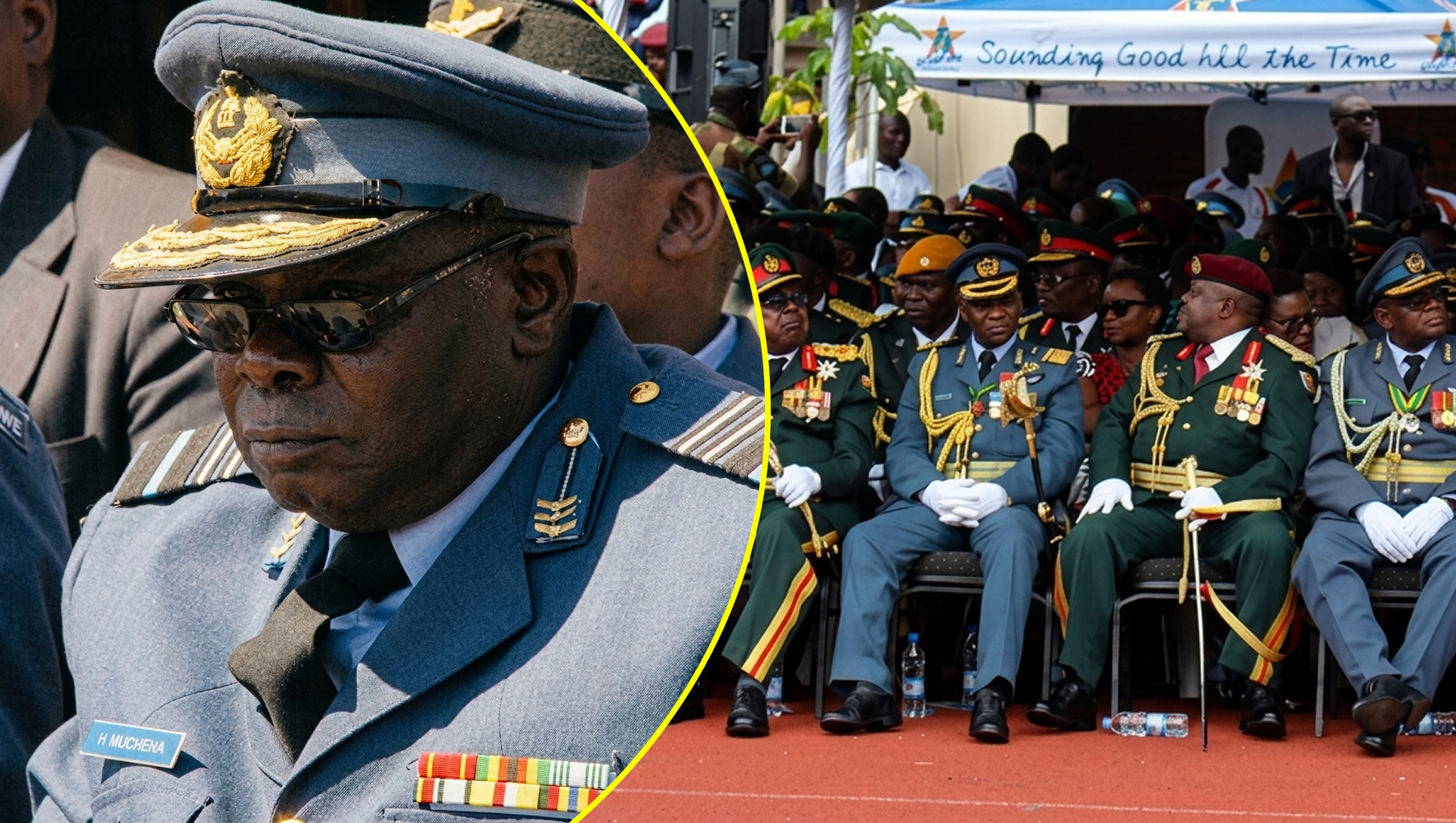
Former army chief says he is being followed as Zimbabwe’s 2030 power struggle deepens
HARARE — Retired Air Marshal Henry Muchena has released videos showing unidentified vehicles following him from his home to town, while claiming that members of his family have also been monitored. The retired army general has become an outspoken critic of President Emmerson Mnangagwa’s plan to remain in office until 2030.
The reported surveillance has added a disturbing security dimension to a succession battle that is already dividing Zimbabwe’s ruling Zanu-PF party, the military establishment and former members of the security services. Muchena’s public stand against Constitutional Amendment Bill No. 3 (CAB 3) has placed him at the centre of the dispute over whether Mnangagwa should remain president beyond the end of his second term in 2028.
Muchena represented military veterans who challenged the amendment process, and his opposition has continued after the bill was signed into law by President Mnangagwa. In the videos released on Friday, the vehicles seen following him were not identified, but the appearance of the footage has intensified concern among former soldiers who say the state is treating political dissent as a security threat.
The amendment was gazetted on 16 February 2026 and proposed extending presidential and parliamentary terms from five years to seven. The change would move the next general elections from 2028 to 2030 and allow Mnangagwa, who began his second term in 2023, to remain in power for two additional years. Parliament later approved the constitutional changes, which have been described by opponents as a fundamental alteration of Zimbabwe’s political system.
The legislation also proposes replacing the direct election of the president with a vote by a joint sitting of Parliament. It would allow the president to appoint additional senators and ministers, remove the running-mate requirement for presidential candidates and change the way senior judicial appointments are made. Supporters of the changes have said the bill lengthens the electoral cycle rather than extending presidential term limits. Critics have rejected that distinction and demanded a national referendum.
Vice-President Constantino Chiwenga has emerged as the most prominent figure opposing the proposed extension from within Zanu-PF. Chiwenga, a former army commander, has repeatedly linked his position to the principles of the liberation struggle, especially the demand for land and “one-man, one-vote”. He has insisted that any change affecting presidential term limits must be put directly to the people.
During the exchange, Chiwenga reminded those present that he was a general who had fought to liberate Zimbabwe “while others sought refuge elsewhere to avoid participating in the liberation struggle.” The remark was understood as a direct attack on Mnangagwa’s liberation-war record and exposed the personal nature of the dispute.
Chiwenga later invoked the same political principle at the funeral of the late Kumbirai Kangai’s wife. He also described the 2030 campaign as an “assault on the values of the liberation struggle”, accusing those behind it of seeking to protect personal wealth and “looting the country’s resources”. In a separate cabinet confrontation over the proposed indirect presidential election, he reportedly dismissed comparisons with other countries by telling the Attorney-General: “South Africa is no example at all.”
The political fight has widened beyond the presidency. Former and retired members of the security services have reportedly formed the Guardians of Zimbabwe, a new political party led by president Moses Kumbweya, deputy president Constance Zulu and organising secretary Oscar Chaza. The group includes former serving personnel and veterans who fought in the Second Congo War and took part in the 2017 military-backed removal of Robert Mugabe.
Kumbweya described the organisation as “a political party born out of oath”. Zulu said: “I, too, swore an oath to serve Zimbabwe, an oath that does not expire when the uniform comes off.” The party has presented itself as a movement for discipline, accountability and public service, while criticising the government over unemployment, hunger, declining living standards and the treatment of civil servants and security personnel.
That resentment surfaced sharply in June, when 65 soldiers, including senior officers, were reportedly arrested and interrogated at 2 Brigade Headquarters at Cranborne Barracks. The arrests followed the discovery of leaflets carrying the words “THE PEOPLE’S ARMY” at several military installations, including 1 Commando Regiment, Josiah Magama Tongogara Barracks, Dzivaresekwa Barracks and Manyame Air Base.
The leaflets accused senior political and military leaders of neglecting ordinary soldiers while enriching a wealthy elite referred to as “zvigananda”. They stated: “Our conditions of service are pathetic. We need decent salaries, accommodation, uniforms, buses and vehicles — not handouts.” The authors also questioned why soldiers were being deployed to protect “zvigananda” and alleged that unofficial payments were dividing the army.
The emergence of the Guardians of Zimbabwe followed those arrests and has prompted police and intelligence officers to track the group’s organisers. Kumbweya was reportedly visited at his home by police before being summoned to Bulawayo Central Police Station. He attended the questioning with a lawyer from the Zimbabwe Lawyers for Human Rights and was asked about the party’s objectives, its opposition to the constitutional amendment and whether it would join Zanu-PF.
No charges were laid during that questioning, but the episode showed how quickly the new movement had become a target for state security agencies. Meetings involving former soldiers have reportedly been held on the outskirts of Harare and Bulawayo, adding to official fears that the political campaign could develop into a wider military-linked network.
The current confrontation carries echoes of the events of 2017, when Chiwenga and senior commanders helped force Mugabe from office and cleared the way for Mnangagwa’s presidency. Chiwenga remains closely associated with the military constituency that helped produce that transition, while Mnangagwa has moved to reshape the security and political leadership around him.
The dispute over businessman Kudakwashe Tagwirei has deepened the split. Tagwirei, a prominent Zanu-PF funder with close links to Mnangagwa’s camp, was eventually endorsed for a senior party role after Chiwenga objected to his co-option. He was also recently recommended by President Mnangagwa as one of his 10 nominees for the Senatorial seats that the president is now granted to appoint under the new Constitutional Amendment Act No 3 (CAA3) that General Muchena has been fighting against. Chiwenga warned during the internal debate that “the party is not for sale” and criticised the inclusion of “businessmen with questionable motives” in policy positions.
As pressure grows around the amendment, the reported pursuit of Muchena has become a symbol of the widening struggle. A retired air marshal who once occupied the upper ranks of the state’s military system is now publicly documenting vehicles outside his home and warning that his family is being watched. At the same time, former soldiers are organising a political party, serving troops are accused of circulating protest leaflets, and the vice-president is challenging the president’s succession plans inside the ruling party.