


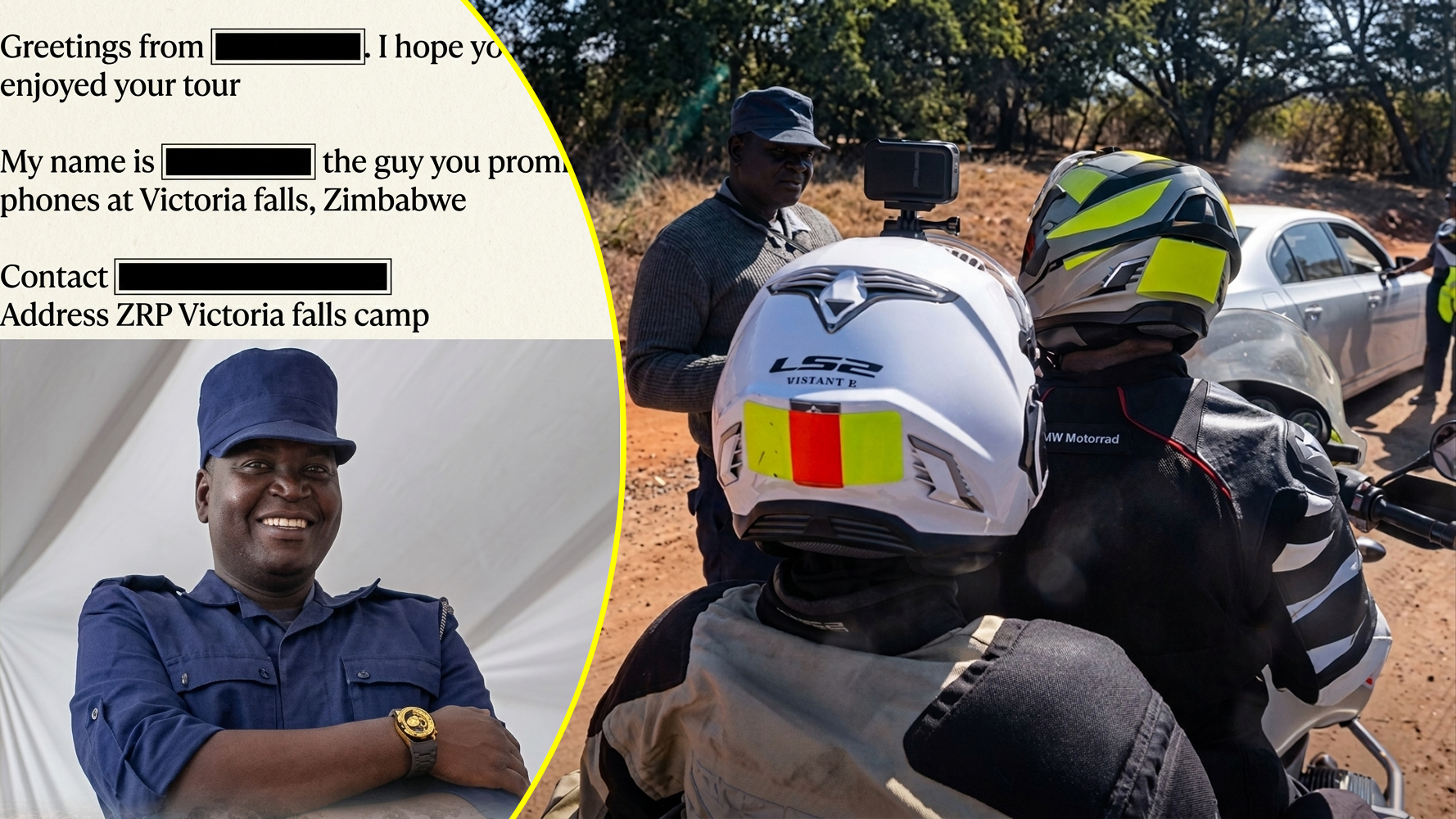
Victoria Falls – A Zimbabwe Republic Police officer is under investigation after a video appeared to show him asking a foreign tourist for an iPhone instead of accepting a US$30 traffic fine during a roadside stop.
The incident has revived long-running concerns about the treatment of visitors at Zimbabwean roadblocks, where complaints about unnecessary stops, unofficial payments and aggressive demands have repeatedly threatened the country’s efforts to present itself as a welcoming tourism destination.
The video, posted on Instagram by an account called Buggyteeth, shows two tourists travelling on motorbikes being stopped by a police officer. They are told that they have failed to stop at a stop sign and that the fine is US$30. The tourists ask whether they can be given a warning. During the exchange, the officer asks for an iPhone instead.
The Zimbabwe Republic Police said on Sunday that it had opened an investigation into the footage. The force said it would establish whether the video was genuine and determine the circumstances surrounding the encounter, including the identity of the officer and the date, time and location of the stop.
“Reference is made to a video circulating on social media platforms purportedly showing a police officer manning a roadblock allegedly negotiating with a tourist for an iPhone instead of a fine for an alleged traffic offence,” reads the statement.
“The ZRP has taken note of the video and has commenced investigations to establish the authenticity and circumstances surrounding the incident. The investigations are also aimed at identifying the police officer involved and establishing the date, time and location of the alleged incident.”
The footage has placed a familiar point of contact between Zimbabwe’s police and its visitors under renewed scrutiny. A traffic stop can last only a few minutes, but for tourists driving long distances between the country’s airports, national parks and resort towns, repeated encounters with officers can shape their entire impression of the destination.
The issue is not new. During the era of President Robert Mugabe, Walter Mzembi, who was then Minister of Tourism and Hospitality Industry, complained that the large number of police roadblocks was damaging tourism. Visitors travelling by road reported being stopped again and again, while tourism operators warned that the interruptions were discouraging people from exploring attractions outside the main centres.
Mzembi objected to the word “roadblock”, saying it damaged the country’s image. He argued that Zimbabwe should use the term “security checkpoint” and bring different compliance agencies together so that tourists would face fewer stops along major highways.
“The moment you say roadblock it means you are blocking entry. We prefer the use of the words ‘security checkpoint’ as is the practice in other countries,” Mzembi said.
He also called for a more coordinated system involving agencies such as the Zimbabwe National Road Administration, customs and immigration. The intention, he said, was to reduce the number of checkpoints on tourist routes rather than have travellers repeatedly pulled over by separate officials.
“As in all other countries at security checkpoints, you find a conglomeration of various compliance agencies from Zinara [Zimbabwe National Roads Administration], customs to immigration – they will all be at one security checkpoint so that they reduce the frequency of those checkpoints along tourist highways. And, I would imagine, that’s what we want to do,” he said.
Mzembi acknowledged that the issue was already hurting the tourism sector.
“I’m actually amazed that there has been such a huge proliferation of those security checkpoints… I think there should be a breakdown because tourism is crying over the impact of security checkpoints.”
At the time, tourism officials said some visitors were choosing to fly directly from Johannesburg to Victoria Falls rather than drive through Zimbabwe and stop at national parks and other attractions. The route between Harare and Mutare normally had as many as 14 checkpoints over 263 kilometres. The complaints also affected roadside traders and rural communities that relied on selling souvenirs to tourists.
The police, under the iron-fist leadership of then police commissioner Augustine Chihuri, defended the checkpoints as necessary for crime prevention and traffic enforcement. Police spokeswoman Charity Charamba said: “We are not fundraising, we want people to adhere to the road rules and regulations.”
The latest incident has emerged as several Zimbabwean traffic officers have faced arrest or imprisonment after roadside encounters involving motorists and cash.
Investigators said Nyamakura spoke to two men in civilian clothes before one of them walked away and returned about 10 minutes later. The man handed the officer US$10, after which the driver and vehicle were released. Anti-corruption officers intercepted the vehicle and searched Nyamakura, finding US$24 in his possession: US$14 in one pocket and the US$10 payment in another.
The driver told investigators that he had been stopped while driving a Mazda Demio and accused of crossing the transverse line at a traffic-light intersection. He said two female officers were involved in the initial stop before leaving him with Nyamakura, who demanded money for his release. Nyamakura was convicted on August 6 and sentenced to three years’ imprisonment.
Three officers stationed at ZRP Murewa Traffic and deployed at Chinamhora Base were also given lengthy prison sentences after an anti-corruption operation at a roadblock on the 21-kilometre peg of the Harare-Domboshava Road.
Constables Prosper Muchangani, Shelton Masvande and Mercy Makarimai were arrested on December 21, 2025, after detectives found them with US$975. Investigators established that traffic fines linked to the money had not been officially receipted, the cash had not been declared before the officers began duty and the deployment itself was not recorded in the official register.
The three officers were convicted of criminal abuse of office and sentenced to five years in prison each at the Harare Magistrates’ Court on June 24, 2026.
“The organisation will continue taking decisive action against any officer who engages in corrupt or criminal activities, regardless of rank or position,” Commissioner Paul Nyathi said.
Another case involved Abel Musimeki, a police officer based at Milton Park Police Station in Harare. He was jailed after receiving US$15 from a motorist during an unauthorised operation in Zvishavane.
The incident took place on September 19, 2024, at Ruswa Complex in Mandava. Musimeki stopped a Toyota Fun Cargo and claimed that it was not properly registered. He ordered the driver to find the vehicle’s owner, auto-electrician Edwin Rangarirai Mahosi. When Mahosi arrived, Musimeki said he was conducting an official vehicle-licensing operation and threatened to impound the vehicle unless money was paid.
Mahosi handed over US$15, later reported the incident and helped police track Musimeki down. Musimeki was sentenced to 16 months in prison, with four months suspended for five years on condition of good behaviour and a further two months suspended on condition that he repaid the US$15. The effective prison term was 10 months.
“Law enforcement officers are entrusted with upholding the law, not abusing their authority for personal gain. This conviction reinforces the NPAZ’s commitment to rooting out corruption and maintaining public trust in the justice delivery system,” the National Prosecuting Authority said.
In November 2024, Sergeant Chifamba and Constable Gunzva were arrested after a video appeared to show them taking payments from pirate taxis and registered public-service vehicles at the Mabvuku turn-off along the Harare-Mutare Road. They faced disciplinary and criminal charges after the footage circulated publicly.
“The ZRP informs the public that Sergeant Chifamba and Constable Gunzva have been arrested and are now in detention. They are facing both disciplinary and criminal charges. These are bad apples who do not deserve to be serving in the Police Service,” Nyathi said.
He added: “The Commissioner-General of Police does not condone corruption by any police officer and will ensure that the law takes its course without fear or favour.”
The cases involve sharply different amounts, from the US$10 linked to Nyamakura’s conviction and the US$15 received by Musimeki to the US$975 found at the Murewa roadblock. The new video introduces a different form of demand: not cash, but a valuable mobile phone sought from a tourist who had already been told the official fine was US$30.
Police have urged members of the public to report bribery, corruption and other criminal conduct involving officers and civilians. For Zimbabwe’s tourism industry, the investigation will be watched closely. The country’s roads connect visitors to Victoria Falls, Hwange, the eastern highlands, the Great Zimbabwe ruins and the country’s national parks. Every roadside stop is therefore also a public encounter with the national brand.
Mzembi’s warning from the Mugabe era remains tied to that reality. A roadblock intended to enforce the law can become, in the eyes of a visitor, a barrier to the country itself. The officer shown in the latest video now faces an investigation, while the growing record of arrests and convictions shows that roadside demands can carry consequences far beyond the value of the money or property sought.