


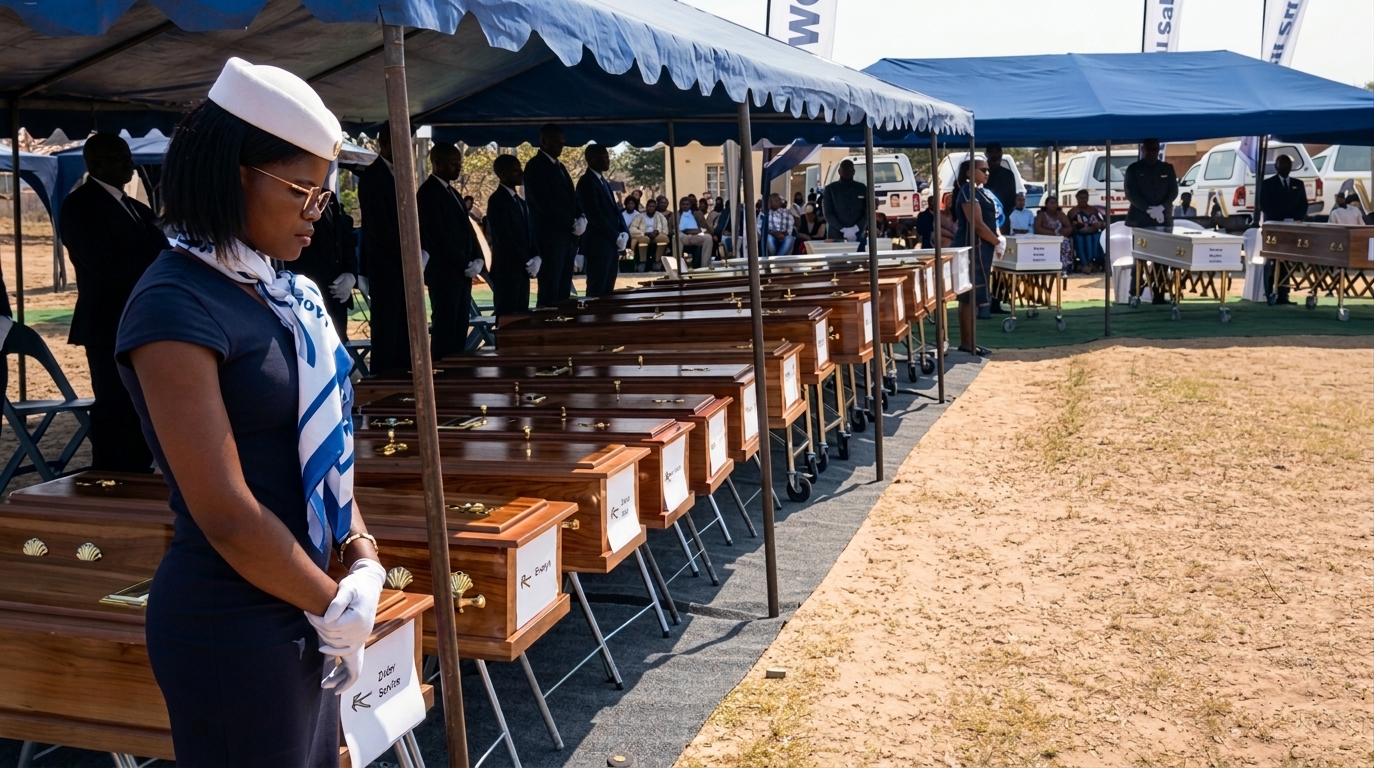
CHITUNGWIZA – A sombre silence settled over Chivhu General Hospital as grieving families gathered to remember 27 people killed in a head-on collision on the Harare-Masvingo highway.
The victims were travelling from Dema to Ndarikure in Mvuma for an African Apostolic Church conference when their commuter omnibus collided with a South African-registered haulage truck near the 132km peg on Friday night. The impact ignited the kombi, trapping passengers inside and leaving relatives to identify their loved ones amid the wreckage.
For Albert Magiya, the journey became a personal catastrophe. His wife and all five of their children were among those who died. He had been expected to travel with them, but changed his plans after noticing that the hired kombi was overloaded.
At the memorial service, Mr Magiya described the moments before the family left and the horror he faced when his bus reached the crash scene.
“On the fateful day, my mind kept on telling me not to go to the conference. I could feel that something was wrong, though I could not actually tell what exactly could be wrong. I kept on having the same feeling until I approached my wife and told her that we should not go to the conference.
“My wife and children pleaded with me to reconsider, but I told them that I had a bad feeling about travelling to the conference. However, they kept on pleading and I reluctantly gave in.
“So, we packed everything that we would need and in the afternoon we went to the bus stop where a hired kombi was supposed to take us. The kombi came, and we loaded our luggage. However, I noticed that it was overloaded. So, my friend and I decided to use public transport to the venue,” Mr Magiya said.
He and a colleague boarded a bus, believing they would meet their family at the conference. Instead, as the bus approached Chivhu, traffic slowed near the accident site. Mr Magiya initially thought the hold-up was an ordinary roadblock. Then he saw the burning vehicle.
“After leaving my family in that kombi, we then boarded a bus with my colleague. I did not even know that that was the last moment to see my wife and my children alive. We travelled well, until we reached near the accident scene where there was a traffic jam. At first, I thought it was just another road block and as vehicles moved slowly we reached the scene.
“The first thing that I saw was a kombi, which had caught fire. I even realised it was the same kombi with my wife and children. We quickly disembarked and what I saw outside broke my heart. People were dead. Some of the bodies were still inside the kombi, and they too were burning. It looked like some of the passengers had been thrown out of the kombi due to the head-on collision.
“I saw my wife, she was still breathing. I saw my children, four of them, lifeless. But I could not see my other child, and I am told she is among the five who were burnt beyond recognition and now awaits forensic process.”
Mr Magiya said the loss had destroyed the centre of his family life. He spoke partly in Shona before describing his grief in English.
“Ndarasikirwa nevana nemudzimai. Ndiri kurwadziwa. Pain yacho handizivi kuti ichapera seyi. Imba yangu yaparadzwa.
“I remain hopeful that one day, I will be able to meet them spiritually. I am hopeful that God has granted them peace, wherever they are because they perished while on their way to a church gathering. But I am hurting,” he said.
“I want to thank our Government for coming in with all the assistance from coffins to food. I remain thankful, I remain hopeful.”
Mr Emmanuel Bonda was also among the mourners carrying the loss of an entire immediate family. His wife and three children were killed in the crash. He said his wife had complained that the kombi was overloaded before leaving for the conference.
“She packed her clothes and that of the kids around 12 and by 2pm they were already in the kombi.
“One thing that she was complaining about was that the kombi was over-loaded. She even asked me if I knew of anyone who had a vehicle going to the same conference so that she and the kids could get a lift, but I knew no-one. I wished them a safe journey,” he said.
When Mr Bonda tried to call later that evening, his wife did not answer. He continued calling, telling himself that the phone might have been hidden inside her purse. The truth reached him through church members who were already at the conference.
“When I finished work, I decided to check on them, but my wife’s mobile phone was not being answered. I kept on trying and I got the same result. I just told myself that maybe she had concealed it in her purse.
“When I got home, I received calls from other church members who were already at the conference informing me of the accident. I informed my work mates and they assisted me to get to the accident scene.”
He said the first information at the scene suggested that the passengers had been injured and taken to hospital. The following day, however, he went to Chivhu General Hospital and discovered the scale of the tragedy.
“We were told that some people were injured and were rushed to hospital and we could only see them on the next day. Today we went to the hospital and that is when I was told that a lot of people had died. The first person I identified was my son, then others. I am so hurt. Losing my entire family, just like that is unbearable,” he said.
Tawanda Mushonga lost his wife in the same crash. He said she was not only his partner but also his closest friend and the mother of his children.
“What will I tell my children when they ask about their mother? This is painful,” Mr Mushonga said.
“On that day, I last talked to my wife around 2pm. Then around 7pm, I decided to call again just to check if they had travelled well. Her phone was just ringing, but not answered. I called several times and still got the same result.”
The accident occurred at about 8.30pm near Honeyspruit Bridge, according to details released after the crash. Twenty-four people died at the scene and three others later succumbed to their injuries at Chivhu General Hospital. The commuter omnibus was carrying church members travelling to the annual gathering in Mvuma, while the truck was transporting mining equipment from South Africa.
Emergency workers, residents and members of the Civil Protection Unit worked through the night. Small cranes were used during the recovery operation, while fire equipment was brought in to extinguish the burning vehicle. The wreckage and the heavy truck blocked the carriageway before the road was cleared for traffic.
President Emmerson Mnangagwa declared the crash a national disaster, directing the Government to assist with burial arrangements and the treatment of survivors. Coffins, food and other support were provided to the bereaved families, while the injured were taken for medical care.
Local Government and Public Works Minister Daniel Garwe, Transport and Infrastructure Development Minister Felix Mhona, and Information Communication Technology, Postal and Courier Services Minister Tatenda Mavetera attended the memorial service. Before meeting mourners, the ministers, traditional leaders and other officials visited the crash site, where traditional leaders performed rituals.
Minister Garwe said the President had responded immediately because the families could not bear the burden alone.
“President Mnangagwa has his people at heart. He loves everyone and is deeply moved by this tragedy that has affected all of us,” Minister Garwe said.
“When I heard about this tragedy, I was hurt. I knew as families, you could not shoulder this alone, and as a ministry, we could not also face it alone, so I immediately informed our listening President who did not waste time to declare this a national disaster. This is why Government is now giving assistance to the bereaved families,” he said.
“President Mnangagwa’s message to us all today, is to console you in this difficult time. The whole nation is in mourning. Recently we were in Kariba, where another tragedy occurred and tears have not dried and now we are faced with this tragedy. This is painful and we all need to mourn together and give each other strength.”
Minister Mhona urged motorists to exercise care, avoid speeding and ensure that vehicles were not overloaded.
“It is sad that we are gathered here at this place, with tears in our eyes, mourning the sad departure of our loved ones, who perished in a road traffic accident. It is painful that our loved ones are perishing due to road accidents. This is painful. I appeal to all of you to remain strong and be comforted in these difficult moments.
“I appeal to motorists to be cautious on the roads. Do not speed, do not overload and adhere to all stipulated road rules and regulations. Let us all be responsible road users.”
Minister Mavetera said she knew many of the affected families from her time working in Seke and regarded them as close to her own family.
“I received the call of the accident around 10pm. I was shocked. I know most of the affected families because I once worked with them in Seke. So to me they are like family. I just want to say to the bereaved families, be comforted. You are not alone in this. We are together in mourning our loved ones.”
The Chivhu crash came during a month of heavy losses for Zimbabwe. The country was still mourning a ferry disaster on Lake Kariba in which scores of people, including children, died after an overloaded vessel capsized. In April, at least 18 people were killed when another minibus caught fire on a highway in southern Zimbabwe. Those incidents have placed renewed attention on the dangers faced by passengers who depend on public transport for long-distance journeys.
At Chivhu General Hospital, however, the immediate concern was not statistics but the families left behind. Coffins were prepared for burial while relatives waited for the forensic process to identify the remaining victims. For Mr Magiya, the wait carries the unbearable knowledge that his wife and children will not return, and the painful task of saying goodbye has not yet ended.
He remains grateful for the assistance offered by the Government and the church, but his final words captured the depth of the loss: “But I am hurting.”
For the families gathered in Chivhu, the memorial service became both a farewell and a plea: that those travelling Zimbabwe’s roads should be protected from preventable danger, and that the 27 people who left for a church conference would be remembered not only as victims of a crash, but as parents, children, friends and members of a community whose lives mattered.