


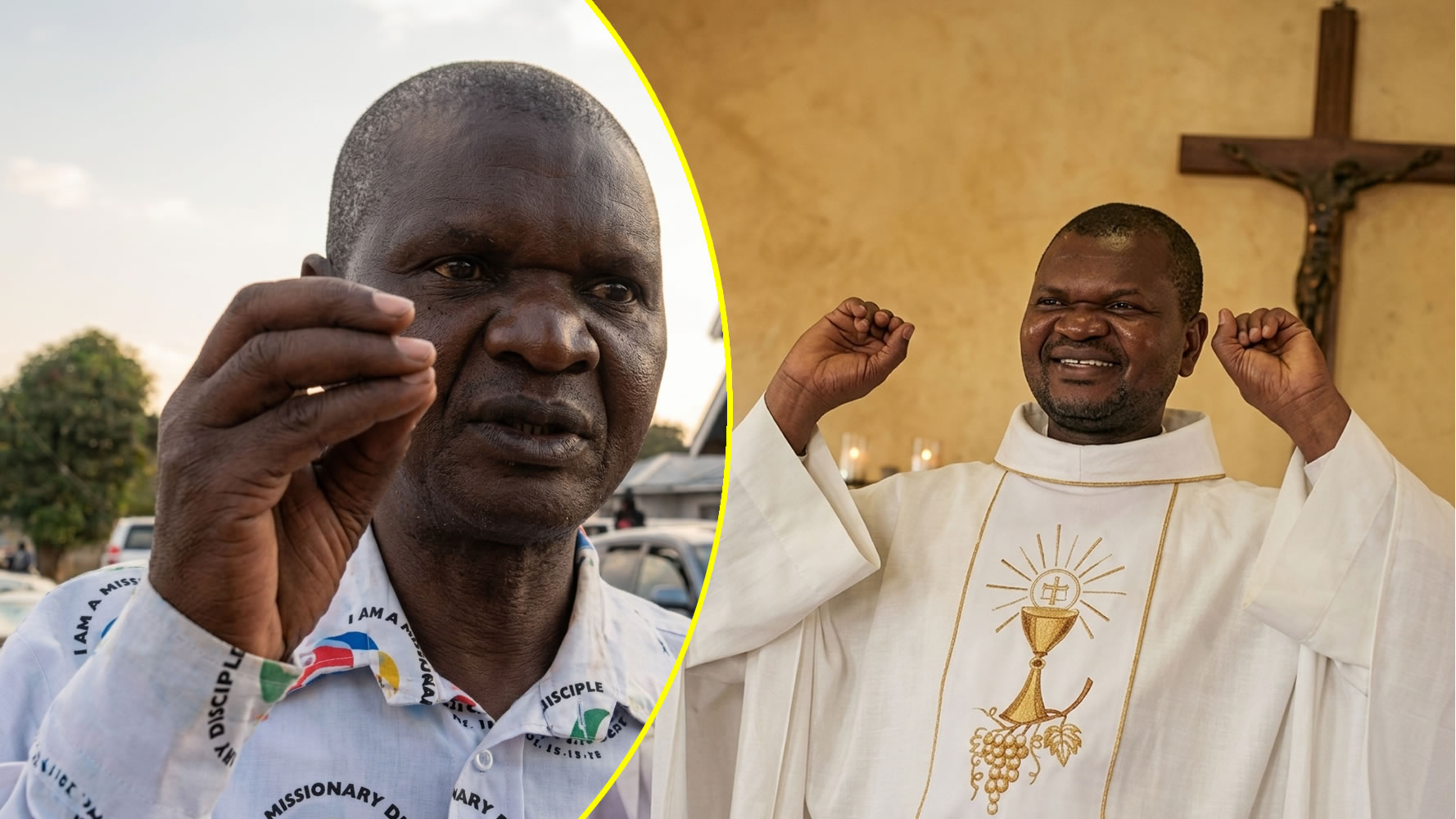
The search for missing Roman Catholic priest Father Regis Chikuni has ended in tragedy after he was found dead at the mortuary of Parirenyatwa Hospital in Harare.
The 58-year-old senior priest was reported missing on 5 September, prompting the Archdiocese of Harare to appeal for information about his whereabouts and ask Catholics to pray for his safe return. Four days later, the church confirmed that he had been found deceased at the hospital.
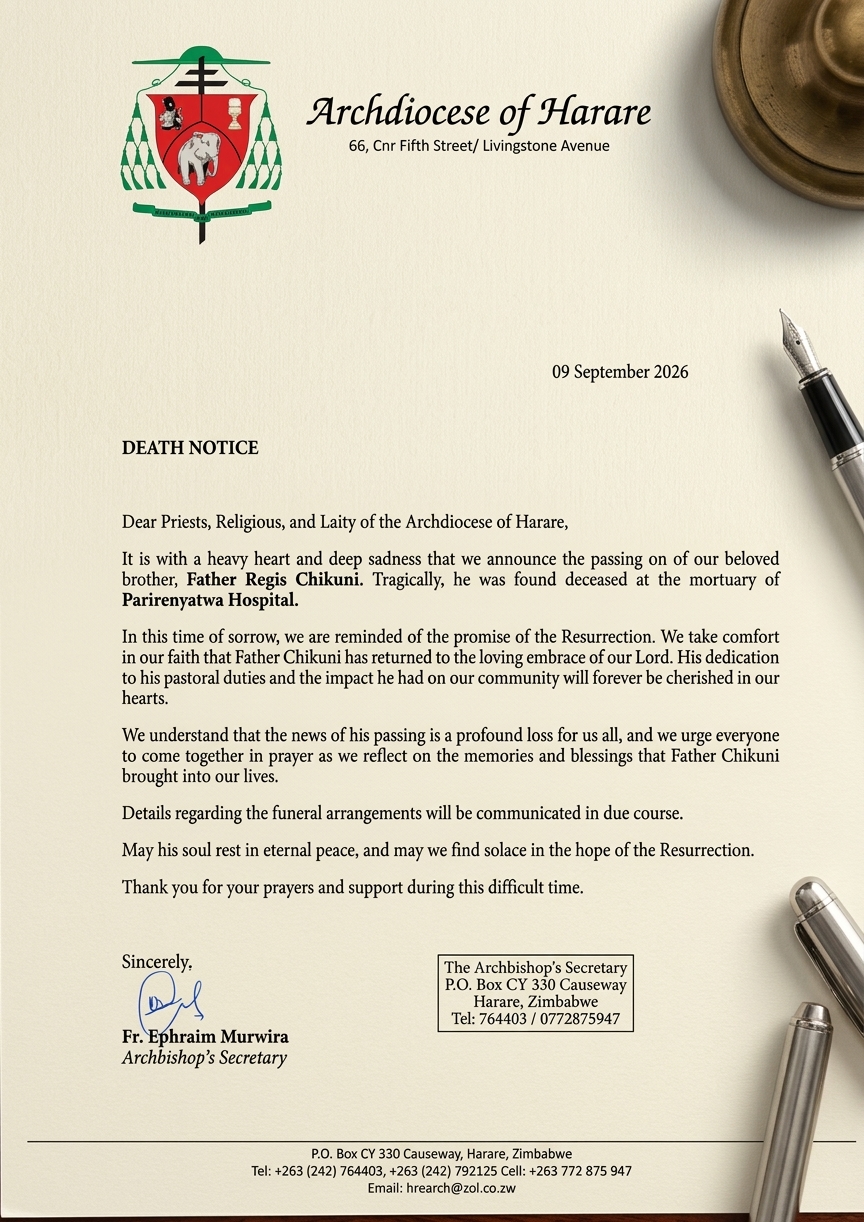
The death notice was issued on 9 September by Father Ephraim Murwira, the Archbishop’s Secretary, on behalf of Archbishop Robert C Ndlovu.
“It is with a heavy heart and deep sadness that we announce the passing on of our beloved brother, Father Regis Chikuni,” Murwira said.
“Tragically, he was found deceased at the mortuary of Parirenyatwa Hospital.”
The church has not released details explaining how Father Chikuni died or how he came to be at the hospital. Funeral arrangements are expected to be announced later.
The Archdiocese had reported the matter to the police while the search was under way. In its earlier appeal, the church described Father Chikuni as one of its senior priests and urged members of the faithful to support the search with prayers and information.
“As a family of faith, let us unite in earnest prayer, asking the Lord, through His loving providence and protection, to guide us in finding Fr Regis safe and sound,” the Archdiocese said at the time.
The appeal brought attention to a priest whose service had stretched across different parts of the Archdiocese of Harare. Father Chikuni formerly led Charismatic groups in Harare and had served at Holy Rosary Parish in Mvurwi, Mashonaland Central Province. He was stationed at the parish from at least 2017.
His earlier ministry in Mvurwi was also marked by a violent incident. On 12 March 2017, two attackers robbed the priest at his parish residence, taking US$300 and injuring him. A police report was filed at Mvurwi station.
“I saw two guys breaking in when l was about to conduct my prayers who demanded money before attacking me. The duo took my $300 which was on my table and varnished, l only saw two men, l don’t know if the syndicate was more than that,” explained Father Chikuni back in 2017.
The circumstances of Father Chikuni’s death remain the immediate concern for the Catholic community, which is now waiting for further information from the church and the authorities. However, comments on social media regarding the man of the cloth’s death indicate that members of the public suspect foul play.
Ano Shumba: “Thanks, Nick. However, this statement reads incorrectly. Apa zviri clear kuti Father Regis was obviously found dead somewhere and was later taken to the mortuary at Pari Hospital. It would therefore be misleading to say that he was ‘found deceased at a mortuary’, as that suggests his body was discovered at the mortuary itself.
It would make sense if the statement read as follows: “His lifeless body was found (at the location) after which it was taken to the mortuary at Pari Hospital.”
Alternatively, if the exact location is not known or has not been confirmed: “His body was found in an undisclosed location and was later taken to the mortuary at Pari Hospital.”
Paradzai Manyanga: “How is that possible Nickson? He went into the mortuary and died there or he was admitted at the hospital and died there? What are the hospital records say about him?”
Tafadzwa Jengwa: “Yah zvakaoma, ndiyani zve akazouya navo muchipatara mushure mekunge vashaikwa?”
Kay Cee: “Did he oppose cab3”
Meanwhile, Father Chikuni’s death has also revived memories of other cases involving Catholic priests in Zimbabwe, including a decades-old murder that has recently returned to the centre of a traditional court dispute and a violent robbery in which a soldier was jailed.
Father Matara, who served at St Barbara’s Mission in Mutasa, was murdered in the 1970s. The circumstances surrounding his death were never fully resolved, and the case has remained part of the memory of communities in the area.
The family’s account identified Cosmas Banhu as the person responsible for Father Matara’s death. Cosmas initially confessed before a traditional court in December last year, but later withdrew the confession and said it had been made under pressure.
“I only confessed because they had cornered me. They were assaulting me. They clapped me twice, and I had no option, but to give in, and say what they wanted to hear,” he told the court.
Cosmas also said he had been in Bulawayo when the alleged murder took place, returning home only briefly during the period in question. He said police had questioned him and his brother at the time and later cleared them.
“My conscience is clear. My hands are clean. I did not kill anyone. If I had killed him, his avenging spirit would be haunting me directly, not my relatives,” Cosmas argued.
The traditional dispute centred on compensation to the Matara family in Marange. The avenging spirit was initially said to have demanded 50 cattle. Following consultations, the number was reduced to 30 and then to 15.
The Banhu clan said its ten families had contributed towards the final 15 cattle and that the beasts were ready to be taken to the Matara family. The process was halted after Cosmas sought a protection order from the Mutasa Civil Court.
Sylvester Munyaradzi Banhu, speaking for the family, said the clan had been left unable to complete the ceremony.
“We have 10 families in the Banhu clan. Each family contributed, and we now have the 15 cattle as demanded by the spirit. We are ready to take them to the Matara family in Marange, but Cosmas, who is the village head, and the same person, who confessed to the murder, approached Mutasa Civil Court, applying for a protection order, accusing us of harassing him, and forcibly taking his cattle for the appeasement ceremony,” Sylvester explained to the court.
The order instructed family members not to harass, assault or force Cosmas to take part in traditional ceremonies. It also barred them from taking him to a traditional healer or confiscating his property for the purpose of appeasing the alleged avenging spirit.
Chief Mutasa said the dispute had to be brought to an end so that the family could regain peace.
“We cannot allow the avenging spirit to continue haunting the family. I will talk to the magistrate and try to have the order lifted or cancelled so that this matter can be dealt with properly and finalised because we want the family to be at peace once again and not be tormented like what is happening,” he said.
Another recent case involved Father Kanisious Mashati, who was attacked at his residence at Mt Carmel Primary School in Headlands in the early hours of 8 December 2025. The attack began at about 1.30am, after the priest had gone to bed at around 9pm.
Learnmore Gwenyaya, a 31-year-old soldier from the elite One Commando Regiment, and two accomplices entered the residence using duplicate keys. They were armed with an iron bar, a shovel and an okapi knife, and wore balaclavas to conceal their identities.
The attackers forced their way into Father Mashati’s bedroom and assaulted him. During the struggle, the priest threw a wine bottle at them and injured Gwenyaya. He was then threatened with an okapi knife and surrendered his Itel A70 mobile phone.
Police officers on night patrol intercepted the three men at Halfway House along the Harare-Mutare Road at about 3.30am. Two suspects escaped, while Gwenyaya was arrested. A live cartridge was found in his satchel, although he did not hold a firearm certificate.
The case added to a series of reports involving serving soldiers accused or convicted of violent robberies in Zimbabwe. In April 2024, four soldiers were among nine suspects arrested in connection with armed robberies in Harare, Murehwa and Shamva, including a raid in which more than US$142,000 was stolen from security offices in Eastlea.
In December 2024, three other soldiers were arrested after alleged robberies in the Fort Rixon mining area. The incidents involved weapons including axes, knives and handcuffs.
Police national spokesperson Assistant Commissioner Paul Nyathi said security personnel involved in crime would be dealt with.
“The position of the security services has been that anyone involved in criminal acts will be dealt with professionally,” he said.
For the Catholic Church, Father Chikuni’s death now stands apart from those earlier cases, with the central questions surrounding his disappearance and death still unanswered. His fellow priests, religious communities and lay faithful have been asked to remember his pastoral work and his contribution to the church.
“We take comfort in our faith that Father Chikuni has returned to the loving embrace of our Lord. His dedication to his pastoral duties and the impact he had on our community will forever be cherished in our hearts,” the Archdiocese said.
“May his soul rest in eternal peace, and may we find solace in the hope of the Resurrection.”
The church said funeral arrangements would be communicated in due course.