


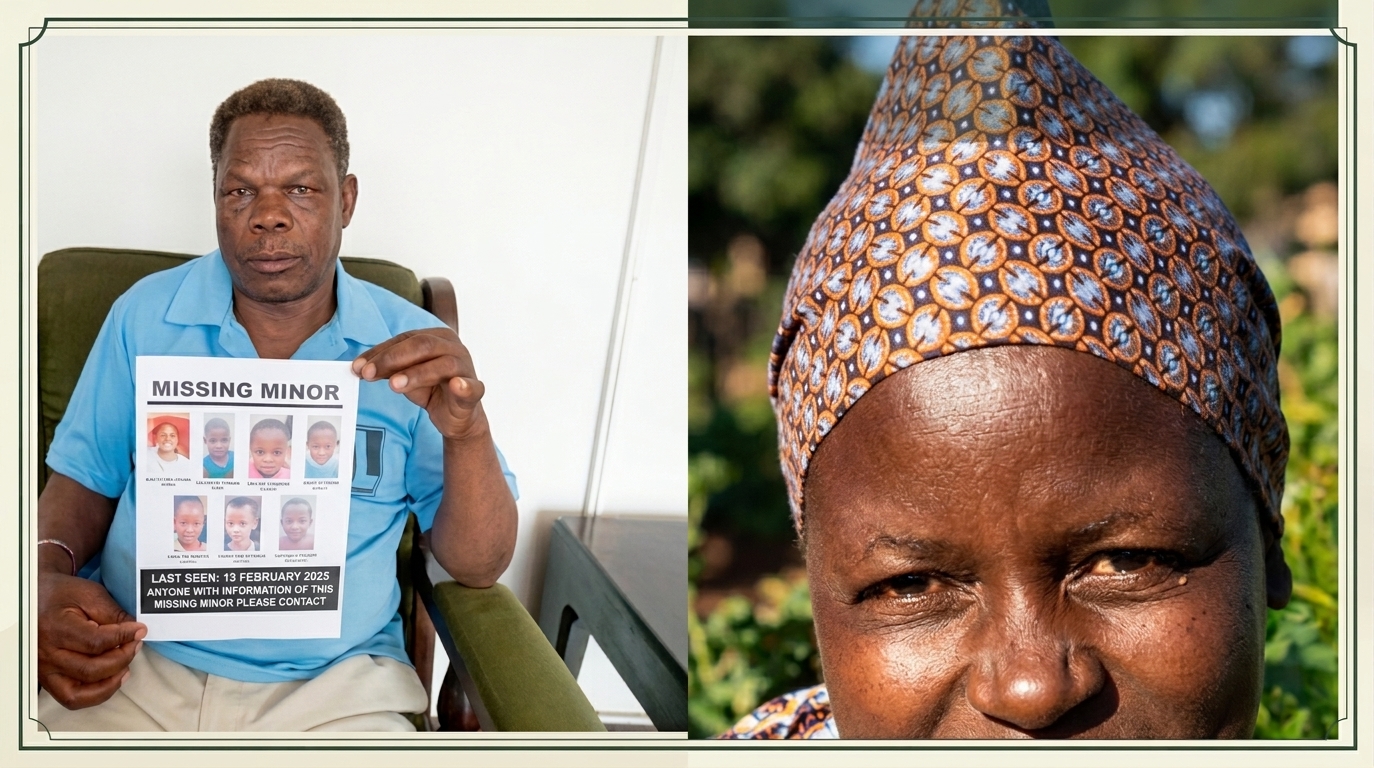
For Richard Ndebele, the evening before Valentine’s Day was once simply another working day. In February 2025, however, he returned from work to a home that had suddenly become silent. His wife, Sigcinokuhle Siziba, and their seven children had left. Their clothes were gone, and the telephone number he tried was switched off.
More than 19 months later, the 56-year-old construction worker from Cowdray Park, Bulawayo, says he is still living with the pain of not knowing how his children are faring. He has not seen them for more than a year and a half. His questions remain the same: are they eating properly, are they attending school, what are they wearing and are they happy?
“It’s not easy going for over a year and a half without seeing my kids. I have no idea whether they are happy, what they wear and what they eat,” he said.
Ndebele says the disappearance brought an abrupt end to a family life he had spent 17 years building. His eldest daughter, now 17, is followed by five boys and a four-year-old girl. He describes the children as the centre of his world and says much of his working life was driven by the desire to provide them with a comfortable home.
He says he and Siziba, who is 36, had the ordinary disagreements that occur in many marriages, but he did not believe their arguments had reached the point of breaking up the household. According to his account, there had been no warning that she would pack her belongings and leave with all the children.
“Like every couple, we have misunderstandings, but they had never been escalated to a position where she packs her bags and leaves the family home,” he said.
“For the record, I did not physically abuse my wife or keep her in the dark about the family finances.”
Ndebele says he was responsible for supporting the family and paying the children’s school fees. At the time, his eldest daughter was in Form Three at a private college in Cowdray Park, while the younger children attended Tategulu Primary School.
When he realised that his wife and children were missing, he says he sought help from the police. He claims he was told that a missing-persons report could only be made after 48 hours. In the days that followed, Siziba’s telephone became reachable again, but Ndebele says she did not answer his calls.
He eventually learnt that she and the children had not travelled far. They were still in Cowdray Park, he says, living in a rented single room not far from the family home. The children continued going to school, giving him hope that the dispute might still be resolved and that the family could return to normal.
“I later got to find out that she had rented a single room in Cowdray Park, not far from our family home and the kids were still going to school,” said Ndebele.
He says he tried to involve Siziba’s relatives, hoping that discussions between the families would bring an end to the separation. Those efforts did not succeed. He says he was also informed that authorities could not force his wife to return to the matrimonial home.
The situation changed again during the April 2025 school holidays. Ndebele claims Siziba left Bulawayo with the children and travelled to her rural home in Ntepe, Gwanda. He did not immediately know that they had gone. He says he discovered what had happened only after the new school term began and the children failed to return to Tategulu Primary School.
“I only discovered that the kids were no longer attending school when the headmaster at Tategulu Primary School informed me that they had not set foot there when schools opened for the second term,” said Ndebele.
A mutual friend later told him that the family had relocated to Ntepe. Ndebele says he wrote to police in the area to report that his children had been taken away without his consent, but he has not received feedback.
The absence has left him trying to follow a family trail that has repeatedly gone cold. He says he has no direct contact with the children and does not know their day-to-day circumstances. He also says he has been unable to establish whether their schooling has continued since they left Bulawayo.
Ndebele now plans to approach traditional leaders in Ntepe. He hopes they can mediate between him and Siziba and help him re-establish contact with the children. He is also considering seeking assistance from organisations that work with children and families.
“I honestly have no idea why my wife would just pack her bags and abandon our home, although I’m still willing to forgive her and move on with our lives,” he said.
His account comes as family-tracing organisations in Zimbabwe continue to deal with large numbers of people separated from relatives. The Zimbabwe Red Cross Society had 355 missing-person cases on its tracing database at the end of 2025. During that year, it received 78 new tracing cases and closed 38 after missing relatives were located.
The organisation also recorded 1 200 inquiries from people seeking help to trace missing family members. Its Restoring Family Links programme provided communication and tracing services in rural communities, at Beitbridge and at Tongogara Refugee Settlement. During the year, it facilitated thousands of calls and internet sessions aimed at helping separated relatives make contact.
The figures include separations linked to migration, disasters, violence and other humanitarian emergencies. They also show how quickly a family can lose contact when relatives move between communities, phones stop working or information is passed through informal networks.
In Bulawayo, the search for two siblings, five-year-old Nkosana Smile Sibanda and 10-year-old Shauna Sibanda, remained active in 2026 after the children disappeared during what was expected to be a routine weekend visit. Police appealed for information and warned the public to rely on official updates while investigators followed possible leads.
Ndebele’s case is different in its circumstances, but the fear created by prolonged uncertainty is familiar. For him, the central issue is not simply the breakdown of a marriage. It is the loss of everyday contact with seven children who had been part of his life for years.
He remembers providing for them, taking responsibility for their education and returning each evening to the family home. Now, he says, he is left with old memories and unanswered questions about their welfare.
The children’s mother could not be reached for comment. Her mobile number was unreachable despite attempts to contact her about Ndebele’s account.
Ndebele says he has not abandoned hope. He wants to see his children, learn how they are living and begin rebuilding a relationship that was interrupted without explanation. Until that happens, each day carries the same uncertainty that began when he opened the door after work and found his family gone.