


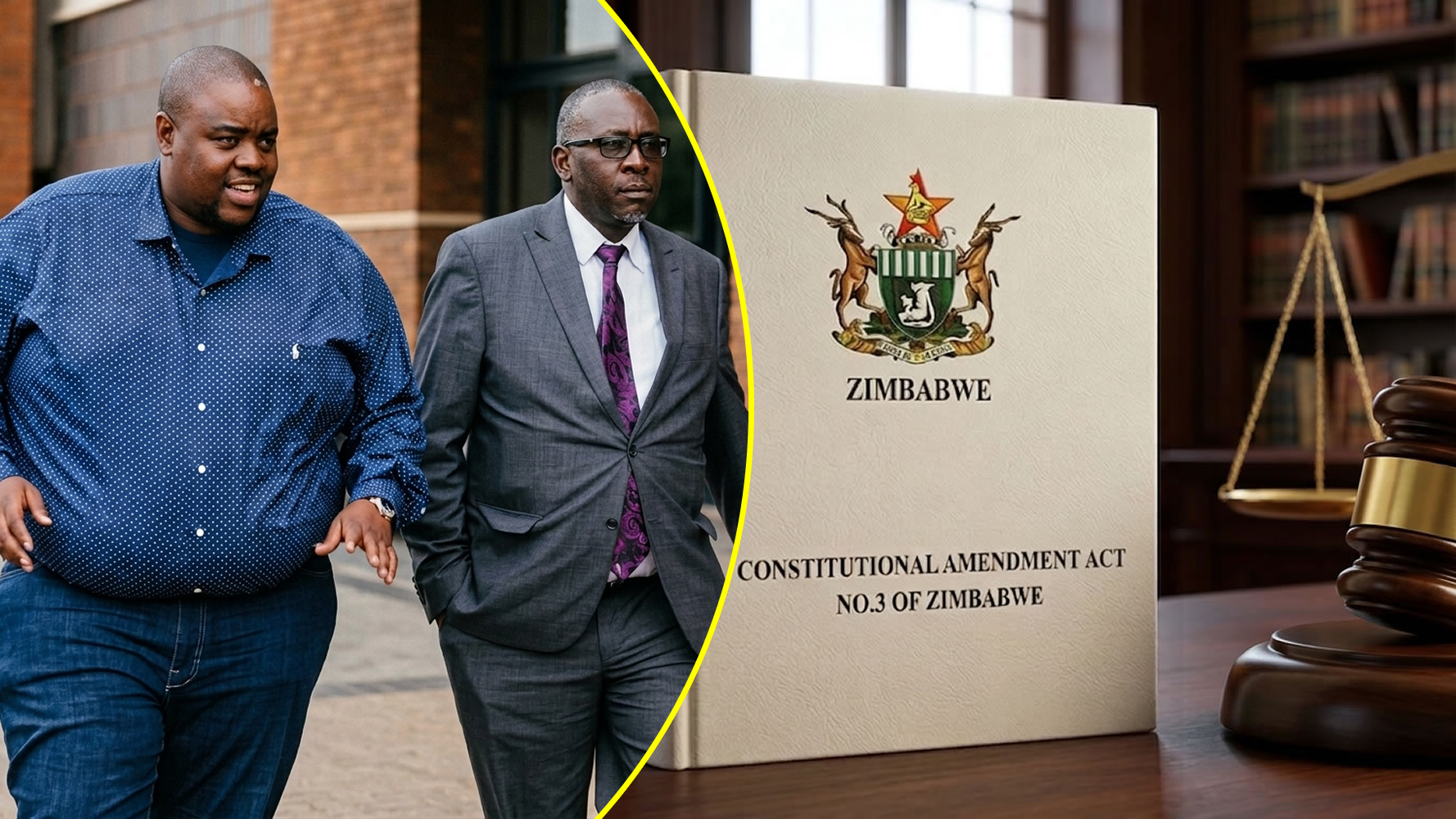
Why Advocate Lewis Uriri said NO to Chivayo’s US$350,000 gift 24 hours before ConCourt hears Mnangagwa’s CAB3 enactment case
Advocate Dr Lewis Uriri turned down a gift package worth US$350,000 from businessman Wicknell Chivayo on Monday, just 24 hours before he was due to appear in the Constitutional Court as part of a legal team challenging the enactment of Constitution of Zimbabwe Amendment No. 3.
The offer consisted of a brand-new 2026 Range Rover Sport Autobiography valued at US$250,000, US$50,000 in cash for Uriri’s fuel and another US$50,000 for his wife, who is also a senior lawyer. Chivayo announced the gifts publicly in a tribute to the advocate, describing him as a “lawyer par excellence” and praising the way he had represented him in several legal battles.
Uriri and his wife rejected all three gifts. In a carefully worded response, he said the decision was necessary to protect their professional standing and the public’s confidence in their independence.
“Your announcement came as a complete surprise, without prior notice or discussion,” Uriri said.
He said the offer required particular care because of the time that had passed since his last conversation with Chivayo, the size of the gifts and the fact that they had been expressly connected to earlier legal work.
“Given the distance that has developed between us since our last conversation, the substantial nature of the gifts, and their express connection to past professional services, I must approach this gesture with particular care,” he said.
Uriri said the two men last spoke in June 2024. He had not carried out any professional work for Chivayo since then, and the work referred to in Chivayo’s tribute had already been paid for in full.
“The historical work to which your tribute refers was performed in my professional capacity and paid for in full. My remuneration was for services actually rendered,” he said.
The advocate said accepting valuable personal benefits after a professional engagement had ended could create the impression that a further financial obligation existed between lawyer and client. He therefore decided that the vehicle and the money should not be accepted.
“I consider it necessary to decline benefits that could reasonably create a perception of personal financial obligation extending beyond a concluded and fully remunerated professional engagement,” Uriri said.
“My wife and I attach great importance to preserving both our professional standing and public confidence in our independence.”
He thanked Chivayo for recognising his past work but made clear that the decision would not be reversed.
“We appreciate the generosity expressed and your acknowledgment of my past work. Our decision is nevertheless firm: we will not accept the vehicle or either of the cash gifts,” he said.
The refusal came at a politically sensitive moment. Uriri is part of a legal team representing six war veterans who have approached the Constitutional Court over Constitution of Zimbabwe Amendment No. 3, the law that grew out of Constitutional Amendment Bill No. 3, commonly known as CAB3.
The amendment extends the terms of the President and Parliament from five years to seven years. It moves Zimbabwe away from the direct election of the President by citizens and provides for the President to be elected by Parliament. It also alters parts of the constitutional succession framework and postpones the next harmonised elections from 2028 to 2030.
The applicants are Reuben Zulu, Godfrey Gurira, Shoorai Nyamagodo, Joseph Chinyangare, Digmore Knowledge Ndiya and Joseph Chinguwa. Their case concerns the constitutional basis for replacing a direct presidential election with a parliamentary vote. They argue that the change affects citizens’ political rights and could not be achieved through a parliamentary process alone.
The case places Uriri in a strikingly different professional position from the one he occupied in 2018, when he represented Mnangagwa in the Constitutional Court challenge brought by Nelson Chamisa after the presidential election.
At that hearing, Uriri argued that the opposition case relied on “bold allegations” rather than the forensic evidence needed to overturn the election result. The Constitutional Court dismissed Chamisa’s challenge with costs and confirmed Mnangagwa as the duly elected President.
Uriri’s later work has shown that representing a powerful client does not prevent him from taking a different position when he believes constitutional limits have been crossed. In the current case, he is representing war veterans challenging a law that benefits the sitting President by extending the period before the next election and changing how future Presidents will be chosen.
That background makes the timing of Chivayo’s offer especially important. Chivayo is known to have a close relationship with Mnangagwa and has described it as similar to a father-and-son relationship. Mnangagwa has publicly praised Chivayo’s philanthropic activities and encouraged him to continue supporting people and institutions through donations.
Chivayo’s offer to Uriri came after a separate controversy involving CAB3 and gifts to members of Parliament. In the weeks before legislators voted on the constitutional changes, Chivayo offered US$10,000 to each of Zimbabwe’s parliamentarians. The proposed distribution, covering Members of Parliament and senators, would have amounted to millions of United States dollars.
The offer was presented as support for legislators and their constituencies. It was condemned by Zanu PF officials, the party’s Youth League and civic organisations, who said the timing made it improper. The concern was not simply the size of the proposed donation. It was that the money was offered while Parliament was preparing to decide on a constitutional amendment that would extend political terms and alter the presidential electoral system.
The controversy deepened when Chivayo began rewarding legislators who publicly supported CAB3. Among those reported to have received benefits were Zanu PF Bindura South MP Remigious Matangira and Citizens Coalition for Change (CCC) proportional representation MP Samantha Mureyani. Each was linked to a 2026 Toyota Fortuner GD6 and US$50,000 after backing the Bill.
Former Norton legislator Temba Mliswa called for lawmakers who had received vehicles or other benefits to stay out of the parliamentary process. He warned that citizens would protest at Parliament if rewarded members attempted to vote on the amendment.
“No member of Parliament must receive any gifts at this time. Not at this time. We shall make sure that, as people of this country, we will protest against it,” Mliswa said.
He added: “We shall make sure that we are at the Parliament’s entries to not allow any member to vote or to take part if you have been given a car.”
Chivayo rejected the suggestion that the rewards were bribes. He said the gifts were given to legislators after they had publicly declared their support for CAB3 and argued that rewarding people who shared his political position was not the same as buying their votes.
The dispute became personal after Chivayo accused Mliswa of hypocrisy and said he had bought him a Ford Raptor worth US$107,000. Mliswa disputed the description, saying the vehicle was intended for an association of headmen (masabhuku) he leads rather than for his personal use.
Zanu PF officials and civic groups nevertheless set a clear public standard: gifts to legislators were considered inappropriate when they came close to a vote on CAB3, even where the giver described them as donations or rewards. That same principle helps explain why Uriri could decide that accepting Chivayo’s latest offer would be wrong, despite having accepted a benefit from him in the past.
Older videos circulated after Uriri’s refusal show the advocate receiving the keys to a Land Rover Discovery bought by Chivayo from a Harare motor dealer. The vehicle was reportedly worth US$110,000, and the footage is believed to have been recorded in late 2023 or early 2024. An online post attributed to Uriri at the time read: “Some clients are Heaven sent! Got this for my 45th birthday.”
The earlier vehicle has become part of the public debate because it shows that Uriri and Chivayo had previously exchanged benefits. Chivayo’s supporters have also claimed that Uriri and his wife travelled abroad on a first-class holiday paid for by the businessman. The travel claim has circulated alongside the videos and photographs of the Land Rover.
The earlier gift does not change the central fact about the latest offer. The new vehicle and the two cash payments were announced after Uriri’s professional relationship with Chivayo had ended, and they were publicly tied to the legal work Chivayo said the advocate had done for him. The offer also arrived on the eve of a Constitutional Court hearing in which Uriri was preparing to challenge a law closely associated with Mnangagwa’s political future.
Uriri’s earlier work for Chivayo included a criminal case arising from allegations linked to the Gwanda solar project. The businessman faced charges involving fraud, money laundering and breaches of Zimbabwe’s Exchange Control Act. Chivayo denied wrongdoing and was later discharged at the close of the State’s case.
Uriri also acted for Intratrek Zimbabwe in its dispute with the Zimbabwe Power Company over the 100-megawatt Gwanda solar project. Intratrek argued that its contract had been unlawfully terminated and sought specific performance or damages of US$22 million. The dispute moved through the courts, with Uriri appearing for Chivayo and his company’s interests.
Chivayo’s tribute referred to those battles and praised the advocate for standing by him when the cases were difficult. He wrote that he could not remember a matter in which Uriri had represented him that was ultimately lost, even when a setback was followed by an appeal. He also referred to the US$50,000 for Uriri’s wife as a “handbag allowance”, suggesting that she may have contributed to legal submissions prepared at home.
Uriri’s answer drew a line between professional fees and personal gifts. His position was that he had been paid for legal services already performed, and that accepting substantial additional benefits could damage the appearance of independence even if no instruction was attached to the gifts.
The response was praised by fellow lawyers and public figures. Advocate Thabani Mpofu said the decision demonstrated that professional independence mattered most when refusing a gift was more difficult than accepting it.
“His example reminds us that professional independence is not an abstract ideal. It is tested precisely when accepting would be easier than refusing,” Mpofu said.
Mpofu later argued that Uriri’s past conduct should be considered separately from the decision before the Constitutional Court hearing. He said the important point was that, when faced with the latest offer, Uriri made a clear choice to protect the independence of himself, his wife and the legal team representing the war veterans.
The refusal also drew praise from former Finance Minister Tendai Biti, who said he had recruited Uriri from law school and mentored him at Honey & Blanckenberg. Biti described Uriri as a leading advocate and academic whose work on constitutional law would add to Zimbabwe’s legal scholarship.
“He has risen to be silk and also a top academic… Fortunately, there are a few good persons still out there. Thank you, Lewis,” Biti wrote, adding that Uriri’s forthcoming volumes on constitutional law would be valuable additions to legal libraries.
Chivayo has spent tens of millions of dollars on vehicles and cash gifts for musicians, religious leaders, sports administrators, traditional leaders and other prominent figures during the past two years.