


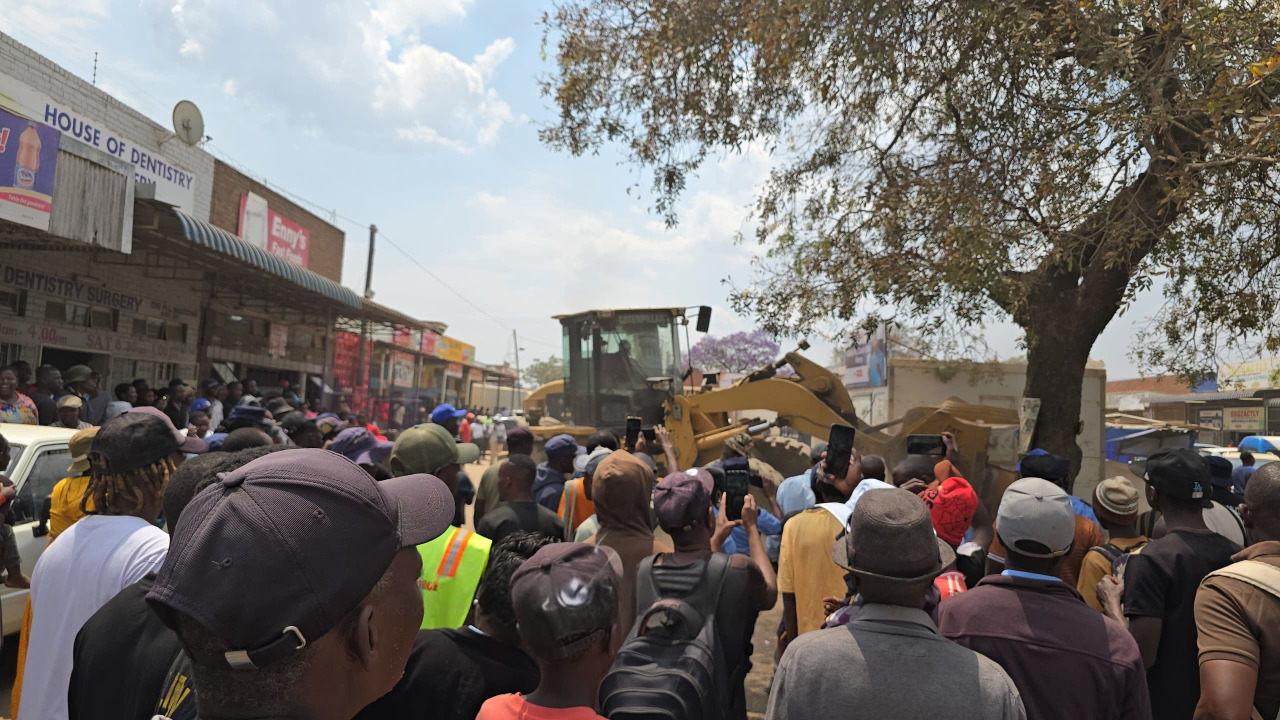
A notorious Zanu PF stronghold at Makoni shopping centre in Chitungwiza has been swept away during the demolition of hundreds of informal trading structures under Operation Chenesa, reviving memories of political violence and raising fresh concern about the fate of displaced vendors, the Newsday has reported.
Chitungwiza Municipality said it removed illegal structures at Makoni Business Centre after repeatedly warning traders to leave sites that had not been designated for vending. The operation began after public notices and announcements made through megaphones, with some traders taking down their stalls voluntarily while others resisted or returned to the streets.
About 500 of the structures were used to sell clothes, while others housed kitchens, tuckshops and small shops. The clean-up has also moved into Seke South, St Mary’s and Zengeza, where the council says some traders have already complied. The municipality says affected traders are now being allocated space at a designated trading area at Makoni as part of a plan to restore order and move informal business into approved sites.
The destruction at Makoni has taken on a deeper meaning in a town that has long been associated with opposition politics and some of the country’s most troubling accounts of organised political intimidation. Chitungwiza, a dormitory town south of Harare, has consistently voted for opposition parties, while Makoni shopping centre has for years been described by opposition activists as a place where ruling-party youths gathered, controlled trading spaces and organised attacks.
Job Sikhala, the National Democratic Working Group chief facilitator and a former St Mary’s and Zengeza West legislator, welcomed the demolition. He said the shopping centre had previously been used to terrorise residents of Chitungwiza.
“This is the place where Zanu PF hooligans used to gather and organise terror gangs to attack innocent citizens of Chitungwiza,” Sikhala said. “They were controlling those vending stalls as if the country belongs to Zanu PF members only.
“Those, who know what was happening at those places, will tell you that was the nest of Zanu PF thugs.”
Chitungwiza South legislator Maxwell Mavhunga said all market stalls considered to be on undesignated sites had been removed. He described Makoni as a launch pad for attacks by political vigilantes and space barons who controlled access to stalls and collected daily payments from traders.
“All market stalls that were deemed to be on undesignated sites were razed to the ground,” Mavhunga said. “The place was notorious as it was also being used as a launch pad for terror by Zanu PF vigilante groups and space barons.
“All the illegal market stalls were parcelled out along political lines and the traders were forced to pay daily rates.”
Mavhunga also warned that the operation had left behind families whose incomes depended on the market. While he said some people might view the removal as a welcome end to a place associated with intimidation, he urged authorities to provide immediate help for those who had lost their trading spaces.
“From that angle, one might be forgiven for concluding that it is good riddance to bad rubbish, but the humane side will tell you that the survival of many families hinged on this market,” he said. “These people have nothing to do with the politics of the day, they were just trying to survive. There must be an immediate rescue plan to assist those people.”
The history of Makoni stretches back to the violent run-up to the 2002 presidential election, when Zanu PF youth militias operated bases across Chitungwiza. Opposition supporters were abducted, beaten and held at several locations, according to accounts from that period. One account described an MDC activist being handcuffed and dragged for more than 500 metres to a Zanu PF base near a flea market, where he was beaten with sjamboks, sticks and iron bars.
Rights investigators also recorded a co-ordinated campaign by ruling-party-backed militias to track, attack and abduct opposition members in Chitungwiza and six other provinces. The bases were not limited to Makoni. Similar installations were reported in Unit N, Unit M, Zengeza and St Mary’s, where they were used to monitor residents, enforce political loyalty and organise campaigns against political opponents.
Such groups included Chipangano in Mbare, the Al-Shabaab Gang in Mbizo, Kwekwe, and Top Six in Chinhoyi. They were largely urban-based outfits that targeted opposition parties, controlled market stalls and collected fees at bus termini. Their influence depended on political patronage, and some became personal militias answerable to powerful political figures.
Makoni again became a scene of violence in February 2017, when three members of Transform Zimbabwe were attacked during a clean-up campaign at a flea market. The campaign had been intended to improve public health and reduce the spread of typhoid and other water-borne diseases. Kudakwashe Chikwanha, one of the activists, suffered a cut to the head after suspected Zanu PF youths disrupted the event, which had been cleared by police.
The incident showed how an ordinary public space could quickly become a political battleground. Opposition activists said the attackers were protecting their control of the market, while rights groups condemned the disruption and called for those responsible to be held to account. The episode also reinforced the long-standing link between vending spaces, transport ranks and political power in Chitungwiza.
The latest demolition is not the first time vendors in the town have been left facing rubble. In 2019, armed police and soldiers backed the destruction of the Zengeza 4 market after traders were given a short period to remove their goods. Many vendors said they had paid rent for their stalls but were left without a place to work after the market was cleared. The council said the exercise was aimed at removing illegal structures and businesses and creating order in the town.
The same tension now hangs over Makoni. Authorities say the operation is intended to improve cleanliness, public safety and the appearance of urban centres. Traders, however, have repeatedly warned that removing stalls without secure alternatives threatens the incomes of families already dependent on informal work. The council’s promise of a designated trading area will therefore be closely watched by people whose livelihoods have been tied to Makoni for years.
Operation Chenesa is unfolding as Zimbabwe prepares to host the 25th COMESA Summit in Harare from 19 to 22 October 2026. The regional meeting will bring together heads of state and government, while business and policy forums are scheduled to take place ahead of the main summit. The clean-up campaign is widely viewed as an effort to bring greater order and cleanliness to the country’s urban centres before the high-profile regional gathering.
The summit will focus on inclusive industrialisation, investment, regional trade and integration under the theme “ONE MARKET, ONE FUTURE: Advancing Inclusive Industrialisation, Investment and Regional Integration in COMESA.” Zimbabwe’s hosting role is expected to place Harare’s roads, markets and public spaces under heightened scrutiny as visiting delegations arrive.