


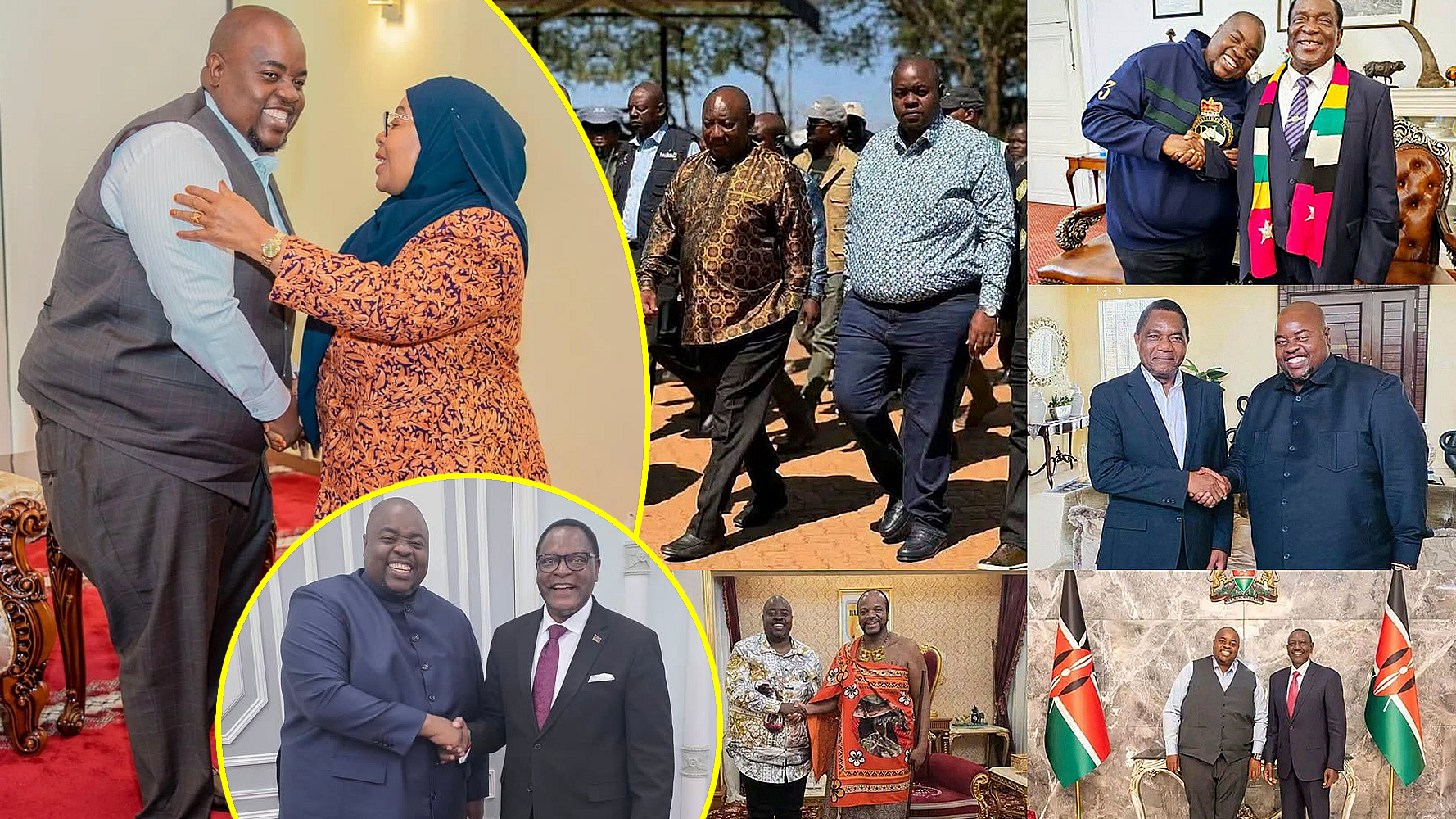
HARARE – The Zimbabwean businessman cultivated close ties with presidents and a king, publicised lavish gifts and pursued energy and tourism projects. The documented record shows political access and commercial proposals.
Wicknell Chivayo’s final days brought together the two worlds that defined his public life: Zimbabwe’s ruling elite and a regional network of presidents, royal figures and business ambitions.
Chivayo died with his wife, Lucy Muteke, in a helicopter crash near Marondera on September 30, 2026. On October 6, Tanzanian President Samia Suluhu Hassan travelled to Harare, visited the family and paid a courtesy call on Zimbabwean President Emmerson Mnangagwa before returning home. The visit was conducted privately, with photography restricted at the Chivayo home. Hassan had already sent a public message of condolence, describing him as a “young and visionary entrepreneur”.
The unusual journey drew attention because Chivayo was a private businessman, not a public official. Yet he had spent years posting images of himself with leaders, attending high-profile gatherings and presenting himself as a potential investor in countries across southern and eastern Africa. Zimbabwe’s President William Ruto later called him a friend. Chivayo’s social-media persona, built around expensive cars, private aircraft and public generosity, made access to power part of his brand.
Kenyan President William Ruto’s former deputy, Rigathi Gachagua, who served from September 2022 until his impeachment in October 2024, says his ex-boss is angry and emotional about the sudden and unexpected death of Zimbabwean businessman Wicknell Chivayo because owed him huge sums of money, help in money laundering and was going to also help him rig the country’s next elections on 10 August 2027 using Korean technology.
Ruto expressed deep sorrow over the tragedy that claimed the lives of Chivayo, his wife Lucy Muteke, her personal assistant and two pilots near Marondera last Wednesday.
Ruto said: “Wicknell was a dear friend whose warmth touched many people. I will remember him for his friendship, his energy and his deep conviction in the possibilities of our continent.”
He described the sudden deaths as a painful loss to the families, friends, and all who knew the victims.
Ruto extended his sympathies to President Emmerson Mnangagwa, the people of Zimbabwe, and the grieving families, concluding with a prayer: “May God grant Wicknell, Lucy and all those who perished eternal rest.”— TheNewsHawks (@NewsHawksLive) October 4, 2026
Meetings, proposals and the limits of the record
The list of leaders Chivayo met or publicly appeared with includes Mnangagwa, Ruto, Hassan, Uganda’s Yoweri Museveni, Zambia’s Hakainde Hichilema, Nigeria’s Bola Tinubu, Malawi’s Lazarus Chakwera and Peter Mutharika, Mozambique’s Daniel Chapo, and South Africa’s Cyril Ramaphosa. He also met Eswatini’s King Mswati III. Some encounters were formal business meetings; others were social visits or appearances at official events. The public record does not show that all of them involved contracts. His cross-border meetings and business pitches were often publicised through his own social-media accounts.
Kenya offered some of the clearest images of personal proximity. Chivayo met Ruto during the Kenyan president’s visit to Zimbabwe in 2024 and later shared footage of Ruto driving him and his wife to their helicopter after a family engagement. After Chivayo’s death, Ruto wrote: “I will remember him for his friendship, his energy, and his deep conviction in the possibilities of our continent.”
That relationship became entangled in a separate controversy over Kenyan identity documents. In February 2026, Chivayo’s name appeared on a leaked immigration document that was reported to list passport applications or recipients. Chivayo was listed as number six on the leaked manifest, which recorded him as holding Kenyan passport number 1111685723, with an issuance date of July 8, 2025. The document prompted questions about how foreign nationals might have obtained Kenyan papers. The Kenyan authorities had not publicly confirmed that Chivayo had been granted citizenship or issued a passport in the reporting available at the time.
Another Kenyan claim also made headlines. Reports circulated that a company linked to Chivayo had won a multibillion-dollar contract to expand Nairobi’s Jomo Kenyatta International Airport. Kenya’s transport minister said IMC Construction had not bid and had no role in the project. No airport contract was awarded to Chivayo’s firm, the Kenyan government claimed.
🔴In the aftermath of the death of his Zimbabwean “friend”, tycoon Wicknell Chivayo, in a helicopter crash last week, Kenyan President William Ruto has been under siege from his former deputy Rigathi Gachagua. https://t.co/IJW518k323
— TheNewsHawks (@NewsHawksLive) October 7, 2026
In Tanzania, Chivayo met Hassan and publicly presented business plans. After an engagement with the president, he announced a proposed US$200 million luxury hospitality development in the Serengeti and Ngorongoro areas through Intratrek Holdings. It was an investment proposal, not a confirmed state tender or a completed development. Earlier contacts between the pair included talks about technology and business partnerships.
Chivayo also met Hichilema in Zambia and said they discussed challenges in the country’s energy sector. Museveni hosted him in Uganda, while meetings with other leaders featured in Chivayo’s account of his expanding business interests. The meetings helped him display regional reach. The most concrete foreign project commitment came from Eswatini. In June, Mswati granted Chivayo citizenship and a diplomatic passport. The Eswatini government confirmed the grant and said it recognised his philanthropic contributions and support for development initiatives. Chivayo said the passport was “meant to facilitate ease of travel and doing business in Eswatini”.
In the same announcement, the government said Intratrek Holdings had committed R3 billion, about US$182 million, towards a 300-megawatt solar project. The planned independent power project is to use 120 hectares of land made available by the king. Eswatini described the proposed development as a way to improve energy security and support jobs, industry and economic growth. The government’s statement set out the expected public benefits; it did not say that the citizenship or passport was payment for the investment.
A record shaped by gifts and state contracts
At home, Chivayo’s business career was built around state-linked contracts, most notably Intratrek Zimbabwe’s Gwanda solar project. The company was selected in 2014 to build a 100-megawatt plant, and a contract worth more than US$170 million was signed in 2015. Intratrek received an advance of more than US$5 million, but the plant remained unbuilt for years as the project became mired in delays and legal disputes. A parliamentary inquiry described Intratrek as a “briefcase company”. Shortly before Chivayo’s death, the government issued a notice for the project to proceed, with a 24-month completion period. The Gwanda contract history and project status remained central to scrutiny of his business dealings.
Chivayo’s name also surfaced in the controversy over Zimbabwe’s 2023 election-material procurement. Allegations centred on contracts awarded to South African printing firm Ren-Form and claims of inflated invoices and payments to companies linked to him. Chivayo denied wrongdoing. In December 2025, Zimbabwe’s Anti-Corruption Commission said it had found no evidence linking him or the Zimbabwe Electoral Commission to procurement fraud and closed its inquiry. Ren-Form also denied wrongdoing. The commission’s public account of the inquiry’s closure described the basis for its decision.
Ren-Form later won a ballot-paper printing contract in Namibia valued at N$6,259,686. Namibia’s Electoral Commission said the South African company was selected after an evaluation process and defended the decision. Ren-Form is not Chivayo’s Zimbabwean company, and the Namibian contract should not be described as a tender awarded directly to him. The commission’s explanation of the contract identified Ren-Form as the successful bidder.
His political giving was more visible than many of his business arrangements. Chivayo regularly posted videos and photographs of luxury cars and large cash gifts to musicians, religious figures and other public personalities. Some recipients were prominent supporters of ZANU-PF, the governing party. In April 2026, he offered US$10,000 to each of Zimbabwe’s 360 legislators, a proposed total of US$3.6 million, as Parliament prepared to consider a constitutional change affecting Mnangagwa’s tenure. The offer drew criticism and was withdrawn. Chivayo denied that it was intended to influence the vote. The offer and its political setting drew renewed attention to how private wealth and politics overlapped. Just a week before his death, Chivayo revealed that he had donated over 3,000 cars and cash amounting to over US$100 million to members of the public.
He was not simply a businessman whose name appeared in political photographs. He had been convicted of money laundering and sentenced in 2005 to 5 years in prison, with 2 years suspended. After his release, he rebuilt his career around energy and government business. The Gwanda deal, the election-procurement dispute and his conspicuous political donations became recurring points of scrutiny.
The relationships were not all identical, and the available facts do not show that presidents personally received money or cars from him. What they do show is a businessman who turned access into visibility: leaders hosted him, photographs travelled widely, and proposals in energy, infrastructure and tourism followed. In Eswatini, a large solar commitment appeared alongside the granting of citizenship and a diplomatic passport. In Tanzania, a major hospitality plan followed presidential talks. In Kenya, he was welcomed into Ruto’s personal circle, while claims of a passport and an airport contract remained unconfirmed.
That is the record behind Chivayo’s continental profile: political closeness, public generosity and the pursuit of state-connected opportunities. It is substantial enough to explain why his death prompted official tributes and regional attention.